🐙 8 times table: triple doubling, the trick that changes everything

The 8 times table has a special feature: you can work out every answer using a skill your child already knows well—doubling. To multiply by 8, you just double, double again, and then double a third time. Once your child understands this, no answer is out of reach, even on a day when everything seems forgotten.
Here you'll find the complete 8 times table with the doubling steps, what your child already knows from other tables, the only two results to really learn by heart, a simple way to check answers, some fun games with 8, and a two-week practice routine.
The full 8 times table, including doubling steps
Read each row from left to right: start with the number, double it three times, and you get the answer. The last column reminds you where your child has already seen this result if you're following our guide how to learn multiplication tables, where the 8 times table comes just before the 7 times table.
| Multiplication | Triple doubling | Result | Already known from… |
|---|---|---|---|
| 8 × 1 | 1 → 2 → 4 → 8 | 8 | the 1 times table |
| 8 × 2 | 2 → 4 → 8 → 16 | 16 | the 2 times table |
| 8 × 3 | 3 → 6 → 12 → 24 | 24 | the 3 times table |
| 8 × 4 | 4 → 8 → 16 → 32 | 32 | the 4 times table |
| 8 × 5 | 5 → 10 → 20 → 40 | 40 | the 5 times table |
| 8 × 6 | 6 → 12 → 24 → 48 | 48 | the 6 times table |
| 8 × 7 | 7 → 14 → 28 → 56 | 56 | New (already known if the 7 times table is learned) |
| 8 × 8 | 8 → 16 → 32 → 64 | 64 | New |
| 8 × 9 | 9 → 18 → 36 → 72 | 72 | the 9 times table |
| 8 × 10 | 10 → 20 → 40 → 80 | 80 | the 10 times table |
Count with your child: eight out of ten answers are already familiar, since 8 × 3 is the same as 3 × 8, 8 × 9 is the same as 9 × 8, and so on. Only two results are truly new: 8 × 7 and 8 × 8. Suddenly, the task feels much lighter.
The top trick: triple doubling
Why does it work? Because 8 = 2 × 2 × 2. So multiplying by 8 is just multiplying by 2 three times in a row. For 8 × 6, start with 6, double: 12, double again: 24, double once more: 48.
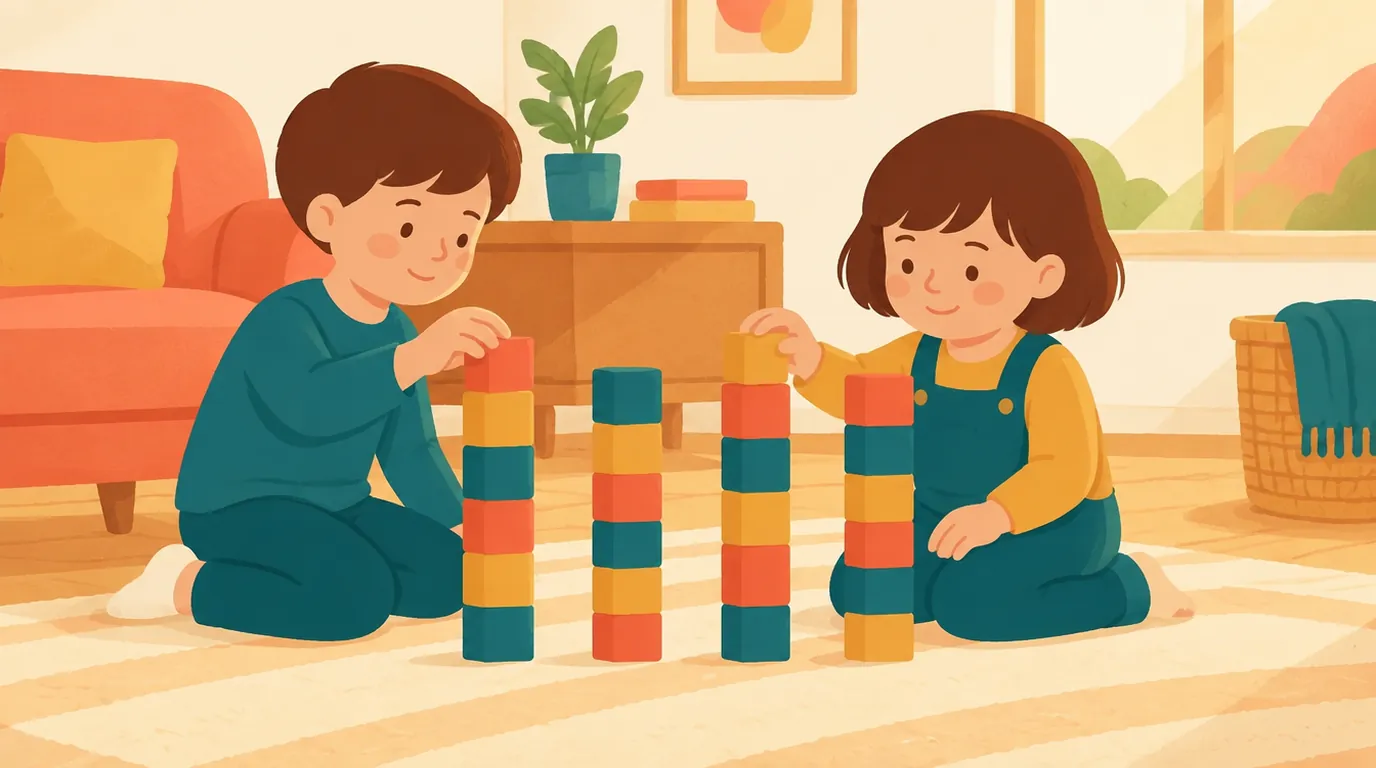
Show this with stackable cubes or building bricks. Line up 3 cubes: that's 3 towers of 1. Double the height of each tower: 3 towers of 2, so 6 cubes. Double again: 3 towers of 4, so 12 cubes. One last time: 3 towers of 8, so 24 cubes. The total doubles each time: 3, 6, 12, 24—and you get 3 × 8 = 24.
Doubling also links to the 4 times table, which your child probably knows already: every answer in the 8 times table is double the answer in the 4 times table. 4 × 7 = 28, so 8 × 7 = 56. 4 × 9 = 36, so 8 × 9 = 72.
A second route: 10 times minus 2 times
Some children prefer round numbers. For them, there's another way: 8 is 10 minus 2. So:
- 8 × 7 is 10 × 7 minus 2 × 7: 70 − 14 = 56;
- 8 × 9 is 90 − 18 = 72;
- 8 × 6 is 60 − 12 = 48.
It's the same idea as for the 9 times table, where you do 10 times minus 1 times: 9 × 7 = 70 − 7 = 63. Our article on the 9 times table and its finger trick explains this and other tips.
Offer both methods—doubling and subtraction—and let your child choose the one that makes sense to them. The important thing is having a reliable way to find a forgotten answer, without having to count up in eights from the start.
Doubling has a bonus for older children: it works beyond 10. 8 × 12 is 12, 24, 48, 96. And 8 × 25 is 25, 50, 100, 200—a calculation that's sure to impress at dinner.
The two results to learn by heart: 56 and 64
8 × 7 = 56
Write “56 = 7 × 8” and read the digits in order: 5, 6, 7, 8. The sequence is so neat, it's hard to forget. It's the same answer as 7 × 8, which we also practise in our article on the 7 times table: one effort for two tables.
8 × 8 = 64: the chessboard
A chessboard has 8 rows of 8 squares, so 64 squares in total. If you have one at home, count a row together, then ask how many squares there are altogether. Doubling confirms it: 8, 16, 32, 64.
These two answers come one after the other in the table, and they're often mixed up. Show how they're linked: 8 × 8 is 8 × 7 plus another 8. So 56 + 8 = 64. If your child knows one, the other follows.
Checking answers: the 8, 6, 4, 2, 0 pattern
Write out the 8 times table in two columns of five:
- On the left: 8, 16, 24, 32, 40;
- On the right: 48, 56, 64, 72, 80.
Have your child look at the unit digits: 8, 6, 4, 2, 0 on the left, and the same pattern repeats on the right. Two handy tips: first, every answer in the 8 times table is even—so if you get an odd number, it's definitely wrong. Second, each number on the right is the one on the left plus 40: 16 + 40 = 56, 24 + 40 = 64. If your child knows the start of the table, they can work out the rest.
Fun games with the number 8
- Octopuses and spiders: an octopus has 8 arms, a spider has 8 legs. Draw a few on a sheet and ask: “5 octopuses, how many arms?” — 40. Your child can then make up their own questions and quiz you.
- The doubling relay: you call out a number from 1 to 10, and your child says the three doubles out loud, clapping each time. “7!” — “14, 28, 56!” Three claps, one answer.
- The tower race: each of you rolls a die and builds that many towers of 8 cubes. The first to announce the correct total, before counting the cubes, scores a point.
For a change, classic games like snap or memory work really well using just the 8 times table: you'll find the rules in our multiplication table games.
A two-week routine
For the 8 times table, the key is to practise doubling in the first week, then move away from it in the second.
- Week 1, every day (5 minutes): two minutes of quick-fire doubling, then recite the table in order, saying each step out loud: “8 × 6: 6, 12, 24, 48”.
- Week 1, midweek: a special session on 56 and 64, using the sequence 5-6-7-8 and the chessboard.
- Week 2, every day (5 minutes): practise the table in random order. Your child answers from memory, and only doubles if unsure.
- Week 2, end of the week: do a worksheet, for example the fill-in-the-gap tables from our printable multiplication tables, then the random test: ten questions in any order.
Doubling doesn't disappear: it stays as a safety net, and that's just fine. The Kidibook Big Book of Memory Tricks has more tips like this, for times tables and the rest of the primary curriculum.
Want to put these tips into practice?
Every day, a new adventure workbook adapted to your child's school level — to print or do on screen. No commitment.
Your questions
Is tripling the double too slow?
At first, it can be, and that's normal. Doubling is there to help find the answer, not to use forever. With practice, the answer comes straight away, and doubling is just a backup if needed.
Should my child know the 4 times table before the 8 times table?
It's best if they do. Every answer in the 8 times table is double the 4 times table: if 4 × 7 = 28 is solid, then 8 × 7 = 56 follows easily. If the 4 times table is still shaky, spend a few days strengthening it first.
My child mixes up 8 × 7 and 8 × 8—what can I do?
Give them a picture for each answer: the sequence 5, 6, 7, 8 for 56, the chessboard with its 64 squares for 8 × 8. Remind them the two answers are 8 apart: 56 + 8 = 64. Alternate the questions for a few days.
How do I know if the 8 times table is really learnt?
Ask ten 8 times table questions in random order. If your child answers without counting or doubling, several days in a row, the table is set. Then revisit it once a week to keep it fresh.
Read next
 Memory tricks & memorisation
Tricky words: the list from age 5 to 11 and 6 ways to remember them
Tricky words: the list by age from 5 to 11, the traps to highlight, and 6 simple ways to remember them…
 Memory tricks & memorisation
English verbs for kids: 7 tricks for tenses that really work
Verbs without tears: the -s of he/she/it, was or were, did or done, irregular verbs in sound families…
 Memory tricks & memorisation
How to remember history dates: timelines, stories and mental images
How to remember history dates without mindless reciting: mental images, stories, the corridor timeline and 12 key dates…