👀 Ces or ses: the 'les siens' and 'ces… -là' tricks to choose the right one
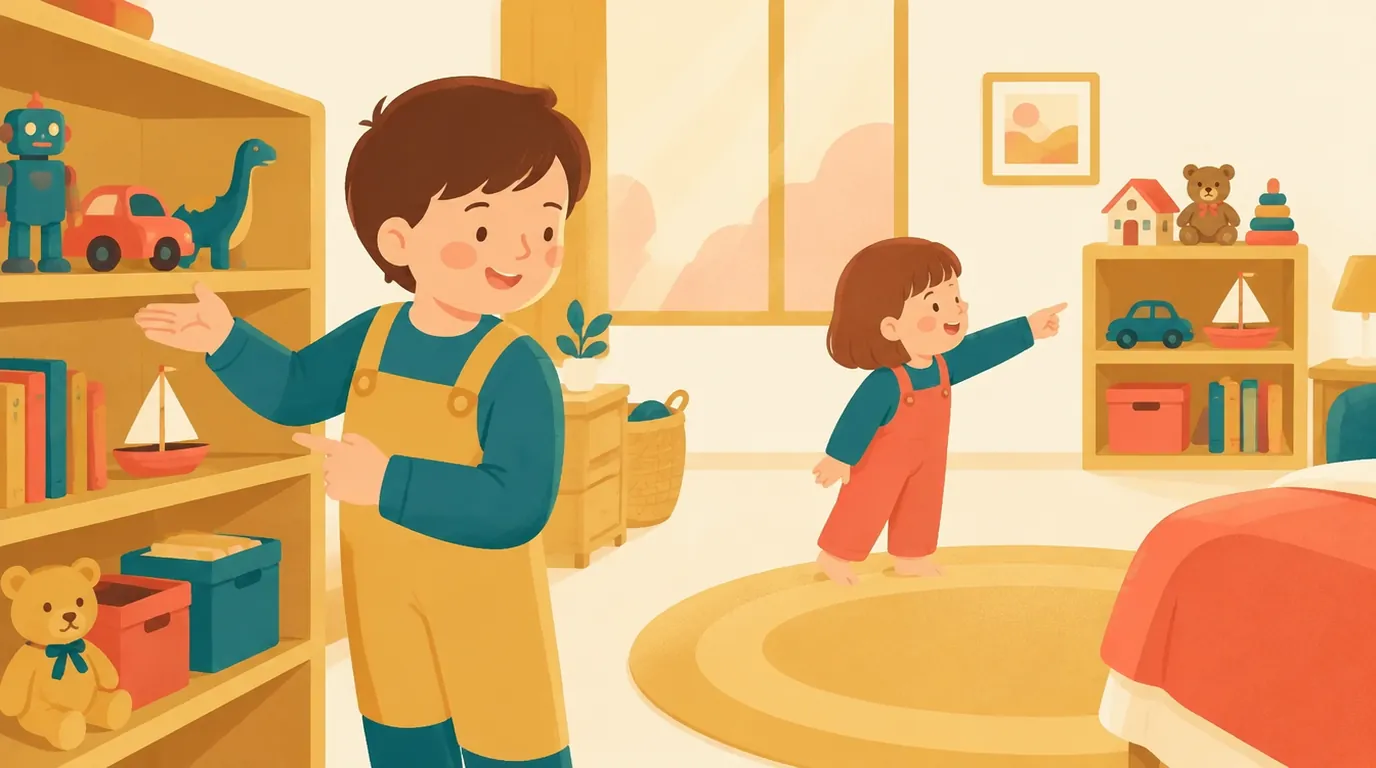
Ces or ses: the difference is all about meaning. In the bedroom, your son proudly shows you his toys, neatly lined up on his shelf; at the same time, his little sister points to those toys over there, at the other end of the room. One is about what belongs to someone; the other is about pointing something out. When speaking, you can't tell the difference. In writing, your child has to choose.
To help, just two simple phrases do the trick: use « les siens » (or « les siennes ») to check for ses, and « ces… -là » to check for ces. Here’s how to use them, the tricky cases to watch out for, and a quick note on c'est and s'est, which often get mixed up with these.
Ces points out, ses owns
Start by explaining the two roles in simple words.
- ces is a demonstrative determiner in the plural. It’s used to point out something (“Regarde ces oiseaux !”) or to refer back to something just mentioned (“J'ai lu trois romans. Ces livres m'ont plu.”). In the singular, it becomes ce, cet or cette.
- ses is a possessive determiner in the plural. It shows that things belong to someone, to him or her (“Nina cherche ses lunettes”). In the singular, it becomes son or sa.
What makes this pair trickier than others is that ces and ses are both determiners, both placed before a plural noun. With son ou sont, one is a verb and the 'étaient' test reveals it straight away. Here, there’s no such shortcut: the position in the sentence is the same, both are plural. Only the meaning can help, and that’s exactly what the next two tricks check. For a refresher on the main types of determiners, our article on les déterminants explains it simply.
The 'les siens, les siennes' test: spotting ses
If you’re unsure, try replacing the whole group with les siens (for a masculine noun) or les siennes (for a feminine noun). If the sentence still makes sense, you’re talking about things that belong to someone: use ses.
- « Julie a prêté ses feutres. » → « Julie a prêté les siens. » The sentence works: ses.
- « Le chat lèche ses pattes. » → « Le chat lèche les siennes. » Still ses: the owner can be an animal too.
- « Le chêne perd ses feuilles. » → « Le chêne perd les siennes. » Again ses, even when the owner is a thing.
- « Regarde ces nuages ! » → « Regarde les siens ! » Les siens… whose? No one’s. It’s not about ownership: use ces.
If your child hesitates between « les siens » and « les siennes », reassure them: for this test, it doesn’t matter. What matters is the idea of 'his' or 'hers'. They can also rephrase: « les feutres à Julie », « les pattes du chat ». If this makes sense, it’s ses.
The 'ces… -là' test: spotting ces
The second test does the opposite: add -là right after the noun. If the sentence still sounds natural and you feel like you’re pointing something out, it’s the demonstrative: use ces.
- « Tu as vu ces chaussures ? » → « Tu as vu ces chaussures-là ? » That works: ces.
- « J'ai lu trois romans cet été. Ces livres m'ont beaucoup plu. » → « Ces livres-là m'ont beaucoup plu. » Again ces: it refers back to what was just mentioned.
- « Il range ses jouets. » → « Il range ses jouets-là. » That doesn’t sound right: nothing is being pointed out, it’s about toys that belong to him. That’s ses.
Switching to the singular gives a third check, great for children who like rules: ces enfants becomes cet enfant, while ses enfants becomes son enfant. But the 'les siens' and '-là' tests are best, as they make your child think about meaning, which helps avoid mistakes in longer sentences.
Summary table
| ces | ses | |
|---|---|---|
| What it is | Plural demonstrative determiner | Plural possessive determiner |
| What it does | Points out, or refers back to something mentioned | Shows who owns the things |
| In the singular | ce, cet, cette | son, sa |
| The test | You can add -là after the noun | You can say les siens or les siennes |
| Example | Range ces cartons-là. | He puts away his boxes: his own. |
Tricky cases
When both are possible
« Montre-moi ses dessins » and « Montre-moi ces dessins » are both correct, but they don't mean the same thing. The first asks to see someone's drawings (their own); the second points to specific drawings that are there (those drawings). It's just like in the bedroom: the older brother shows ses toys, the little sister points to ces toys. Use these double-meaning sentences to show your child how the choice changes the message.
With chacun and on
« Chacun range ses affaires. » There is no « il » or « elle », but each person puts away their own things: so it's ses. The same goes for « on »: « On a parfois du mal à retrouver ses clés. »
Time expressions
« Ces jours-ci », « un de ces jours », « ces derniers temps »: in these set phrases, you're talking about a period of time, not something that belongs to anyone. They always use ces.
And what about c'est and s'est?
That's not the focus of this article, but since c'est and s'est are pronounced the same as ces and ses, they sometimes sneak into writing. Two simple checks:
- c'est means « cela est ». You can replace it with c'était: « C'est mon anniversaire » → « C'était mon anniversaire ».
- s'est is part of a verb like se laver or se tromper, in the past tense. When talking about yourself, it becomes me suis: « Léo s'est trompé » → « Je me suis trompé ».
If neither of these replacements works and a plural noun follows, go back to ces or ses, and use the tests above. The same replacement logic helps with et ou est, and our summary of homophones grammaticaux au CM2 brings all these pairs together in one place.
Practising at home, without making it a chore
Short, everyday sessions work best. Here are a few ideas:
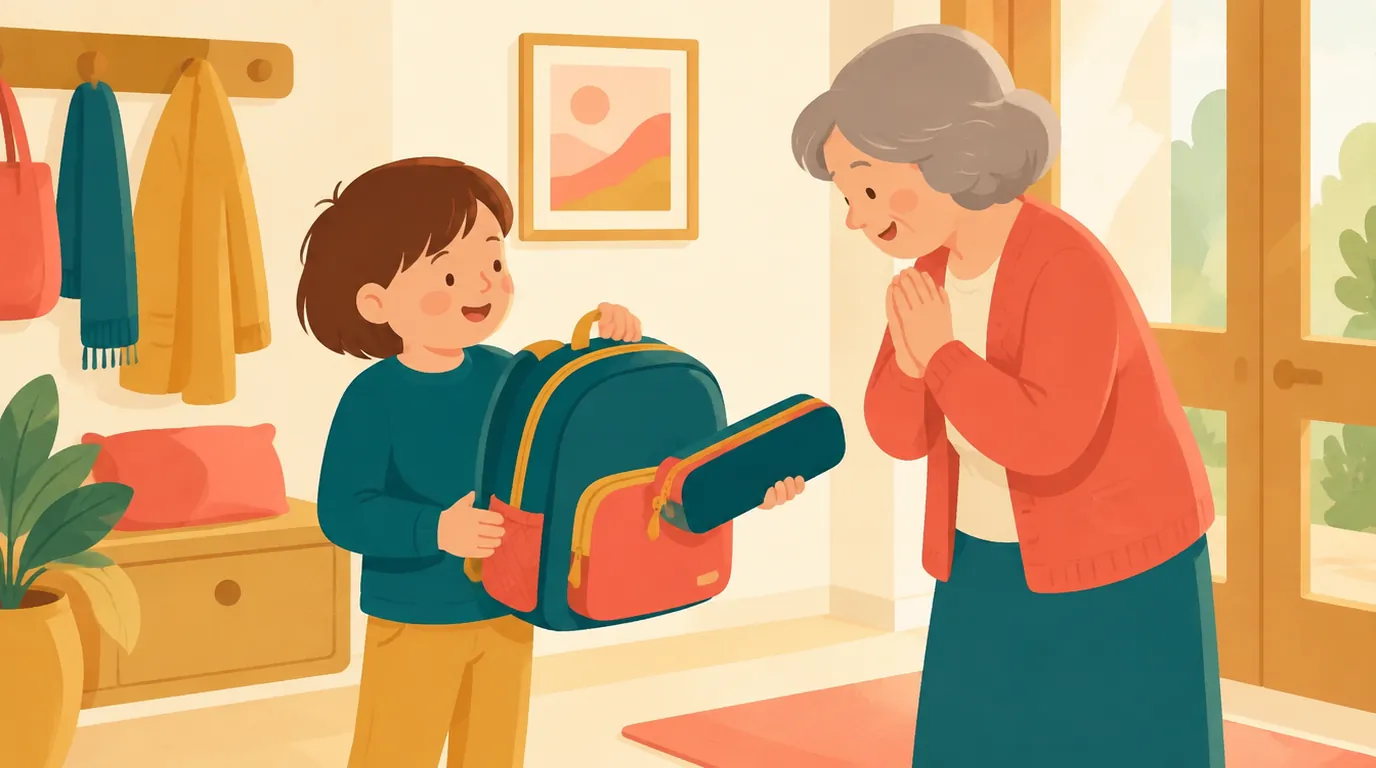
- The gesture game. You say a sentence, your child responds with the gesture (pointing or arms crossed) before saying « ces » or « ses ». For example: « Mamie admire ses nouvelles affaires » (arms crossed: they're hers), « Tu peux ranger ces chaussettes ? » (pointing finger).
- Book hunt. During bedtime reading, your child spots each ces and ses, and does the test out loud.
- Double-meaning sentences. Your child invents a sentence that works with both, then explains the difference in meaning.
For more structured practice, our printable CM1 exercises offer a variety of activities. And if your child learns best with images and short phrases, our illustrated Memory Tricks use the same approach as the tips in this article: a simple cue that's easy to recall on dictation day.
Want to put these tips into practice?
Every day, a new adventure workbook adapted to your child's school level — to print or do on screen. No commitment.
Your questions
How can you quickly tell whether to write ces or ses?
Try replacing the phrase with "les siens" or "les siennes": if the sentence still makes sense, it's ses. If not, add "-là" after the noun: if that sounds right, it's ces. Only one of these tests should work.
Can ses be used for an animal or an object?
Yes. The owner doesn't have to be a person: you write « le chat lèche ses pattes » or « le chêne perd ses feuilles ». The test works the same way: le chat lèche les siennes.
My child also mixes up ces, ses and c'est. How can I help?
Start with ces and ses, which come before a noun, then add c'est, which can be replaced by c'était. Mixing all three too soon often confuses children. Once each test is clear, mixed dictations are great practice.
In which class do children learn ces and ses?
This pair is usually introduced in CE2 and reinforced in CM1, along with demonstrative and possessive determiners. It then comes up regularly in dictations through the end of primary school.
You might also like
 Memory tricks & memorisation
Tricky words: the list from age 5 to 11 and 6 ways to remember them
Tricky words: the list by age from 5 to 11, the traps to highlight, and 6 simple ways to remember them…
 Memory tricks & memorisation
English verbs for kids: 7 tricks for tenses that really work
Verbs without tears: the -s of he/she/it, was or were, did or done, irregular verbs in sound families…
 Memory tricks & memorisation
How to remember history dates: timelines, stories and mental images
How to Remember History Dates without endless repetition: mental images, storytelling, the hallway timeline, and 12 key dates…