✖️ How to learn multiplication tables: order, method, tips

How can you help your child learn multiplication tables without turning every evening into a tedious recitation? The question comes up in CE1, returns in CE2, and becomes urgent when the 7 times table is still tricky in March. Don’t worry: it’s not about having a ‘maths brain’, it’s all about the right method.
In this guide, you'll find the best order to tackle the tables, a practical tip for each one, and a ten-minute routine that fits into a normal evening. You'll also see that there’s much less to memorise than you might think.
Before reciting, make sure they understand what ‘times’ means
A table learned by rote but not understood is fragile: as soon as your child forgets an answer, they have no way to work it out. Before asking them to memorise anything, check they know what 3 × 4 means.
- Equal groups: 3 × 4 means 3 groups of 4 marbles, so 4 + 4 + 4 = 12.
- A rectangle: 3 rows of 4 squares on a grid, making 12 squares. Turn the page a quarter turn: now you have 4 rows of 3, still 12 squares.
Turning the rectangle shows that 3 × 4 = 4 × 3: swapping the numbers doesn’t change the answer. This little detail will almost halve the work later on. Let your child check it once with pasta or coins.
See it, say it, move it: let your child learn tables in different ways
Just reading a table rarely makes it stick. What helps is meeting it in different forms: written, heard, spoken, even jumped! Every child has their preferences (see our article on visual and auditory memory in children), but all benefit from variety.
- See: put a multiplication tables poster on the fridge or bedroom door, with a different colour for each table. They’ll glance at it as they pass. You can use our printable multiplication tables, including a poster, a Pythagoras table, and fill-in-the-blank tables.
- Say: recite out loud, whisper, use a robot or giant’s voice. The sillier it is, the more likely they’ll want to try again.
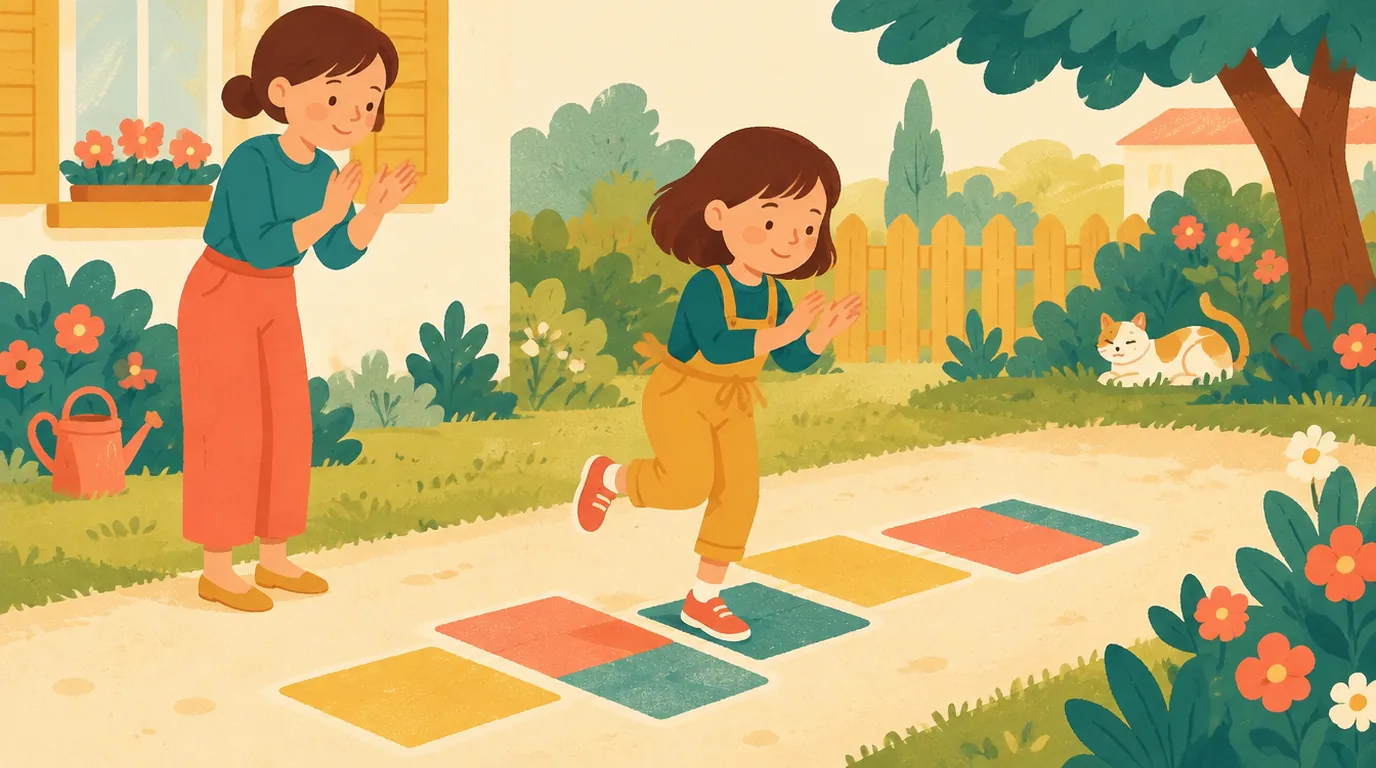
- Move: draw a hopscotch grid with chalk and jump to each answer, clapping as they go. Moving the body helps fix the rhythm of the table.
What’s the best order to learn multiplication tables?
Reciting the tables from 1 to 10 in order isn’t the smartest way. It’s better to start with the easy tables, then use those to tackle the trickier ones. The 1 and 10 tables are quick to grasp: multiplying by 1 changes nothing, and multiplying a whole number by 10 just adds a zero to the end. For the 2 to 9 tables, here’s the order we recommend:
| Step | Table | What it builds on | Truly new multiplications |
|---|---|---|---|
| 1 | 2 | The doubles | 8 (from 2 × 2 to 2 × 9) |
| 2 | 5 | Half of the 10 table | 7 |
| 3 | 4 | Double the 2 table | 6 |
| 4 | 3 | The 2 table, plus the number once more | 5 |
| 5 | 9 | The 10 table, minus the number once | 4 |
| 6 | 6 | The 5 table, plus the number once | 3 |
| 7 | 8 | Double the 4 table | 2 |
| 8 | 7 | Everything else is already known | 1 (7 × 7) |
Count them: 8 + 7 + 6 + 5 + 4 + 3 + 2 + 1 = 36. Thanks to the rule 3 × 4 = 4 × 3, the grid from 2 × 2 to 9 × 9 has 64 squares, but only 36 different multiplications to remember. And when you get to the dreaded 7 times table, there’s only one new answer left: 7 × 7 = 49. Show your child: it’s often a relief.
A memory trick for each table
Every table has its ‘handle’. Here are the ones you can share tonight.
The 2, 4 and 8 tables: the doubles family
Multiplying by 2 means doubling. By 4 means doubling twice: 4 × 7 is double 14, which is 28. By 8 means doubling three times: for 8 × 6, go from 6 to 12, then 24, then 48.
The 5 and 10 tables: the inseparables
All answers in the 10 table end in 0. In the 5 table, they end in 0 or 5, and are half those in the 10 table: 5 × 8 is half of 80, so 40.
The 3 and 6 tables: one more time
3 × 7 is 2 × 7 plus another 7: 14 + 7 = 21. Similarly, 6 × 7 is 5 × 7 plus 7: 35 + 7 = 42. Bonus for the 6 table with an even number: the answer ends with that number, and the tens digit is half of it. 6 × 4 = 24, 6 × 6 = 36, 6 × 8 = 48.
The 9 table: the finger trick
Place your hands flat, numbering your fingers 1 to 10 from left to right. For 9 × 4, fold down the fourth finger: you have 3 fingers left on the left (tens) and 6 on the right (units), making 36. Another tip: 9 × 7 is the same as 10 × 7 minus 7, so 70 − 7 = 63. Our article on the 9 times table and its tricks explains each method in detail.
The 7 times table: the last and shortest one
With the order suggested above, you only have 7 × 7 = 49 left to learn from scratch. For 7 × 8, one of the trickiest, remember the sequence 5, 6, 7, 8: 56 = 7 × 8. You'll find more ideas in our article on the 7 times table, and plenty of other clever tips for maths and French in The Big Book of Memory Tricks.
A 10-minute daily routine
When it comes to times tables, regular practice matters far more than long sessions: ten minutes a day is better than an hour on Sunday evening. Here’s a typical session, which you can fit in after snack time or while making dinner.
- 2 minutes of warm-up: recite a table your child already knows, to start with a success.
- 4 minutes on the current table: first in order, then mixed up. The mixed-up questions are what count: in class, no one will ask for “the 6 times table in full”, but rather “what’s 6 × 7?” in the middle of a problem.
- 3 minutes of quick-fire questions: you ask, your child answers. Any mistakes go into a little “to review” box.
- 1 minute for a quick review: tick off today’s box on a chart stuck to the fridge.
The “to review” box is the key to this system. On index cards, write the question on one side and the answer on the other. Any card answered incorrectly comes back the next day; a card answered correctly three days in a row joins the “mastered” pile, which you bring out once a week. Focus on what’s tricky, not what’s already known.
Ten minutes too much? Try two five-minute blocks with a timer, as in the child-friendly Pomodoro method. And to keep things fun, try our games for learning times tables: card games, memory, dice or hopscotch are great alternatives to quick-fire questions two or three times a week.
When things get stuck: mistakes to avoid
- Trying to go too fast. One new table a week or every two weeks is already a lot.
- Only reciting in order. If your child has to start from 7 × 1 to work out 7 × 8, they know a rhyme, not the table itself yet.
- Turning tables into a punishment. “No pudding until you know your 8 times table” links maths with pressure. Keep it playful.
Some multiplications are often trickier than others: 6 × 7, 6 × 8, 7 × 8, 8 × 9. Put these on separate cards, stick them up by the sink, and revisit them a little each day. If, despite regular practice, your child is really stuck or panics at every question, talk to their teacher: they can tell you what they see in class and, if needed, suggest next steps.
Want to put these tips into practice?
Every day, a new adventure workbook adapted to your child's school level — to print or do on screen. No commitment.
Your questions
At what age do children learn times tables?
Usually, the 2 to 5 times tables are covered in CE1 (age 7-8), and the 6 to 9 tables in CE2 (age 8-9). In CM1 and CM2, the aim is for them to become automatic to speed up calculations. Being a few months ahead or behind is nothing to worry about — what matters is steady progress.
How long does it take to learn a times table?
There’s no set time — every child learns at their own pace. A reasonable guide is one to two weeks per table, practising ten minutes a day. The last tables often go faster, as they include more and more familiar answers.
Should times tables be learned in order or mixed up?
Both, one after the other. Start by reciting the table in order to get the pattern, then practise out of order, as that’s how multiplications appear in exercises and problems.
My child counts on their fingers — is that a problem?
No, it’s a normal stage at first and shows your child understands what multiplication means. Encourage them to use a known answer, like 5 × 8 to find 6 × 8, rather than starting from scratch each time. With regular practice, the answers will become automatic.
Read next
 Memory tricks & memorisation
Tricky words: the list from age 5 to 11 and 6 ways to remember them
Tricky words: the list by age from 5 to 11, the traps to highlight, and 6 simple ways to remember them…
 Memory tricks & memorisation
English verbs for kids: 7 tricks for tenses that really work
Verbs without tears: the -s of he/she/it, was or were, did or done, irregular verbs in sound families…
 Memory tricks & memorisation
How to remember history dates: timelines, stories and mental images
How to remember history dates without rote learning: mental images, storytelling, the corridor timeline and 12 key dates