🎲 Game to learn multiplication tables: 8 ideas for home
A game can make all the difference when practising multiplication tables between recitations: it’s a way to repeat 7 × 8 for the twentieth time without anyone sighing. And you don’t need an app or a tablet: a deck of cards, two dice, a piece of chalk and a good mood are all you need.
Here are eight screen-free games to try tonight, with rules, materials and suggested levels. They’re a great addition to your learning routine, but not a replacement: for the order of tables and memory tips, see our guide how to learn multiplication tables.
Why playing helps memorise the tables
To remember a table, you need to repeat it again and again until the answer comes naturally. The trouble is, repetition gets boring fast. Games solve this: you play another round because you want a rematch, not because you have to.
Games have other advantages:
- mistakes don’t really matter: you lose a round, not marks;
- questions come in random order, just like in class or in word problems;
- your role changes: you become an opponent or teammate, not just the quizmaster.
There’s just one condition: your child should already understand what multiplication is and have started learning the table you’re practising. Games are for reinforcing, not discovering. Keep a poster of the answers handy, such as our printable multiplication tables, to settle any disputes: it’s the neutral referee for every game.
Card games: battle and memory
1. Multiplication battle
Take a standard deck of 52 cards and remove the face cards: you’ll have 40 left, ace counts as 1 and 10 as 10. Deal all the cards. Each turn, each player turns over two cards and says their product. The highest result wins all four cards. For example: your child turns over 7 and 6, says 42; you turn over 8 and 5, which is 40. They win the round.
If there’s a tie, for example 3 × 8 versus 4 × 6, both making 24, it’s a battle: each puts one card face down, then two new cards face up. A wrong answer loses the round, so everyone checks each other’s maths. For beginners, make it easier: turn over just one card and always multiply by the table you’re working on.
2. Multiplication memory
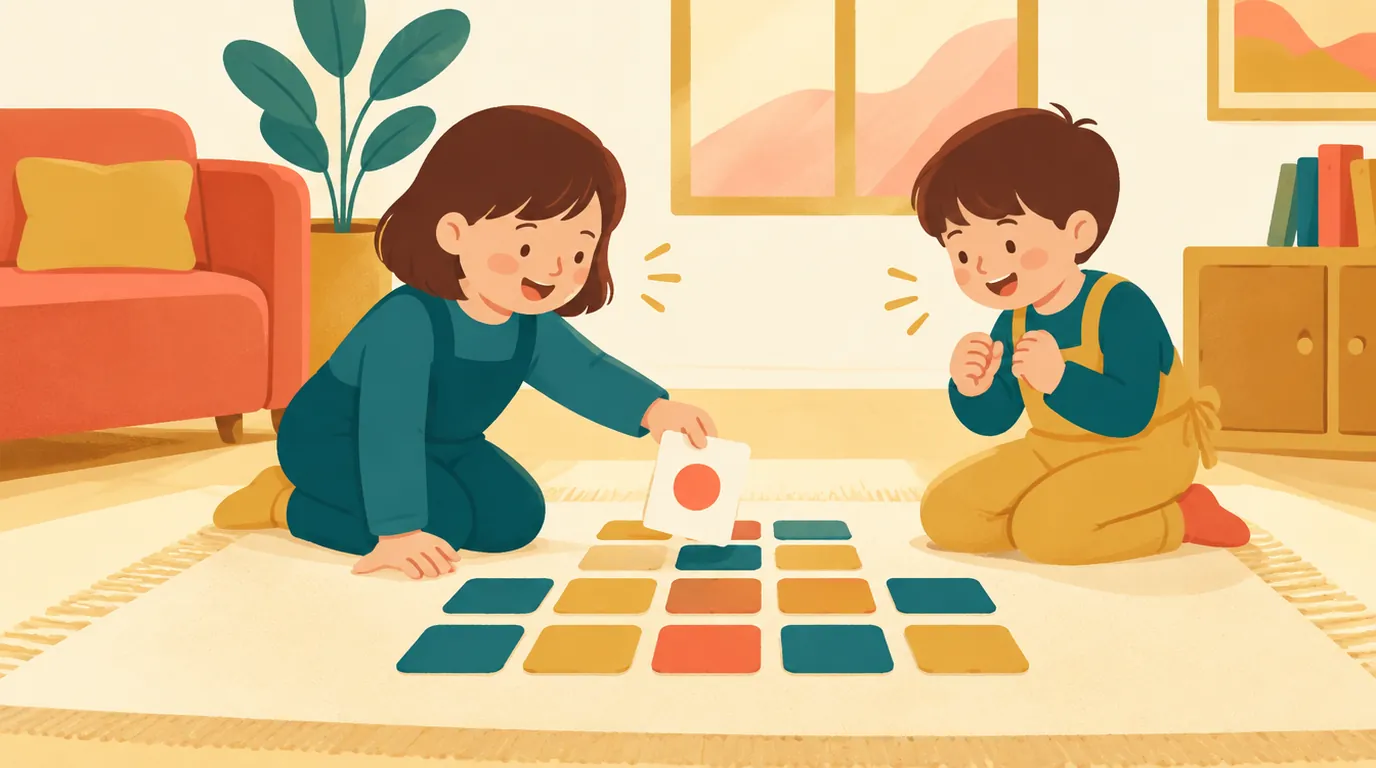
On index cards, write pairs: one card with “6 × 7”, another with “42”. Ten pairs is plenty. Shuffle and lay them face down; each player turns over two cards per turn: if the operation and result match, they keep the pair and play again.
A tip when making the game: some results come up more than once. 3 × 8 and 4 × 6 both make 24; 2 × 6 and 3 × 4 both make 12. Either avoid these duplicates, or accept any correct pairing, which makes you think even harder.
Dice and finger games
3. Dice grid
Draw a grid of sixteen squares, four by four, and fill them with possible results from multiplying two dice: 3, 4, 5, 6, 8, 9, 10, 12, 15, 16, 18, 20, 24, 25, 30 and 36. Each player has a colour. On your turn, roll both dice, multiply, and colour in the square with that result if it’s still free. The first to get three in a row wins.
Standard dice only go up to 6 × 6. For the 7, 8 and 9 tables, use one die and always multiply by the table of the day: if the die shows 4, you say 7 × 4 = 28. If you have a ten-sided die, even better.
4. Finger duel
No equipment needed, and you can start in three seconds. Facing each other, both players hide one hand behind their back, count “one, two, three” and show a number of fingers. The first to call out the product of the two numbers scores a point. Your child shows 3, you show 4: “12!” With both hands, you can go up to 10 × 10.
To even things up, give yourself a handicap: only answer after counting to three in your head. Your child scores fair and square, and will want to play again.
Active games: hopscotch and result hunt
5. Multiples hopscotch
With chalk outside or tape indoors, draw ten squares and write the answers to the table you’re practising, in random order. For the 7 table: 7, 14, 21, 28, 35, 42, 49, 56, 63 and 70. You call out “7 × 6”, your child jumps to 42. If they get it wrong, back to the start—no big deal. If this table is tricky, our article on the 7 times table has some tips.
Variation for older children: they announce the multiplication for each square they land on (“49, that’s 7 × 7”).
6. Result hunt
Hide about ten post-its with answers around a room. You pick a multiplication at random: your child must find and bring back the right post-it. Perfect for rainy days or for children who struggle to sit still. For the 9 table, slip in an odd one like 64, which doesn’t belong: they’ll need to spot it using the trick from the 9 times table, where the digits in the answers from 9 × 2 to 9 × 10 always add up to 9. But 6 + 4 = 10.
Oral games: in the car or with the family
7. Fizz-buzz and ping-pong
In the car, in a queue or on the way to school, play the multiples game: take turns adding the table. “6”, “12”, “18”, “24”… Whoever makes a mistake or hesitates too long starts again from zero. Ping-pong is faster: you say “8 × 3”, they answer “24” and throw you a multiplication in return. You’ll find more travel ideas in our car games for children.
8. Multiplication bingo
Perfect when siblings or cousins are around the table. Each player gets a grid with nine answers. The caller picks multiplications at random and reads them out: “5 × 9!” Whoever has 45 puts down a token. First to fill their grid shouts “Bingo!” To mix ages, give the youngest a grid with the 2 and 5 tables, and the oldest one with 7 and 8.
Which game to choose for your child’s level?
| Game | Materials | Recommended level | Tables practised |
|---|---|---|---|
| Finger Duel | None | From CE1 | Up to 5 × 5 with one hand, 10 × 10 with both |
| Dice Grid | 2 dice, paper, felt-tip pens | CE1 – CE2 | Up to 6 × 6, or the table of the day with just one die |
| Multiples Hopscotch | Chalk or masking tape | CE1 – CE2 | One table at a time |
| Result Hunt | Sticky notes | CE1 – CE2 | One or two tables |
| Memory | Index cards | CE1 – CM1 | Your choice |
| Lotto | Grids, paper, counters | CE1 – CM2, family play | Any, depending on the player |
| Furet and Ping-Pong | None | CE2 – CM2 | All tables |
| Battle | Pack of cards (remove the picture cards) | CE2 – CM2 | All tables, from 1 × 1 to 10 × 10 |
Keep sessions short and regular: aim for five to ten minutes, two or three times a week, on top of a quick daily review. Stop while everyone is still having fun—never when tired. That way, your child will want to play again tomorrow.
Oral games like Furet are also great for mental maths practice. For more ideas, see our articles on mental maths in CE1 and mental maths in CM1, with exercises for each level.
Want to put these tips into practice?
Every day, a new adventure workbook adapted to your child's school level — to print or do on screen. No commitment.
Your questions
At what age can you start playing these multiplication games?
As soon as your child understands what multiplication is—usually in CE1. Start with Finger Duel or hopscotch using the 2 or 5 times table, then move on to Battle once they know a few more tables.
Are games enough to learn times tables?
Games are great for reinforcing knowledge, but they don’t replace understanding or a quick regular review. The best approach is to combine both: spend a few minutes each day reciting and asking questions, and play a game together two or three times a week.
My child hates losing—what can I do?
Try cooperative or timed versions, like finding all the memory pairs together in under five minutes. You can also give yourself a handicap, such as only answering after silently counting to three.
Should you ban screens completely?
No, but screen-free games create real shared moments and let you hear mistakes as they happen. If you use an app, keep it as an occasional extra for short sessions.
Read next
 Learning through play
15 games to keep children busy in the car (that get them thinking)
15 games to keep children entertained in the car, almost no equipment needed: classic and clever ideas that get them practising…
 Parent guide
The ‘summer slide’: why your child forgets, and what to do
Learning loss over the school holidays isn’t inevitable: here’s how to prevent it in just 10 minutes a day…
 Holiday workbooks
Holiday workbook: how to choose the right one, level by level (Kindergarten → CM2)
Level, length, answers: the 5 things to look for in a holiday workbook that really suits your child, level by level…