🔤 Learn invariable words without tears: 6 tips that change everything
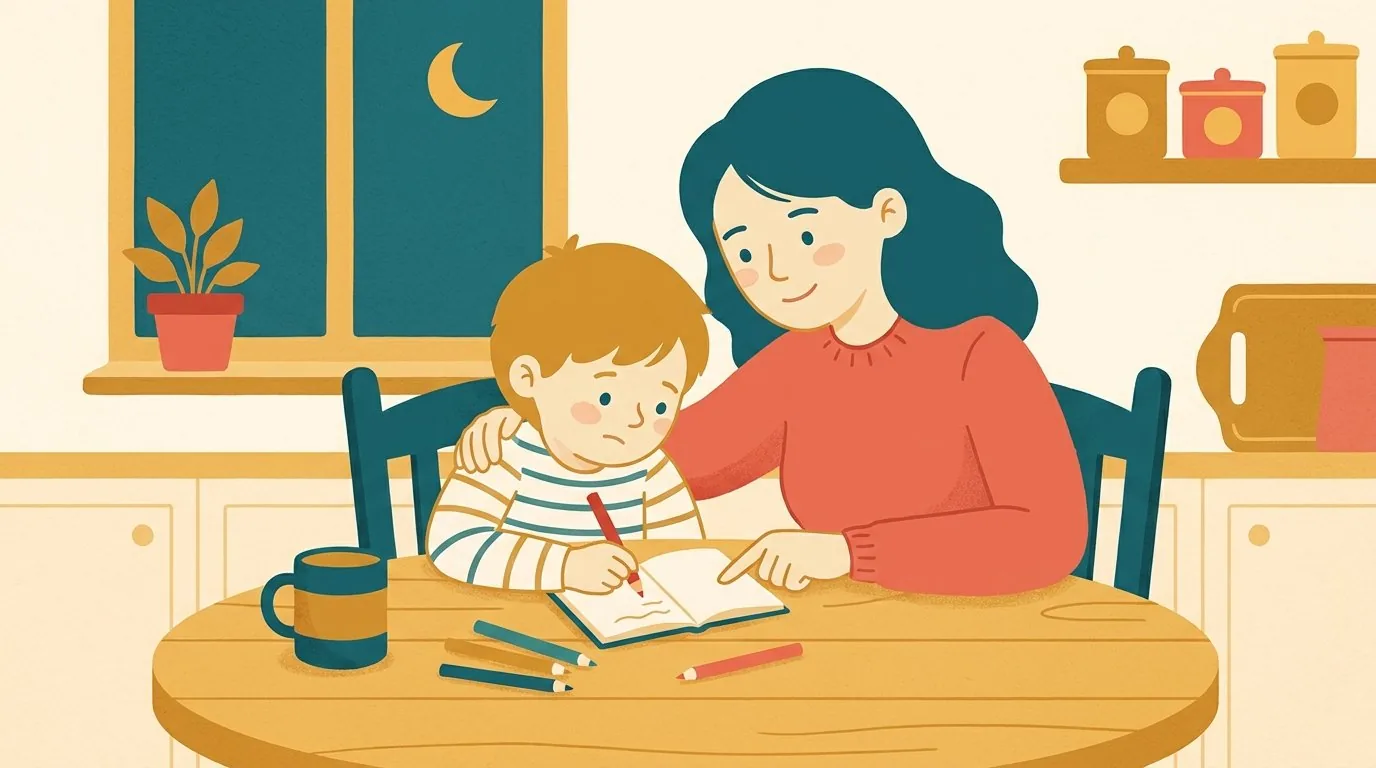
"That's it, I know them!" And the next day, the dictation comes back with toujour, beaucou and pendan. Lists of invariable words are one of the few primary school learnings that cannot be improvised: there is no rule to understand, only an image to engrave.
This is also good news: no rule, so no reasoning to build. These words settle quickly, provided you approach them differently than just rereading the list the night before. Here are six tips to try starting tonight.
What exactly is an invariable word?
An invariable word is written always the same way : it never takes a feminine or plural ending, whatever the rest of the sentence. "Elles arrivent souvent en retard" is written exactly like "Il arrive souvent en retard."
The lists given in class actually mix three families of words:
- the adverbs : souvent, toujours, très, beaucoup, presque…;
- the prepositions : dans, sur, avec, sans, pour, malgré, parmi…;
- the conjunctions, which connect: but, or, and, so, when, as, since…
Memorizing the spelling of the most frequent invariable words is explicitly included in the French curriculum from cycle 2 (CP-CE2, ages 6-8), and the list extends up to CM2 (age 10-11). So this is not just a teacher's whim: these words appear in every dictation and every writing assignment.
Why learning invariable words often gets stuck
Three reasons, and they are all avoidable.
1. The ear is useless. For almost all these words, the trap is a final silent letter : the s in always, the t in souvent, the p in a lot, the d in when. A child who “writes as they hear” will inevitably make mistakes. So you have to memorize an image, not a sound.
2. The alphabetical list makes no sense. Learning elsewhere, thus, then, enough, also in a row asks the brain to remember five words that have no connection to each other. It has nothing to anchor them to.
3. Rereading is not learning. Passing your eyes over the list three times gives the pleasant illusion of knowing it — it’s an illusion. As with learning a poem, the brain retains what it had to search for, not what it reread: as long as the child has not written the word without seeing it, nothing is acquired.
Learning invariable words by families: the real breakthrough
Even before starting to revise, do one thing: copy the teacher’s list in a different order, into four groups by meaning. Five minutes of your time, and half the work is done.
- Time : yesterday, today, tomorrow, often, always, soon, long ago.
- Place : here, outside, inside, above, below, in front, behind, everywhere, elsewhere.
- Quantity : a lot, too much, enough, little, very, less, almost, more.
- Connecting words : but, or, and, so, for, yet, however, since.
Second immediate gain: learn them in pairs of opposites. Always/never, a lot/little, above/below, before/after, inside/outside, far/near. One effort, two words remembered — and the child who hesitates on one recalls the other.

Six tips to try tonight
1. Spell out loud, including the silent letter
The child spells the word articulating the tricky letter: “t-o-u-j-o-u-r-s, with the s that we do not hear.” The act of saying the silent letter creates a sound marker where there was none.
2. The tricky letter in color
The word is written in pencil gray, the silent letter in red: beaucoup, souvent, quand. It is this visual contrast that the child will recall in their mind at dictation time. One color only, always the same, otherwise the effect dilutes.
3. Write without looking, immediately
Look at the word for 5 seconds, hide it, write it, compare letter by letter. If wrong, try once more — not ten times. Copying a word twenty times trains the hand, not the memory: after the third line, the child copies without reading.
4. The quick dictation of three words
Two minutes, standing in the kitchen: you dictate three words, the child writes on a slate. That makes fifteen words in the week, much better spread out than a list crammed the night before.
5. Mnemonic devices for small closed groups
Some groups are remembered at once because they are short and complete:
- “Mais où est donc Ornicar?” gives the seven coordinating conjunctions: mais, ou, et, donc, or, ni, car.
- “Adam part pour Anvers avec cent sous” gives nine very common prepositions: à, dans, par, pour, en, vers, avec, sans, sous.
These two formulas are used from primary school up to collège (middle school, ages 11-15). If your child connects with this learning method, there are dozens more in our article on essential mnemonic devices.
6. The word of the week displayed
A difficult word written large and taped to the fridge: the child sees it twenty times a day effortlessly, and it is changed on Monday. It’s free, and for words that really resist (aujourd'hui, cependant, parmi), it works.
Which words at which level?
Every school has its list, but the progression is very similar from class to class. Here are the words most often found, and the trap to highlight as a priority at each level.
| Level | Typical words | The highlighting trap |
|---|---|---|
| CP (6-7 years old) | dans, sur, sous, avec, pour, et, très, bien, aussi, encore, toujours | always takes a s that is never heard |
| . | après, avant, pendant, souvent, parfois, jamais, beaucoup, presque, depuis | a lot and too much end with a p silent |
| CE2 (8-9 years old) | cependant, pourtant, plutôt, surtout, partout, dessus, dessous, quelquefois | rather (= preferably) ≠ earlier (= before), in two words |
| CM1 (9-10 years old) | malgré, parmi, environ, plusieurs, volontiers, davantage, tandis que | parmi and despite do not take never in s |
| CM2 (10-11 years old) | néanmoins, toutefois, auparavant, aussitôt, ainsi, certes, guère, dorénavant | when (time) ≠ as for (= regarding) |
If your child is already struggling on the line above, go down one level without hesitation: the lists are cumulative, a CM1 who writes beaucou must first master CE1.
The three-words-a-day routine
The best schedule is one that takes two minutes and does not depend on your evening mood. Here is the one we recommend, based on a list of ten to fifteen words per week:
- Monday : sort the list into groups of meaning and highlight the silent letters (5 min, with you).
- Tuesday to Thursday : quick dictation of three words, picking from the whole list (2 min).
- Friday : dictation of two sentences containing four or five words from the list.
- The following weekend : three words from the previous week's list .It is this delayed review that turns rote learning into lasting knowledge.
This last point is the most important and most often forgotten: a word reviewed eight days later is retained much better than a word practiced five times in the same evening. This is also the logic of our cheat sheet books : short tips, reviewed regularly, rather than hours of block revision.

The four traps that come up in all dictations
- quand / quant à : when talks about time (« quand tu veux » = "whenever you want"), as for means "as for" or "regarding".
- plutôt / plus tôt : in one word, it's a preference; in two words, it's a time.
- près / prêt : près (distance) is invariable, prêt (the adjective) agrees: elles sont prêtes.
- parmi / malgré : never use s final, whereas the ear expects one.
Take one per month, displayed on the fridge: these four confusions alone are worth several dictation points over a year.
The rest is a matter of tiny regularity: three words, two minutes, every day. To test the principle without buying anything, start with our free printable workbook, then continue with access to all Kidibook workbooks if your child gets hooked.
📘 All these tips are also available in book form: Le Grand Livre des Pense-Bêtes — a hook for every word that cannot be made up.
Want to put these tips into practice?
Every day, a new adventure workbook adapted to your child's school level — to print or do on screen. No commitment.

Your questions
How many invariable words should be learned per week?
Ten to fifteen words per week are more than enough in elementary school (ages 6 to 11), at a rate of three words per day. Beyond that, the child recognizes the words on Friday but does not reuse them in writing. Better to have fifteen words truly mastered than thirty seen once. If the class list is longer, split it: nothing forbids working on half one week and the other half the next.
My child succeeds in Friday's dictation but repeats mistakes in writing. Why?
Because they learned the words in the order of the list, not in usage. In prepared dictation, they know which words will come; in writing, they must find them without clues. The remedy is simple: pick words at random from the entire list during quick dictations, and regularly add three words from previous weeks.
Should the word be copied ten times?
No. From the third line, the child copies mechanically without reading what they write: the hand works, the memory does not. Writing without a model in sight, followed by letter-by-letter comparison, is worth twenty copies. If the word is wrong, only one retry, then put it back in the pool for the next day.
At what age should one start?
From CP (Cours Préparatoire, ages 6-7), with a handful of very short and very frequent words (dans, avec, pour, très, bien). The essential thing at this age is not quantity but habit: showing that some words are not written as they sound, and that we learn them by looking at them, not by guessing.
To read next
 Memory aids & memorization
15 mnemonic techniques every student should know (from CP to Bac)
A good mnemonic technique gets a lesson into the head in a few seconds. Discover 15 proven tips, from …
 Memory aids & memorization
How to learn multiplication tables: the plan that finally works
In what order, with which tips and how much time per day? The concrete plan to learn multiplication tables…
 Memory aids & memorization
Mnemonic for the planets: remember the order of the solar system in one sentence
The mnemonic for the planets: the sentence that puts Mercury to Neptune back in order, the table of the 8 planets and …