7️⃣ The 7 Times Table: just one really new result, plus all the tips

The 7 times table is often the last one tackled, and that's good news: by the time your child gets to it, they already know almost all of it without realising. Out of the ten multiplications from 7 × 1 to 7 × 10, only one is truly new if the other tables are in place. You just need to show them.
In this article, you'll find the full table, a list of what your child has already learned elsewhere, tips for the two trickiest results—7 × 7 and 7 × 8—games to make 7 more concrete, and a week-long routine: seven days for the 7 times table, including a rest day.
The complete 7 times table, and what your child already knows
Here's the 7 times table up to 7 × 10. The third column is the key: it shows which table your child has already seen each result in. This follows the order we recommend in our guide how to learn multiplication tables: start with the 1 and 10 tables, then 2, 5, 4, 3, 9, 6, 8, and finally 7.
| Multiplication | Result | Already known thanks to… |
|---|---|---|
| 7 × 1 | 7 | the 1 times table: multiplying by 1 doesn't change the number |
| 7 × 2 | 14 | the 2 times table: 2 × 7 = 14, double 7 |
| 7 × 3 | 21 | the 3 times table: 3 × 7 = 21 |
| 7 × 4 | 28 | the 4 times table: 4 × 7 = 28 |
| 7 × 5 | 35 | the 5 times table: 5 × 7 = 35 |
| 7 × 6 | 42 | the 6 times table: 6 × 7 = 42 |
| 7 × 7 | 49 | New: the only result to learn |
| 7 × 8 | 56 | the 8 times table: 8 × 7 = 56 |
| 7 × 9 | 63 | the 9 times table: 9 × 7 = 63 |
| 7 × 10 | 70 | the 10 times table: just add a zero to 7 |
It all comes down to a simple rule: the order of the numbers doesn't change the result. 7 × 4 and 4 × 7 both give 28. Let your child check this with real objects—7 rows of 4, then 4 rows of 7—and they'll see that the 7 times table is mostly made up of results 'borrowed' from other tables.
Next, go through the table together and tick off the rows they already know. If only one row is left—7 × 7—well done! If there are three or four, it's not the 7 times table that's tricky, but an earlier one that still needs practice: that's the one to focus on first.
Making 7 concrete: rows, weeks and the calendar
The number 7 isn't as obvious as 5 or 10: no hand has seven fingers, and there are no 7-cent coins. So you need to find other supports. The best one is right in front of you every day: a week has 7 days.
- Weeks: 2 weeks make 14 days, 3 weeks 21 days, 4 weeks 28 days—that's exactly a February in a non-leap year.
- The monthly calendar: on a calendar laid out in weeks, moving down one square in a column adds 7. So the 7th, 14th, 21st and 28th always fall on the same day of the week: the whole 7 times table up to 28 fits in one column.
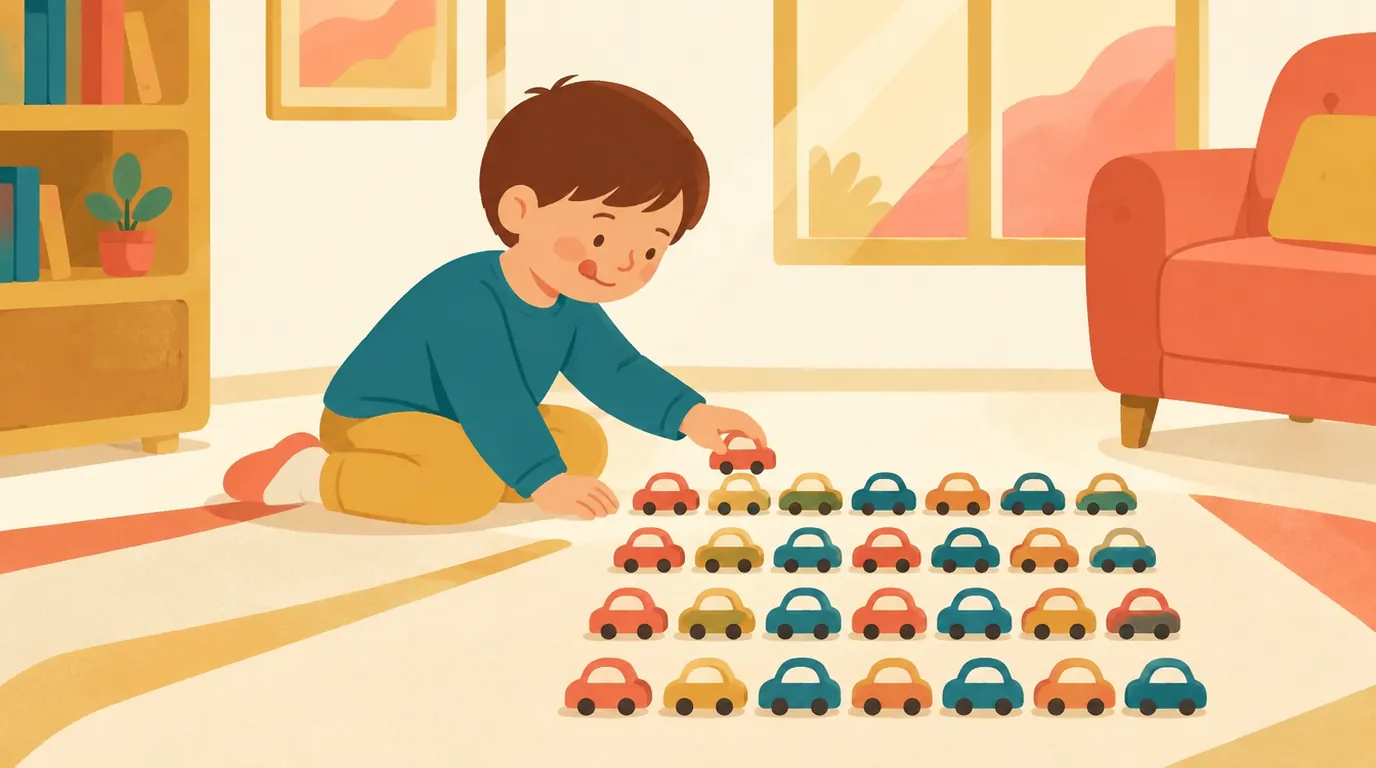
- Rows of objects: toy cars, pasta, building blocks… Line up rows of 7, count the rows, and announce the total. 4 rows of 7 cars is 28 cars.
This hands-on approach is time well spent. If your child forgets a result, they can rebuild it from a real image they've handled ('three weeks is 21 days'), instead of getting stuck on a blank.
Tips for 7 × 7 and 7 × 8
7 × 7 = 49: just before 50
Three ways to remember, so you can pick what suits your child best:
- The rhyme: 'Seven times seven is forty-nine, easy to define.' (A little rhyme helps it stick!)
- The calendar: 7 weeks of 7 days make 49 days—just one short of 50.
- Breakdown method: 7 is 5 + 2. So 7 × 7 is 5 × 7 plus 2 × 7, which is 35 + 14 = 49. This split works for the whole table: 7 × 8 is 40 + 16 = 56.
7 × 8 = 56: the 5, 6, 7, 8 sequence
This is the most popular trick, and for good reason: write '56 = 7 × 8' and read the digits from left to right. You get 5, 6, 7, 8—four numbers in order. Have your child write it out big once, then ask them the reverse ('8 × 7?'). We cover this result from the 8 × 7 angle in our article on the 8 times table and its doubling trick.
For the others: backup strategies
- 7 × 4: double twice—7, then 14, then 28.
- 7 × 6: it's double 7 × 3—21 + 21 = 42.
- 7 × 9: it's 7 × 10 minus 7—70 − 7 = 63. You can also find it on your fingers, using the method explained in our article on the 9 times table.
Games for the 7 Times Table
The "Bang!" Game
Take turns counting as a family from 1: "one", "two", "three"… But every time you reach a number in the 7 times table, don't say the number—shout "Bang!" and clap your hands. Anyone who says "fourteen" instead of "Bang!" is out for that round. Once you reach 70, you've covered the whole table. Perfect for dinner or car journeys, and younger siblings can join in by simply counting.
The Calendar Hunt
Give your child the monthly calendar and a marker: they circle all the days that are multiples of 7, then look for what they have in common. They'll discover they form a column. Then turn the questions around: "21 days is how many weeks?" — three. "And 35 days?" — five. Without realising, they're already doing their first divisions.
Rows with Dice
Roll a die: your child lines up that many rows of 7 pieces of pasta or 7 toy cars. Before counting, they guess the total. Then count together to check. If the die shows 5? "5 × 7 = 35", and the 35 pieces are right there on the table to prove it.
For more ideas (war, memory, hopscotch…), see our games for learning times tables: all work perfectly if you focus just on the 7 times table.
A Week of Routine: Seven Days for the 7 Times Table
Ten minutes a day is enough. The idea is to do a little each day, from different angles, rather than repeating the same thing seven nights in a row.
- Monday: read the whole table out loud and tick off the answers your child already knows.
- Tuesday: just 7 × 7 and 7 × 8. Use the rhyme, the sequence 5-6-7-8, then ten quick-fire questions alternating between the two.
- Wednesday: do the calendar hunt and the dice rows.
- Thursday: mix up the table on cards: the calculation on one side, the answer on the other.
- Friday: play a round of "Bang!" at dinner.
- Saturday: try a fill-in-the-blanks worksheet, for example one from our printable times tables, and check it together.
- Sunday: rest. The following Monday, start by going over the questions your child missed during the week.
At the end of the week, do a mixed-up test: ten 7 times table questions in any order. If your child answers without starting from 7 × 1 each time, the table is learned. If not, repeat the week focusing only on the tricky answers—no need to start from scratch.
Want to put these tips into practice?
Every day, a new adventure workbook adapted to your child's school level — to print or do on screen. No commitment.
Your Questions
Why does the 7 times table seem so hard?
It often comes last, when your child has already recited a lot, and 7 doesn't appear much in everyday life, unlike 5 (fingers) or 10. But if the other tables are in place, there's only one new answer: 7 × 7 = 49. Showing your child this is often enough to take away the worry.
My child mixes up 7 × 6 and 7 × 8—what can I do?
Practise both answers side by side: 7 × 6 = 42 and 7 × 8 = 56. For 56, use the sequence 5, 6, 7, 8; for 42, double 7 × 3, so 21 + 21. Alternate between them for a few days, asking your child each time how they work out the answer.
Does the 7 times table have to be learned last?
It's not essential, but it's easier: each table learned beforehand gives ready-made answers. If your child's class does them in a different order, follow the teacher's lead and use the tables already covered to lighten the load.
My child can recite the 7 times table but gets stuck when it's mixed up—is that normal?
Yes, that's a common stage: your child knows the chant, but not each answer on its own yet. Move on to cards and quick-fire questions in random order, just a few minutes a day. When they answer without starting from 7 × 1, the table is truly learned.
You might also like
 Memory Tricks & Memorisation
Tricky words: the list from age 5 to 11 and 6 ways to remember them
Tricky words: the list by age from 5 to 11, the traps to highlight, and 6 simple ways to remember them…
 Memory Tricks & Memorisation
English verbs for kids: 7 tricks for tenses that really work
Verbs without tears: the -s of he/she/it, was or were, did or done, irregular verbs in sound families…
 Memory Tricks & Memorisation
How to Remember History Dates: Timelines, Stories and Mental Images
How to Remember History Dates Without Rote Learning: Mental Images, Stories, the Hallway Timeline and 12 More Tips