📏 Decimal fractions: tenths, hundredths and decimal numbers in CM1-CM2
Decimal fractions often pop up at home as a worried question: “What does three tenths mean?” And when faced with the exercise, many parents realise they know how to do it… but not how to explain it. Don’t worry: the idea is much simpler than it seems, as long as you show it before you write it down.
In CM1, children discover tenths and hundredths; in CM2, they become confident with them, add thousandths, and link them to decimal numbers. This guide gives you the right words, a conversion table, common mistakes to watch for, and activities you can do tonight with things from your kitchen. No need to buy anything.
What is a decimal fraction?
A decimal fraction is a fraction where the denominator (the bottom number) is 10, 100, 1,000… in other words, a 1 followed by zeros. That’s all there is to it. Here are some examples:
- 7/10 is read as “seven tenths”: you divide one whole into 10 equal parts and take 7;
- 23/100 is “twenty-three hundredths”: the whole is split into 100 equal parts, and you take 23;
- 51/1,000 is “fifty-one thousandths”: 1,000 equal parts, and you take 51.
On the other hand, 4/7 or 2/3 are not decimal fractions: their denominators are not 10, 100 or 1,000. A small detail your child might see in CM2: 1/2 doesn’t have 10 as a denominator, but it’s equal to 5/10. Similarly, 3/4 is equal to 75/100. However, 1/3 can never be written exactly with 10, 100 or 1,000 as the denominator.
If “classic” fractions (like sharing a pizza or reading 3/4 on a strip) are still tricky, start there: our article on fractions in CM1 covers the basics step by step. Decimal fractions are just a very useful special case.
Tenths and hundredths: making them visible
The word “tenth” doesn’t mean much to a 9-year-old. What matters is what they can see and touch. Three simple props are all you need.
With ten identical objects
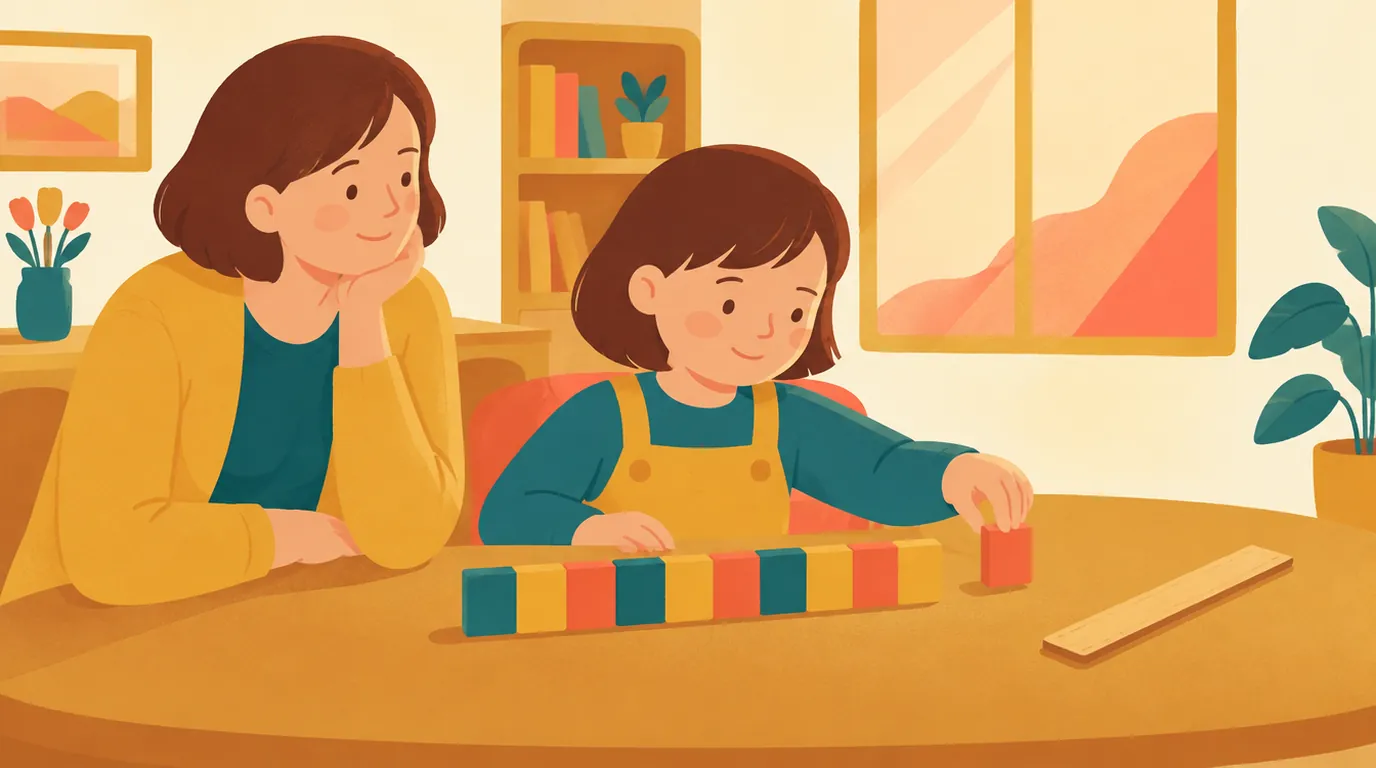
Line up ten cubes, bottle tops or sugar lumps. The whole row is one unit. Each object is one tenth of the row: 1/10. Take three away: you’ve set aside 3/10 of the row, leaving 7/10. And when you have all ten, that’s 10/10 — a complete unit.
With money
One euro is 100 cents. A 1-cent coin is one hundredth of a euro (1/100), and a 10-cent coin is one tenth of a euro (1/10), since you need ten to make a euro. This is often when it clicks: 10 one-cent coins make a 10-cent coin, just as 10 hundredths make 1 tenth.
With cooking
Take a measuring jug. One litre is 10 decilitres: so a decilitre is one tenth of a litre. It’s also 100 centilitres: a centilitre is one hundredth of a litre. If a recipe asks for 25 cL of milk, your child pours 25/100 of a litre. The language of measurement (deci-, centi-, milli-) tells exactly the same story as decimal fractions.

From decimal fractions to decimal numbers
The whole point of decimal fractions is that you can also write them with a decimal point. 3/10 = 0.3, 25/100 = 0.25. The decimal point simply separates whole units from anything smaller. The first digit after the point counts tenths, the second counts hundredths, the third thousandths.
| Decimal fraction | Read as | Breakdown | Decimal number |
|---|---|---|---|
| 3/10 | three tenths | 3/10 | 0,3 |
| 7/100 | seven hundredths | 0/10 + 7/100 | 0,07 |
| 25/100 | twenty-five hundredths | 2/10 + 5/100 | 0,25 |
| 12/10 | twelve tenths | 1 + 2/10 | 1,2 |
| 135/100 | one hundred and thirty-five hundredths | 1 + 3/10 + 5/100 | 1,35 |
| 408/100 | four hundred and eight hundredths | 4 + 0/10 + 8/100 | 4,08 |
| 51/1 000 | fifty-one thousandths | 0/10 + 5/100 + 1/1 000 | 0,051 |
The “Breakdown” column is the most important. It shows why 12/10 is 1.2: in twelve tenths, there are ten tenths (which make one whole), and two left over. Try this with cubes: twelve cubes, a full row of ten, and two more beside.
A simple rule for converting: the number of zeros in the denominator tells you how many digits after the decimal point. 7/100 has two zeros, so two digits after the point: 0.07 (not 0.7). 51/1,000 has three zeros, so three digits: 0.051. This is a checking tool, not an explanation: the real meaning comes from breaking into tenths and hundredths.
Common mistakes and how to fix them
These mix-ups are normal — almost every child makes them at some point. The key is to spot them early.
- Writing 3/100 = 0.3. The child has put the 3 in the wrong place. Solution: say “three hundredths”, then put the 3 in the hundredths column of a place value chart. You get 0.03.
- Thinking 0.12 is bigger than 0.5 “because 12 is bigger than 5”. This is the most common mistake. Solution: write both numbers in hundredths. 0.5 = 50/100 and 0.12 = 12/100. Fifty hundredths is more than twelve hundredths. With money, it’s even clearer: 50 cents versus 12 cents.
- Believing 0.3 and 0.30 are different. They are the same: 3/10 = 30/100, just as three 10-cent coins are worth thirty cents.
- Forgetting the zero in 4.08. Four hundred and eight hundredths means 4 units, 0 tenths and 8 hundredths. If you leave out the zero, you write 4.8, which is 4 units and 8 tenths—a completely different number.
Comparing and adding decimal fractions
Once your child understands the link, the first calculations become much easier, because you can always convert to the same denominator.
- Same denominator: 3/10 + 4/10 = 7/10. You add tenths just as you would marbles.
- Different denominators: 3/10 + 25/100. Change 3/10 to 30/100, then 30/100 + 25/100 = 55/100, which is 0.55. Check in decimal form: 0.3 + 0.25 = 0.55.
- Comparing: 0.4 or 0.35? Write 0.4 = 40/100. Since 40/100 is greater than 35/100, 0.4 is bigger than 0.35.
- Making a whole: How much do you need to add to 7/10 to make 1? You need 3/10, since 10/10 = 1.
These quick calculations are perfect for practising out loud, on the way to school or while setting the table. Add a tenth, take away a hundredth, find what’s needed to make 1—you’ll find more ideas in our mental maths for CM1, just five minutes a day.
Five activities to practise at home
No need for endless worksheets: a few regular minutes with everyday objects are better than one long session on Sunday.
- The row of ten. Line up ten objects. You say “four tenths”, your child moves four aside, then says how many are left in tenths.
- The shopkeeper’s till. Use 1 and 10 cent coins. Your child pays 0.35 € with three 10-cent coins and five 1-cent coins, then writes 35/100.
- The measured recipe. Your child reads centilitres on the measuring jug and converts them to fractions of a litre: 20 cL is 20/100 of a litre, so 0.2 L.
- The ruler. One millimetre is a tenth of a centimetre. So a pencil measuring 13 cm and 4 mm is 13.4 cm long.
- The card duel. Write numbers like 0.6, 0.45, 0.09, 0.7 on slips of paper. Each person draws a card; the biggest number wins, but only if it’s justified in hundredths.
When to worry, and how to practise on paper
Matching fractions and decimals takes time. If a child in CM1 is still unsure halfway through the year, it’s nothing to worry about. What should alert you is if they get the right answers ‘mechanically’ without understanding: they convert 25/100 to 0.25 but can’t say if 0.25 is more or less than a half. In that case, go back to using objects and money, and talk to the teacher if the difficulty continues.
For written practice, choose short, varied exercises: colouring tenths on a strip, placing numbers on a number line, completing equalities. You’ll find ready-to-print sets, sorted by topic, in our CM1 printable exercises and, for extra practice at the end of primary, in our CM2 printable exercises. One well-understood exercise is worth more than three rushed ones.
Want to put these tips into practice?
Every day, a new adventure workbook adapted to your child's school level — to print or do on screen. No commitment.
Your questions
What’s the difference between a decimal fraction and a decimal number?
They’re the same amount written in two ways. 25/100 is a decimal fraction, 0.25 is the matching decimal number. The fraction shows how the unit is split; the decimal form is more practical for calculation and measurement.
When do children learn decimal fractions?
They’re usually introduced in CM1, with tenths and hundredths, after working on simple fractions. In CM2, children consolidate this, add thousandths, and always link to decimal numbers.
Is 1/2 a decimal fraction?
Written like this, no, because its denominator is 2. But it’s equal to 5/10, which is a decimal fraction, and so to 0.5. It’s a good question to ask a child in CM2 to check they understand the meaning, not just the rule.
My child thinks 0.12 is bigger than 0.5—how can I help?
Have your child write both numbers in hundredths: 0.5 = 50/100 and 0.12 = 12/100. Then use money: 50 cents versus 12 cents. Repeat the exercise with other pairs of numbers over several days until it becomes automatic.
Read next
 Revision methods
The syllabic method for learning to read: why it’s making a comeback
Phonics Method for Learning to Read: how it differs from the whole-word approach, what official guidelines say, and…
 Revision methods
The Pomodoro Method for Children: Study in 10-Minute Bursts
The Pomodoro Technique for Kids: best block length by level, which timer to use, and a sample homework session…
 Revision methods
Mind Maps: How to Help Your Child Learn
Mind mapping explained for parents: how to create one with your child, a real lesson example, and practical tips.