🖐️ 9 times table: the finger trick and other clever tips

The 9 times table has some surprising patterns, which is great news for your child: they can use their fingers to find the answers, check a result by adding the digits, or work it out from the 10 times table. If you can rebuild a table in three different ways, it’s much easier to remember.
Here you’ll find the full table, a step-by-step guide to the finger trick, the patterns to spot, the '10 times minus 1 times' method, what your child already knows from other tables, and a routine to gradually move away from using fingers.
The complete 9 times table and its patterns
The table below shows all ten results, from 9 × 1 to 9 × 10, with the digits separated. For 9, there are 0 tens and 9 units.
| Multiplication | Result | Tens digit | Units digit | Sum of the digits |
|---|---|---|---|---|
| 9 × 1 | 9 | 0 | 9 | 0 + 9 = 9 |
| 9 × 2 | 18 | 1 | 8 | 1 + 8 = 9 |
| 9 × 3 | 27 | 2 | 7 | 2 + 7 = 9 |
| 9 × 4 | 36 | 3 | 6 | 3 + 6 = 9 |
| 9 × 5 | 45 | 4 | 5 | 4 + 5 = 9 |
| 9 × 6 | 54 | 5 | 4 | 5 + 4 = 9 |
| 9 × 7 | 63 | 6 | 3 | 6 + 3 = 9 |
| 9 × 8 | 72 | 7 | 2 | 7 + 2 = 9 |
| 9 × 9 | 81 | 8 | 1 | 8 + 1 = 9 |
| 9 × 10 | 90 | 9 | 0 | 9 + 0 = 9 |
Don’t point out the patterns straight away: let your child discover them. “Look at the tens column. What do you notice? And the units?” They’ll see that the tens go up from 0 to 9 while the units go down from 9 to 0, and the sum of the two digits is always 9. Discovering something for yourself makes it much easier to remember.
The finger trick, step by step
This is the most impressive trick for the 9 times table, and you don’t need any equipment.
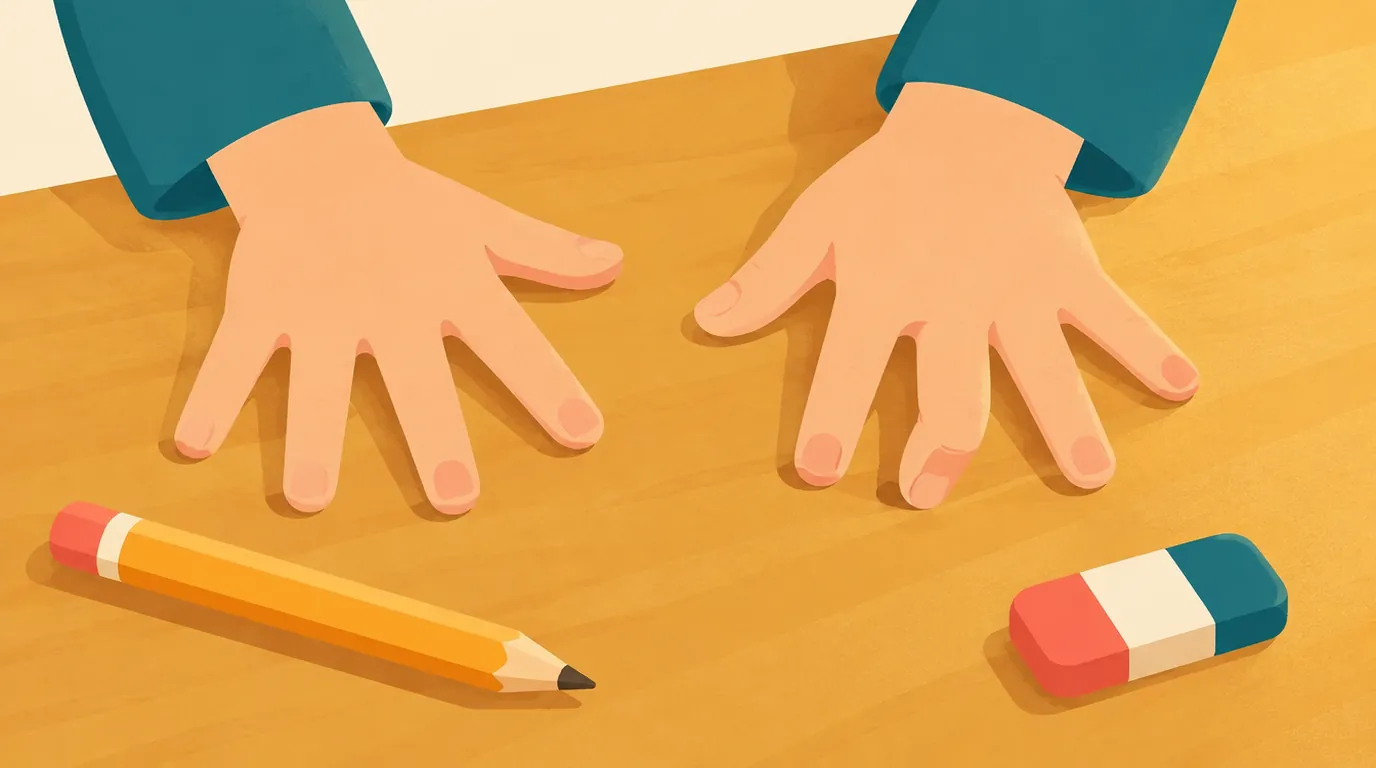
- Lay both hands flat on the table, fingers spread wide.
- Number the fingers from 1 to 10, left to right: the little finger on the left hand is 1, the left thumb is 5, the right thumb is 6, and the little finger on the right hand is 10.
- To work out 9 × 4, fold down finger number 4, the left index finger.
- Count the fingers to the left of the folded finger: 3. That’s the tens.
- Count the fingers to the right: 6. That’s the units. So the answer is 36.
Another example: for 9 × 7, fold down the seventh finger, the right index finger. There are 6 fingers to the left and 3 to the right: 63. Let your child try this for each row in the table, checking the answer each time. The trick works from 9 × 1 to 9 × 10, but not beyond — we only have ten fingers.
Two patterns to help find and check answers
Tens: one less
In 9 × 8, the tens digit is one less than 8, so 7. The units digit is what you need to add to reach 9: 7 + 2 = 9, so 2. The answer is 72. Same for 9 × 6: 5 tens, then 4 units to make 9, so 54. This is really just the 'no hands' version of the finger trick.
Digits add up to 9
From 9 × 2 to 9 × 10, the two digits of each answer always add up to 9. It’s a great way to check. If your child isn’t sure whether 9 × 6 is 54 or 56, 5 + 4 = 9, but 5 + 6 = 11, so the right answer is 54. Even better: between 10 and 99, the only numbers whose digits add up to 9 are 18, 27, 36, 45, 54, 63, 72, 81 and 90.
Remember, after 9 × 10, the sum changes: 9 × 11 = 99, and 9 + 9 = 18. Older children will see this property again in a more general way with the rules for divisibility by 9.
Mirror results
One last pattern to look for: the results come in reversed pairs. 18 and 81, 27 and 72, 36 and 63, 45 and 54. In other words, 9 × 2 and 9 × 9 are mirror images, as are 9 × 3 and 9 × 8.
The backup method: 10 times minus 1 times
9 is 10 minus 1. So multiplying by 9 means multiplying by 10, then subtracting the number once:
- 9 × 6 = 60 − 6 = 54 ;
- 9 × 7 = 70 − 7 = 63 ;
- 9 × 8 = 80 − 8 = 72.
This method has a big advantage over the finger trick: it works with any number. 9 × 12 = 120 − 12 = 108, and 9 × 25 = 250 − 25 = 225. It also builds a useful mental maths habit: to add 9, add 10 then subtract 1. 37 + 9 is 47 − 1, which is 46. You’ll find more techniques like this in our article on mental maths for CM1 (age 9-10).
What your child already knows
If you follow the recommended order in our guide how to learn multiplication tables, the 9 times table comes just after 2, 5, 4 and 3. Since the order of numbers doesn’t change the result, much of it is already familiar:
- 9 × 1 = 9 and 9 × 10 = 90, thanks to the 1 and 10 times tables;
- 9 × 2 = 18, 9 × 3 = 27, 9 × 4 = 36 and 9 × 5 = 45, thanks to the 2, 3, 4 and 5 times tables.
That leaves four new results: 9 × 6 = 54, 9 × 7 = 63, 9 × 8 = 72 and 9 × 9 = 81. These are the ones to practise, and this practice pays off twice. When your child learns the 8 times table, 8 × 9 = 72 will already be familiar — see our article on the 8 times table and the doubling trick. And when it’s time for the 7 times table, 7 × 9 = 63 will be too: that’s one reason why the 7 times table ends up with just one new result to learn.
Games and routines to move beyond fingers
Three quick games
- The odd one out: Write down six numbers, for example 45, 54, 56, 63, 72, 76, and ask your child which ones aren’t in the 9 times table. By adding the digits together, your child will spot 56 (5 + 6 = 11) and 76 (7 + 6 = 13).
- The mirror: You say “27”, your child replies “72” and gives both multiplications: 9 × 3 and 9 × 8.
- Countdown: Recite the 9 times table backwards, from 90 down to 9, subtracting 9 each time: 90, 81, 72, 63… Perfect for car journeys.
Three weeks to stop using fingers
The finger method is brilliant for getting started, but the aim is for your child to know the answers by heart. Here’s a gentle step-by-step routine, just five minutes a day.
- Week 1: Fingers are allowed for every question. Recite the table in order, then out of order.
- Week 2: Your child answers in their head first, then checks with their fingers or by adding the digits.
- Week 3: Hands stay under the table. Only use the sum of the digits to check, and finish with a worksheet, for example the missing-number tables in our printable multiplication tables.
Don’t worry if your child uses their fingers now and then: it’s a safety net, not a crutch. And if they enjoy these kinds of tricks, Kidibook’s Big Book of Memory Tricks has plenty more, for maths and other subjects.
Want to put these tips into practice?
Every day, a new adventure workbook adapted to your child's school level — to print or do on screen. No commitment.
Your questions
Is using fingers for the 9 times table cheating?
No. The finger method is based on a real pattern in the 9 times table, and it helps your child understand it. The aim is for them to answer from memory: gradually use fingers just to check, then set them aside.
Does the finger method work beyond 9 × 10?
No, it only works from 9 × 1 to 9 × 10, since we have ten fingers. For bigger numbers, use the ‘10 times minus 1 times’ trick: 9 × 12 is 120 − 12, which is 108.
My child mixes up 9 × 6 and 9 × 7 — what can I do?
Try the tens rule: in 9 × 6, there are 5 tens, so 54; in 9 × 7, there are 6 tens, so 63. Then check by adding the digits: 5 + 4 = 9 and 6 + 3 = 9.
Which trick should I use: fingers, adding the digits, or ‘10 times minus 1 times’?
All three work together. Fingers are great for starting out, adding the digits is perfect for checking, and the ‘10 times minus 1 times’ method is handy for bigger numbers. Let your child try each one and stick with their favourite.
You might also like
 Memory tricks & memorisation
Tricky words: the list from age 5 to 11 and 6 ways to remember them
Tricky words: the list by age from 5 to 11, the traps to highlight, and 6 simple ways to remember them…
 Memory tricks & memorisation
English verbs for kids: 7 tricks for tenses that really work
Verbs without tears: the -s of he/she/it, was or were, did or done, irregular verbs in sound families…
 Memory tricks & memorisation
How to remember history dates: timelines, stories and mental images
How to Remember History Dates without endless repetition: mental images, storytelling, the hallway timeline, and 12 key dates…