📎 Determiners in CM1: articles, possessives, demonstratives and common pitfalls
Determiners are everywhere: you can hardly write three words without using one. Le chien, une pomme, mes cahiers, cette idée… These little words are so discreet that many children don’t even notice them when the teacher asks them to underline them. Yet by CM1, children are expected to spot and sort them into families.
This article gives you the essentials to support your child: a simple definition, a table of the different types, agreement rules to watch out for, and a couple of common traps that come up in almost every test. At the end, you’ll find some quick games to practise at home.
What is a determiner?
A determiner is a small word placed before a noun to introduce it. It shows the gender (masculine or feminine) and number (singular or plural) of the noun, and gives extra information: is the thing already known? Who does it belong to? How many are there?
It’s not always right next to the noun: sometimes an adjective slips in between (une belle pomme, mon petit frère). But there’s always a noun after it. That’s how you recognise it, and it’s what makes it different from a pronoun, which replaces the noun.
The simplest test: replace the word with another determiner. In « le chien aboie », you can say « un chien », « mon chien », « ce chien »: le is definitely a determiner. For a reminder of the other word classes, see our article on the nature of words, which covers the eight main types.
The types of determiners to know in CM1
Here’s a handy table to keep nearby during homework.
| Type | What it shows | Forms | Example |
|---|---|---|---|
| Definite article | Something known or already identified | le, la, l', les | le cartable de Tom |
| Indefinite article | Something not specified, mentioned for the first time | un, une, des | une pomme |
| Partitive article | An amount you can’t count | du, de la, de l' | du pain, de l'eau |
| Possessive | Who owns the thing | mon, ton, son, notre, leur… | ma trousse |
| Demonstrative | Something you point out or have just mentioned | ce, cet, cette, ces | cet arbre |
| Numeral | A specific number | deux, dix, cent… | trois billes |
| Indefinite | A vague amount or each item | chaque, plusieurs, quelques, aucun | each pupil |
| Interrogative / exclamatory | A question or an exclamation | quel, quelle, quels, quelles | What day is it? |

Articles: definite, indefinite, partitive
These are the most common determiners. The definite article (le, la, l', les) refers to something specific: « Passe-moi le sel » (the one on the table). The indefinite article (un, une, des) introduces something new or not specified: « Il y a un chat dans le jardin ».
The partitive article (du, de la, de l') refers to a part of something you can't count: du lait, de la confiture, de l'eau. For a snack, you eat « une pomme », but « de la compote ».
Watch out for contracted articles, which combine a preposition and a definite article: à + le = au, à + les = aux, de + le = du, de + les = des. You say « je vais au marché » and not « à le marché ».
The choice of article can completely change the meaning of a sentence. « Le chien de Paul a aboyé » refers to a specific dog everyone knows; « Un chien a aboyé » means any dog. Point out this difference to your child when reading: it helps them see that determiners are not just decorative words.
Possessives and demonstratives: whose? which one?
The possessive determiner changes depending on who owns the object and the noun that follows:
- one owner: mon, ma, mes; ton, ta, tes; son, sa, ses;
- several owners: notre, nos; votre, vos; leur, leurs.
Before a feminine noun starting with a vowel or silent h, ma, ta, sa become mon, ton, son for easier pronunciation: mon amie, ton école, son histoire. And leur only takes an s if the noun is plural: « Les élèves rangent leurs cahiers. »
The demonstrative determiner is used to point something out: ce vélo, cette maison, ces livres. Before a masculine noun starting with a vowel or silent h, ce becomes cet: cet arbre, cet hôpital.
This is where two very common spelling confusions appear, each with its own trick: ces or ses, two determiners that sound the same, and son or sont, where one is a determiner and the other a verb.
Numerals, indefinites, interrogatives and exclamatives
Numerals give an exact number: deux chats, dix doigts. They don't change, except un/une, and vingt and cent which take an s when multiplied and at the end of the number: quatre-vingts pages, deux cents mètres, but quatre-vingt-deux pages. Mille never takes an s.
Indefinites express an unclear quantity or distribution: plusieurs amis, quelques bonbons, aucun bruit, chaque élève. One thing to remember: chaque is always followed by a singular noun.
Finally, quel, quelle, quels, quelles agree with the noun they go with, whether asking a question (« Quelle heure est-il ? ») or expressing emotion (« Quelle belle journée ! »).
Determiner or pronoun? Tricky cases to know
Some words can be determiners or pronouns. The rule: a determiner is followed by a noun, a pronoun replaces a noun and is usually found before a verb.
- « Je range la chambre » (determiner) / « Je la range » (pronoun).
- « Je donne leurs cahiers » (determiner) / « Je leur donne » (pronoun, never with s).
Second tricky case: du and des have two uses. In « je bois du lait », du is a partitive article; in « la niche du chien », it's a contracted article (de + le). Similarly, des is indefinite in « j'ai des billes », contracted in « le jouet des enfants ».
Third tricky case: after a negative, un, une, des and partitives often become de: « J'ai des billes » → « Je n'ai pas de billes »; « Il boit du lait » → « Il ne boit pas de lait ».
Practising at home with games
Determiners are easy to practise out loud in everyday life:
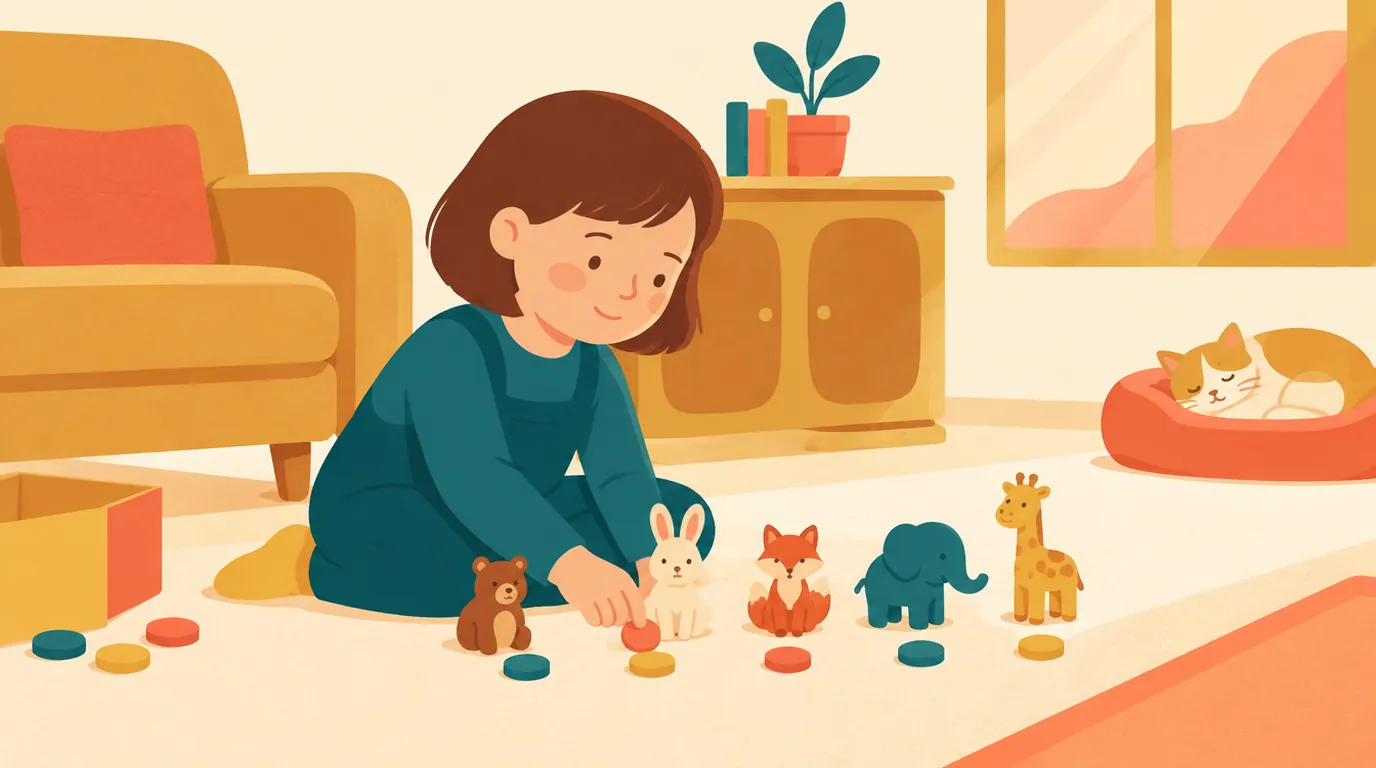
- The token game: line up some figures or objects and put a token in front of each. Your child has to say a different determiner for each token: le lion, mon zèbre, cette girafe, trois singes.
- At the market or supermarket: “How many apples?” (numeral), “Which ones?” (demonstrative: ces pommes-là), “Whose basket is this?” (possessive).
- The changing sentence: start with « le chien dort » and change only the determiner. When you switch to trois or mes, your child should also put the noun and verb in the plural. This is a great bridge to plural nouns.
- The sentence without determiners: read aloud « Chat de voisine a mangé souris dans jardin ». Your child will immediately hear something is missing, and will add the right little words themselves. It's the best proof that determiners matter.
For written practice, our printable CM1 worksheets offer spotting and sorting activities, and our illustrated Memory Tricks gather tips like these, short and easy to review the night before a test.
Want to put these tips into practice?
Every day, a new adventure workbook adapted to your child's school level — to print or do on screen. No commitment.
Your questions
How can you spot a determiner?
It comes before a noun, sometimes with an adjective in between, and you can swap it for another determiner like “the”, “a” or “my”. If it's followed by a verb, it's not a determiner but a pronoun.
What's the difference between an article and a determiner?
The article is a type of determiner, and the most common one. All articles (le, une, des, du…) are determiners, but not all determiners are articles: « mon », « ce » or « trois » are also determiners.
Does your child need to know all the types of determiners in CM1?
The main thing is to be able to spot a determiner and recognise articles, possessives and demonstratives. Numerals, indefinites and interrogatives are often introduced at the same time or in CM2, and will be covered again in middle school.
Why do we say « mon amie » when amie is feminine?
Before a feminine noun starting with a vowel or a silent h, « ma », « ta » and « sa » become « mon », « ton » and « son » to avoid two vowels clashing. The noun remains feminine: you still write « mon amie est gentille ».
Read next
 Revision methods
The syllabic method for learning to read: why it’s making a comeback
Phonics Method for Learning to Read: how it differs from the whole-word approach, what official guidelines say, and…
 Revision methods
The Pomodoro Method for Children: Study in 10-Minute Bursts
The Pomodoro Technique for Kids: best block length by level, which timer to use, and a sample homework session…
 Revision methods
Mind Maps: How to Help Your Child Learn
Mind mapping explained for parents: how to create one with your child, a real lesson example, and practical tips.