📌 Invariable words in CE2: the must-know list and 6 tips to help your child remember them
The invariable words in CE2 are those little words your child writes several times a day (beaucoup, toujours, maintenant), yet they still get underlined in red in the Friday spelling test. Their spelling never changes, which is exactly what makes them tricky: there are no agreement rules to help out, so your child simply has to learn them by heart.
The good news: the list isn’t endless, and most of these words have a clue hidden inside to help you remember them. Here are the invariable words to know in CE2, grouped by meaning, with the main spelling trap for each and some easy ways to practise at home in just ten minutes.
What exactly is an invariable word?
An invariable word doesn’t change for gender or number, and it isn’t conjugated. Compare: « Il court vite » and « Elles courent vite ». The verb and the subject have changed, but vite stays exactly the same. By contrast, a noun takes an s in the plural (un chat, des chats) and an adjective changes (grand, grande, grands).
In grammar, these words mainly belong to three groups: adverbs (souvent, bientôt, très), prepositions (pendant, depuis, chez) and conjunctions (mais, car, quand). In CE2, your child doesn’t need to master these labels to spell correctly; but if you’d like to review them together, our article on word types explains them simply.
Why are they so tricky? Because many end with a silent letter: you can’t hear the s in toujours, the p in beaucoup, or the z in assez. There’s nothing in the sentence to give them away. So you have to rely on visual memory, and a few clever tricks.
The list of invariable words to know in CE2
Each teacher makes their own list, often based on the week’s spelling tests: ask for it, as that’s the one that matters most. The words below are among the most common in writing. Grouping them by meaning already helps a lot with memorisation.
- To say when: aujourd'hui, hier, demain, maintenant, bientôt, déjà, encore, toujours, jamais, souvent, parfois, longtemps, autrefois, ensuite, enfin, pendant, depuis, avant, après, tôt, tard.
- To say where: ici, là, dehors, dedans, dessus, dessous, devant, derrière, loin, près, partout, ailleurs, chez, vers.
- To say how much: beaucoup, assez, trop, très, peu, plus, moins, autant, presque, aussi.
- To link ideas: mais, pourtant, alors, puis, donc, car, comme, quand, lorsque, parce que, sans, avec.
- To say how: vite, bien, mieux, mal, ensemble, surtout, peut-être.
To see them in context, our printable CE2 dictations are great practice: learning a word on its own isn’t much use until your child can write it in a sentence.

The spelling traps, word by word
Most invariable words are much easier to remember if you spot a shorter word you already know inside them. Here are the most common, with their tricky bit and a simple way to remember each one.
| Word | The trap | How to remember it |
|---|---|---|
| beaucoup | the silent p at the end | beau + coup: “un beau coup” |
| toujours | the silent s at the end | tous les jours → toujours keeps the s from “jours” |
| jamais | the ending -ais | it ends like “mais”: “mais jamais!” |
| souvent | -ent not -ant | you can see “vent” in it: “le vent souffle souvent” |
| maintenant | -ant and the final t | main + tenant: “je te tiens la main maintenant” |
| pendant | -ant not -ent | it ends like “avant”: avant, pendant |
| since | the silent final s | de + puis: « puis » keeps its s |
| however | the silent final t | pour + tant |
| sometimes | the silent final s | « fois » always has an s, even in « une fois »; the same goes for autrefois, quelquefois |
| outside | the silent h and s | de + hors: « hors de la maison » |
| enough | the ending -ez | it ends like « chez »: « j'en ai assez d'aller chez le dentiste » |
| too much | the silent final p | you hear it in liaison: « trop aimable » |
| very | the grave accent and the s | same ending as « après » and « près »: è + s |
| soon | the circumflex accent | bien + tôt: it keeps the hat from « tôt » |
| for a long time | the ending -mps | long + temps: temps keeps its p and s |
| today | the apostrophe | it comes from « au jour de hui »: the apostrophe replaces the e in « de » |
These breakdowns aren’t just random tricks: for most words (beaucoup, toujours, bientôt, longtemps, depuis, dehors), this really is how the word was formed. For souvent or assez, though, it’s just a memory aid.
6 ways to help your child remember tricky French words at home
1. Break the word into smaller parts
This is the method shown in the table above. Let your child look for the parts: “What little word do you see in longtemps?” A clue they find themselves will stick much longer than one you give them.
2. Sort by endings
Make some labels and create two piles: words ending in -ant (avant, pendant, maintenant, pourtant, devant) and those ending in -ent (souvent, lentement, vraiment). Then make a third pile for words with silent s. Sorting makes your child focus on the word endings, where mistakes often hide.
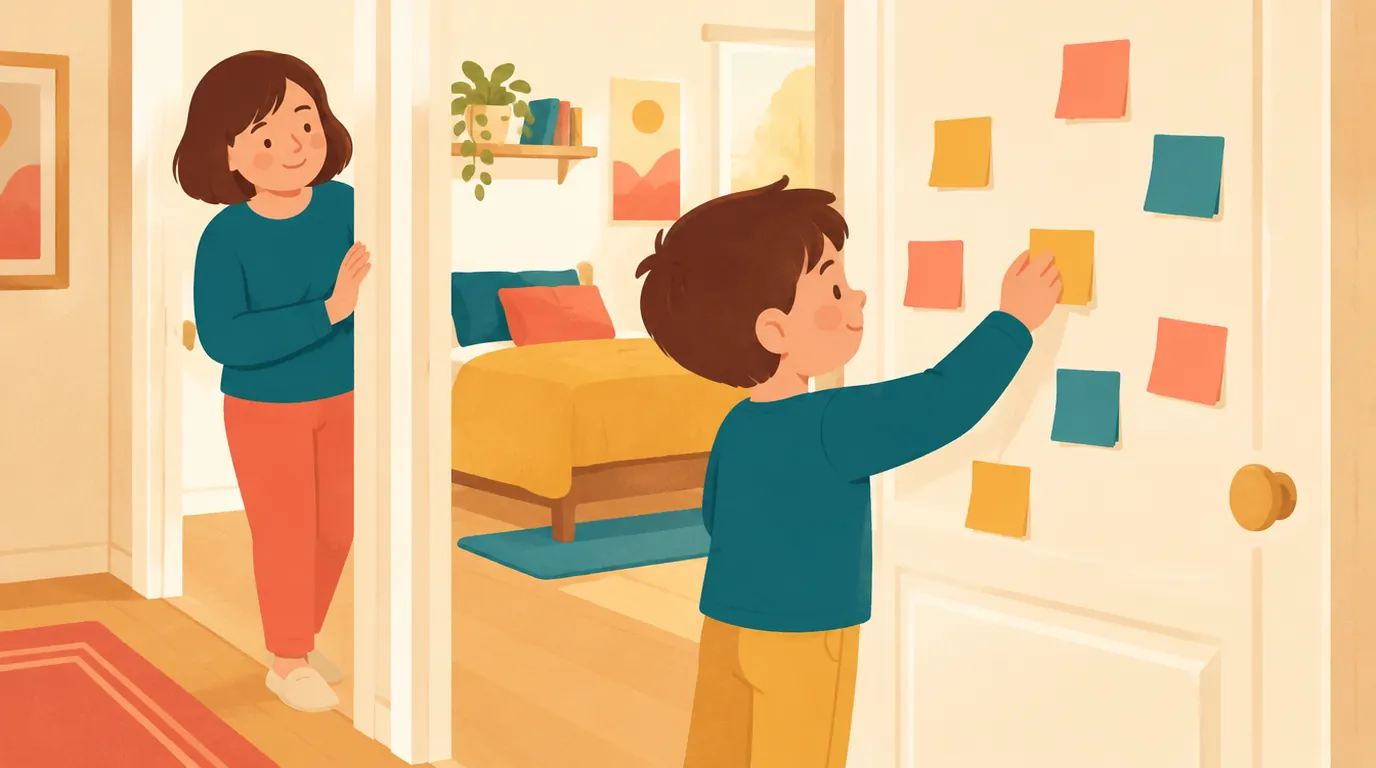
3. Post-its on the door
Write this week’s five words on colourful post-its and stick them at eye level on your child’s bedroom door. They’ll read them every time they pass. When a word is written correctly three days in a row, your child gets to remove it: seeing the door clear shows their progress better than any speech.
4. The pairs game
On cards, write the word on one side (beaucoup), and its memory trick on the other (beau + coup). Mix, turn over, and play like a memory game. Variation: one card has the word, the other a sentence with a gap (“Il pleut ______ en automne”).
5. Photograph the word
Your child looks at the word, spells it out loud, closes their eyes to ‘see’ it, then hides it and writes it down. Finally, they compare it letter by letter with the original. If there’s a mistake, start again. You’ll find more games in our guide to learning tricky French words.
6. The silly sentence
With the week’s five words, make up a funny sentence together: “Aujourd'hui, mon chat mange beaucoup, mais jamais dehors, et toujours trop vite.” The sillier it is, the better it sticks.
A typical week: ten minutes each evening
- Monday — discovery. Read the five words together, look for hidden words, and write the post-its.
- Tuesday — sorting. Play an endings game with the new words and a few old ones.
- Wednesday — pairs game. Play a quick round of memory, just one.
- Thursday — mini dictation. Three short sentences using the five words. Go through the corrections together, no stress.
- Friday — review. Words that are mastered come off the door; those that are still tricky stay for next week.
To mix things up on Thursday, try our printable CE2 exercises: rewriting the words in different sentences is the best way to check they're really learned. And remember to revisit old words now and then: a word learned in October can easily be forgotten by January if it's never seen again.
Common mix-ups to watch for in dictation
Some invariable words have a 'twin' that sounds the same. It's not about memory, but choosing the right word. Here are a few simple tests to help:
- ou / où: if you can say “ou bien”, it’s ou without the accent. Tu veux une pomme ou (bien) une poire ? Otherwise, it’s about a place: Où vas-tu ?
- mais / mes: if you can replace it with “tes”, it’s mes. Je range mes (tes) jouets. Otherwise, it’s mais, which shows contrast.
- près / prêt: prêt can become prête or prêts; près (meaning 'near') never changes. Elle est prête, elle habite près de l'école.
- à / a: if you can say “avait”, it’s the verb a. Il a (avait) un vélo. Otherwise, it’s à, which never changes: Il va à l'école.
These tests are exactly the ones your child will use all through primary school; our article on grammatical homophones brings them all together for the years ahead.
Remember the essentials: just a few words at a time, a clue for each, and short but regular revision sessions. After a few weeks, beaucoup and toujours will be words your child writes automatically, not ones they have to learn.
Want to put these tips into practice?
Every day, a new adventure workbook adapted to your child's school level — to print or do on screen. No commitment.
Your questions
How many invariable words should a child in CE2 know?
There’s no magic number: each teacher sets their own list, often linked to dictations. The most effective way is to learn a few words each week, regularly revising the old ones. It’s better to know twenty words really well than sixty only half-remembered.
My child knows the list by heart but still makes mistakes in dictation. Why?
Reciting a list and writing a word in the middle of a sentence are two different things. In dictation, your child is focused on meaning, agreements, and speed. Practise with short sentences using the week’s words, rather than just the list.
Does my child need to know if a word is an adverb or a preposition?
In CE2, the main goal is to spell these words correctly. The names of grammatical classes will come gradually. Knowing that an invariable word never changes is already a helpful guide.
Should we revise invariable words during the holidays?
A few minutes now and then is enough, as a game: a round of memory, or a silly sentence to write on a postcard. The idea isn’t to work, but to stop the words from being forgotten.
Read next
 Memory tricks & memorisation
Tricky words: the list from age 5 to 11 and 6 ways to remember them
Tricky words: the list by age from 5 to 11, the traps to highlight, and 6 simple ways to remember them…
 Memory tricks & memorisation
English verbs for kids: 7 tricks for tenses that really work
Verbs without tears: the -s of he/she/it, was or were, did or done, irregular verbs in sound families…
 Memory tricks & memorisation
How to remember history dates: timelines, stories and mental images
How to Remember History Dates without endless repetition: mental images, storytelling, the hallway timeline, and 12 key dates…