🍂 Autumn half-term: the perfect time to catch up on early gaps
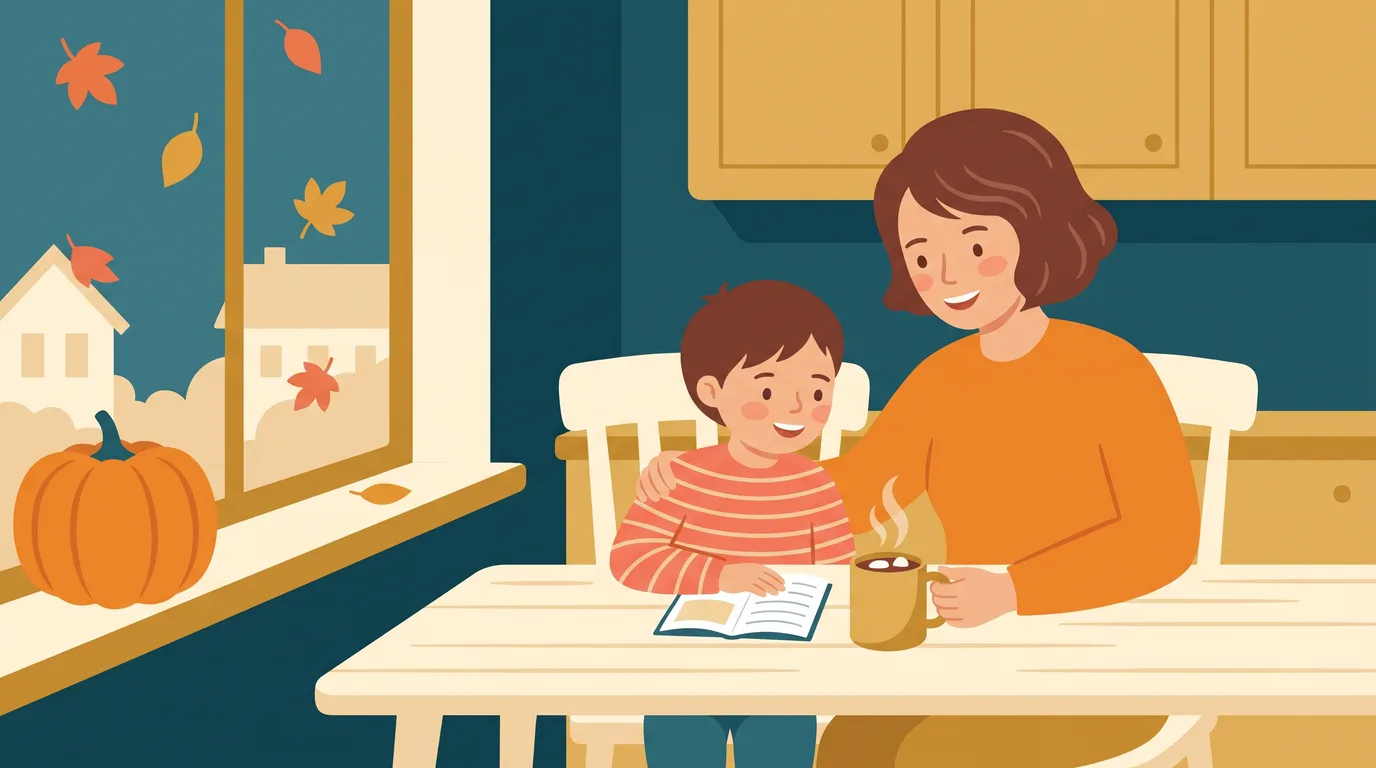
The autumn half-term is coming up quickly: in 2026, it runs from Saturday 17 October to Monday 2 November for all three zones. That’s just over two weeks after seven weeks of school. Your child is tired, and you may be wondering whether to get them to revise… or just let them rest.
The best answer: a bit of both. Half-term is the ideal time to fill in any early gaps, precisely because they’re still small. Just a few focused minutes are enough. Here’s how to do it, without turning the holidays into homework.
Why revise a little (not a lot) during autumn half-term
Since the start of term, the teacher has laid the foundations for the year: reading is becoming more fluent, numbers are getting bigger, and the first grammar rules are being introduced. If something isn’t understood, it becomes the base for the next topic. For example, mixing up tens and units in September can turn into a real problem with written calculations by December.
At half-term, these gaps are still small. They’re easy to spot and can be fixed in just a few sessions. Waiting until Christmas or February only lets them grow.
But tiredness is real, especially for younger children. The main aim of the holidays is still rest: sleep, free play, fresh air. So, revising during autumn half-term should be short, light and focused.
Step 1: review with the daily workbook
Before revising, you need to know what to revise. No need for a test: everything is already in the school bag.
- Look through the daily workbook together (or the maths and French books). Check the teacher’s corrections, repeated exercises, and comments.
- Ask your child: “What was easy? What did you find tricky?” Children often know exactly where they’re stuck.
- Read over the teacher’s comments in the communication book or report. If you met them at the start-of-year meeting, their feedback is a great starting point (see questions to ask the teacher).
Keep this review positive, highlighting what’s gone well first. It’s not a test—it’s a treasure map.

Step 2: pick just 2 or 3 topics, no more
This is the golden rule. Trying to cover everything will only bore your child and nothing will stick. Choose two or three specific points, for example:
- reading letter teams (sh, ee, oa) in CP (age 6-7);
- doubles and number bonds to 10 in CE1 (age 7-8);
- times tables from 2 to 5 in CE2 (age 8-9);
- subject-verb agreement or large numbers in CM1-CM2 (ages 9-11).
A clear topic can be worked on in a few minutes and checked easily. “Revise maths” is too vague. “Know number bonds to 10 without counting on fingers” is perfect.
Step 3: keep it light—15 to 20 minutes in the morning
In the morning, after breakfast, attention is best and the rest of the day is free. A short session is better than a long one: stop before your child loses focus.
| Level | Recommended time | How often | Session idea |
|---|---|---|---|
| CP | 10 to 15 min | 4 to 5 mornings a week | Read a short page aloud, syllable games |
| CE1 - CE2 | 15 min | 4 to 5 mornings a week | Mental maths, 5 spelling words, a short reading |
| CM1 - CM2 | 20 min | 4 to 5 mornings a week | A focused exercise, review a lesson with a memory tip |
These are just general guidelines—feel free to adjust them to suit your child. Make sure to leave some days completely free, especially at the start of the holidays and around 1 November.

Sample schedule: revising during the autumn half-term over 2 weeks
Here's an example to adapt to your family and any trips you might have:
- Arrival weekend: complete rest, plus a quick 10-minute look through the workbook.
- First week: 3 or 4 short mornings focusing on topic no. 1 (for example, making 10). Explain, practise, play.
- Mid-holiday: a complete break for a few days. Outings, family time, building a den with autumn leaves.
- Second week: 3 or 4 mornings on topics no. 2 and 3, plus a quick recap of topic no. 1 to check it's still there.
- Last weekend: tidy the school bag together and get bedtime routines back on track. No revision.
Going back over a topic a few days later helps it stick—much more effective than cramming everything at once.
Revising without it feeling like work: autumn games and activities
In primary school, lots of revision can be done through play and everyday life:
- In the kitchen: weigh out flour for a pumpkin cake, double a recipe, read the list of ingredients.
- On a walk: count conkers in groups of 10, make up riddles using words from the day.
- At home: a 5-word 'challenge' spelling test where your child marks their own work, or a times tables battle with a pack of cards.
- To remember a rule: a funny phrase or a picture works better than repetition. Our Big Book of Memory Tricks brings together these kinds of tips from CP to CM2.
What to avoid during the autumn half-term
- Long sessions 'to catch up': after 20 to 30 minutes, your child gets tired and starts to see the holidays as a chore.
- Getting ahead on the curriculum: that's not what holidays are for, and it can be confusing if the teacher's method is different.
- Revising late in the evening or just before an exciting outing: your child's attention won't be there.
- Comparing with a sibling or friend: everyone learns at their own pace.
If the same difficulty keeps coming up despite your efforts, just mention it to the teacher when school starts again. You might also find inspiration in our article on helping your child regain confidence at school.
An adventure activity book every morning, with no prep needed
No time to create your own exercises? Kidibook's 31-Day Adventure offers a themed activity book each morning, matched to your child's class, from Kindergarten to CM2. It's free, no subscription needed: all you need is a printer or a tablet—perfect for two weeks of holidays. Want to see what it's like first? Download the free PDF sample, no sign-up required.
Two weeks of rest, a few well-chosen mornings, and your child will return in November with stronger foundations. That's all you need from the autumn break.
📚 All free printable holiday activity books
→ See all levels on one page (Preschool → CM2)Want to put these tips into practice?
Every day, a new adventure workbook adapted to your child's school level — to print or do on screen. No commitment.
Your questions
Do you really need to make your child revise during the autumn half-term?
It's not compulsory. Rest comes first. But a few short sessions—10 to 20 minutes in the morning, on 2 or 3 topics spotted since September—can help fill small gaps before they become bigger.
When is the autumn half-term in 2026?
From Saturday, 17 October to Monday, 2 November 2026 (school resumes that day), with the same dates for zones A, B and C in mainland France.
How long should your child revise each day during the holidays in primary school?
Aim for about 10 to 15 minutes in CP, 15 minutes in CE1-CE2, and 20 minutes in CM1-CM2, four or five mornings a week. It's best to stop before your child gets bored and to keep some days completely free.
What should you focus on revising at half-term?
Focus on the topics your child finds tricky in their daily workbook and which are essential for the rest of the year: reading sounds in CP, mental maths and tables in CE, grammar and large numbers in CM. Two or three specific areas are enough.
Read next
 Activity books
How to choose the right activity book for your child, level by level (Kindergarten → CM2)
Level, length, answer keys: the 5 things to look for in an activity book that really suits your child, by level…
 Activity books
Free printable CP activity book: what to revise before CE1
A real free printable CP activity book, no email needed: what to revise before CE1 (reading, writing, maths) withou…
 Activity books
Free printable Kindergarten activity book: get ready for CP without pressure
Free printable Kindergarten activity book in PDF, no email needed: letters, sounds, numbers, handwriting… plus our tips for a smooth start to CP.