🦉 Free printable Grande Section summer workbook: prepare for CP without pressure
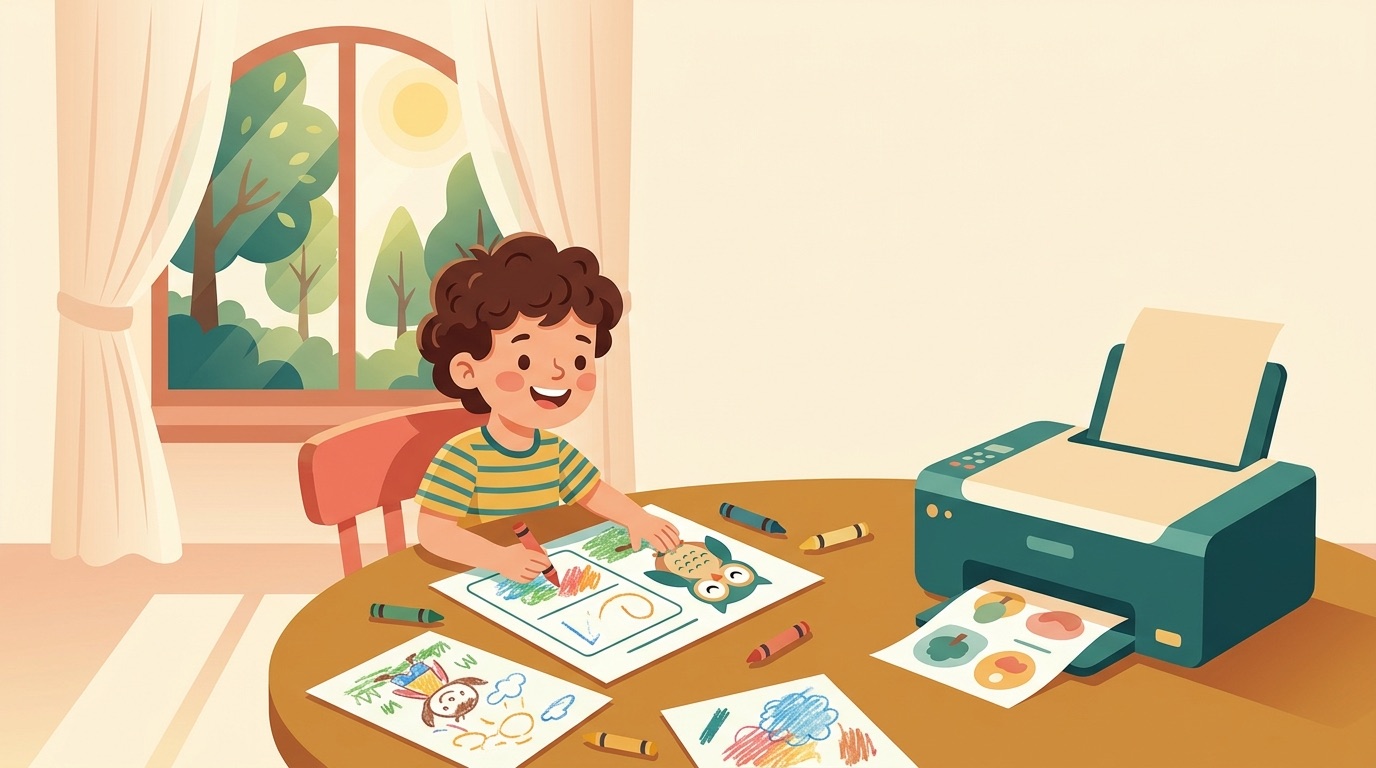
In one year, your child will know how to read. But today, they are finishing Grande Section (last year of kindergarten, age 5), they write their name in block letters, and the idea of "revising" this summer leaves you puzzled — revise what exactly, when they don't know how to read yet? Rest assured: between GS and CP, there is nothing to catch up on. There is just a new desire to learn, to protect and nurture. A free printable Grande Section summer workbook, ten minutes a day, lots of play: that's the whole program. We explain what to do (and especially what not to do), and where to download your workbook right now, no email address required.
In Grande Section, we don't revise: we give the taste for learning
Let's be clear: a 5-year-old child has no delay to catch up. Grande Section is the last year of kindergarten, and kindergarten teaches through play, manipulation, and speech. What CP will expect from them in September is not to know how to read — it is to hold their pencil, listen to instructions until the end, know their letters, and above all, to have the desire to learn.
The summer between Grande Section (last year of kindergarten, age 5-6) and CP (first year of elementary school, age 6-7) has a single goal: to maintain this curiosity. If "summer homework" turns into a battle, the child may associate school with constraint even before setting foot there. Conversely, ten joyful minutes around a successful tracing, a recognized letter, or a rhyme game build exactly what a future schoolchild needs: the pride of succeeding on their own.
What to work on between Grande Section and CP? The summary table
Five areas are enough — and all can be worked on through play, with or without a workbook:
| Area | Why it is valuable for CP | Example in 10 minutes |
|---|---|---|
| Graphics and tracing | Loops, bridges, and waves are the gestures of future cursive writing | A path of loops with a felt-tip pen, without lifting the hand |
| Letter recognition | Naming letters (uppercase, then script) prepares for decoding | Finding the letters of their first name on a cereal box |
| Sounds and syllables | Hearing that "bateau" is "ba-teau" is the key to reading | Clapping the syllables of family members' first names |
| Counting up to 10 | Counting real things, not just reciting the number sequence | Setting the table: "bring exactly 6 forks" |
| Fine motor skills | Strong and precise fingers are the real secret to beautiful handwriting | Cutting, stickers, bead necklaces, modeling clay |
You may have noticed: no reading, no written additions, no cursive writing lines in this table. This is not an omission — it is precisely the next point.
Should children learn to read before entering CP?
No. CP is precisely the year when children learn to read, with a method, a progression planned over months, and a trained teacher to guide them. Trying to get ahead by making a 5-year-old child who is not ready decode risks discouraging them — and making them approach September with a knot in their stomach instead of stars in their eyes.
What really helps the future reader is everything that happens around reading: recognizing and naming letters, playing with sounds (rhymes, syllables, "which word starts like 'moto'?"), enriching vocabulary… and listening to a story every evening. A child who has been read to a lot already knows, without knowing it, how a book works: they have a head start that cannot be bought.
And for what comes next? When your child finishes their CP year, our free printable CP summer workbook will take over: keep it as a favorite, it will be waiting for you next summer.
Concrete summer activities, area by area
Graphics: loops, bridges, and waves
The graphics of Grande Section are these friezes of loops, bridges, battlements, and waves that will become, in CP, the connected letters. Start big before going small: loops with chalk on the terrace, finger tracing in a tray of semolina, with a brush on a large sheet — then only with a felt-tip pen, and finally with a pencil. Take the opportunity to check the pencil grip: the "pinch" between thumb and index finger, the middle finger underneath. It is now that it can be corrected easily, not in CE2 (third year of elementary school, age 8-9).
Letters and sounds: play, don't recite
The first name is the best starting point: your child knows its letters by heart, look for them everywhere — license plates, signs, packaging. Then expand with a letter lotto or a tactile alphabet book. For sounds, everything is done by ear and with laughter: finding rhymes ("what rhymes with hat?"), clapping syllables, guessing the first sound of a word. Five minutes in the car is enough, with no materials.
Counting up to 10… for real
Many Grande Section children recite the number sequence very far, but reciting is not counting. What prepares CP math is counting : touching each object while saying only one number, and understanding that the last word said gives the quantity. Have them count real things up to 10: the steps of the staircase, cherries in the bowl, napkins to set. Add dice patterns (recognizing 5 without counting the dots) and small oral challenges: "There are 5 of us and 3 glasses. How many are missing?"
Fine motor skills: the secret to beautiful handwriting
This is the area that parents underestimate the most, and the one that first grade teachers look at first. Strong and precise fingers will make writing smooth and painless. Summer activities include cutting with scissors (fringes, then curved lines), placing stickers on a line, bead necklaces, modeling clay, hanging clothespins, buttoning buttons. Ten minutes of cutting is worth a page of forced writing.
How much time per day in Grande Section?
Ten to fifteen minutes maximum, in one session, and not necessarily every day: four or five mornings per week are more than enough. At 5 years old, voluntary attention is short, and this is physiological — forcing it to last longer does not train it, it exhausts it. The best time slot: in the morning, after breakfast, when the child is fresh and available.
The day it’s no, it’s no: put the page away without comment and try again tomorrow. A summer of Grande Section should first and foremost feel like a summer — including sand, bike rides, forts, and creative boredom. The morning page is a learning treat, never a toll before going to play.
A simple benchmark: the morning page lasts less time than a cartoon. And if your child can only manage five minutes at the beginning of July, be patient — this little endurance on a focused activity grows naturally over the summer, and it’s precisely this that the first grade teacher will appreciate in September.
Our free printable Grande Section summer workbook, no email required
To start as soon as tomorrow morning, download the free Kidibook summer workbook : a PDF to print at home, with one click, no registration, no email required, and no advertising. The pages are short, illustrated, and designed for children who cannot read yet: the adult reads the instructions aloud, the child does the rest — tracing, coloring, circling, counting.
The "printable" format is a blessing at this age: you only take out one sheet at a time. One single page, you finish it, sign it with your name in block letters, and display it on the fridge. A 60-page workbook, you look at it, sigh, and never open it. Print at the child’s pace, not the printer’s.
Bibou the owl: the world of Grande Section at Kidibook
At Kidibook, each class has its own universe and mascot. The world of Grande Section is watched over by Bibou the owl, who gently prepares the youngest for first grade: recognizing letters, listening to sounds, tracing loops and waves, counting up to 10, recognizing shapes. Everything is designed for a non-reading child — short instructions read by the adult, picture exercises, and a small victory on each page. The child does not "work": they meet Bibou.
If the formula is liked at home, the Kidibook subscription for Grande Section level delivers a new printable adventure workbook every day, for 7 €/month : enough to establish the morning ritual this summer, then support the entire upcoming first grade year. Prefer a beautiful ready-made workbook, no printer needed? The Grande Section summer workbook in paper version available at Kidibook Editions at 14,99 €, free shipping from €25 purchase. And to keep the momentum at the start of school, the ritual My Super Year offers a small daily challenge, with rewards, to keep the flame alive until June.
In summary: no lessons, no pressure, no forced reading. A free printable Grande Section summer workbook, ten minutes in the morning, scissors, rhymes and stories in the evening. A child who enters first grade eager to learn has already won everything — and no paid workbook can buy that, but a well-balanced summer builds it.
Want to put these tips into practice?
Every day, a new adventure workbook adapted to your child's school level — to print or do on screen. No commitment.
Your questions
My child cannot read yet: how to use a summer workbook in Grande Section?
It’s designed for that! A good Grande Section workbook never requires reading: the adult reads the instructions aloud, and the child traces, colors, circles, cuts, or counts. Stay beside them during the session — at 5 years old, the workbook is a shared activity, not independent work.
What should a child know by the end of Grande Section?
The usual end-of-Grande Section milestones: recognize and name most letters, write their first name in capital letters, clap the syllables of a word, count a small collection up to 10, and hold their pencil correctly. Each child progresses at their own pace: a weak point in June can be well consolidated over the summer and early first grade.
How much time per day on a summer workbook in Grande Section?
Ten to fifteen minutes maximum, in one session, preferably in the morning — and four or five days per week are enough. At this age, it’s better to stop while the child is still having fun: regularity and pleasure matter much more than quantity.
Should I teach my child to read before first grade?
No. Reading is learned in first grade, with a method and a teacher. What really helps before: playing with sounds and rhymes, recognizing letters, listening to stories every day, and developing fine motor skills. A curious child comfortable with sounds will learn to read calmly.
Is the Kidibook Grande Section summer workbook really free?
Yes: the free workbook downloads as a PDF with one click, no email or registration, and prints at home. The €7/month subscription (a new adventure workbook each day with Bibou) and the €14.99 paper workbook exist as extras, but they are entirely optional.
To read next
 Holiday workbooks
Holiday workbook: how to choose well, grade by grade (GS → CM2)
Level, duration, answer keys: the 5 criteria to choose a holiday workbook really adapted to your child, grade by g...
 Holiday workbooks
Free printable CP holiday workbook: what to review before CE1
A real free printable CP holiday workbook, no email required: what to review before CE1 (reading, writing, calculation) without...
 Holiday workbooks
Free printable CM2 summer workbook: preparing for entry into 6th grade
A free printable CM2 (5th grade) summer workbook, no email required, to prepare for 6th grade: fractions, conjugation, writing…