🌱 Helping your child regain confidence at school: where to start?

“I’m rubbish.” The words come out during homework or after school. You want to reassure your child straight away. To help your child regain confidence at school, start simply: listen to what happened, pinpoint a specific difficulty, and look for a small next step together. There’s no need to deny the problem or turn every evening into a catch-up session.
Helping your child regain confidence at school: start by listening
“You seem disappointed. What was tricky today?” This question lets your child explain in their own words. A comment from a classmate, a confusing instruction, or an unfinished exercise don’t all need the same response. Try not to jump to conclusions about lack of effort, tiredness, or the class itself.
You can reassure them about one thing without dismissing their feelings: “That exercise was tough, but it doesn’t define you.” If they don’t want to talk, suggest coming back to it later. There’s no need to get a full explanation the moment they drop their bag.
Try rephrasing: “You knew how to start, then got stuck at this step, is that right?” This helps check you’ve understood. The conversation is about a situation, not a label like “bad at maths” or “not academic”.
Moving from “I’m rubbish” to a specific difficulty
Pick just one recent example, with your child’s agreement. Ask them to show what they already understand, then where they get stuck. For an instruction, it might be an unfamiliar word. For reading, an unrecognised sound. For a problem, the difficulty might come before the calculation: knowing what you’re looking for.
Describe what you notice: “You found the information, but we’re not sure yet which operation to use.” This is more helpful than “See, it’s easy!” Something obvious to you may still be hard for them. Don’t compare their speed to a sibling or classmate.
Pick a small goal to build confidence
“Get better at French” is too broad for tonight’s session. Choose a short action linked to what’s been set in class. The goal should be something your child can explain and that matches what they already know. One is enough; you can discuss it with the teacher if it’s still out of reach.
| Goal too general | Goal to try | What you can observe |
|---|---|---|
| “Improve your dictation.” | Pick two words from the class list and explain what makes them tricky. | Your child spots the letters they’re unsure about. |
| “Read better.” | Read a few lines at their level, with help on any tricky words. | You identify a word or sound to practise. |
| “Pay attention in maths.” | In a problem, rephrase the question before calculating. | Your child says what they’re looking for, even if they still need help. |
| “Be independent.” | Get materials ready for a task, then ask for help with a specific step. | You can see what they do alone and what needs support. |
These examples aren’t a must-do list. Choose what really matches your child’s work. If they hit a barrier, break the step down or ask how to tackle it in class. Repeating the same task for longer isn’t the only way.
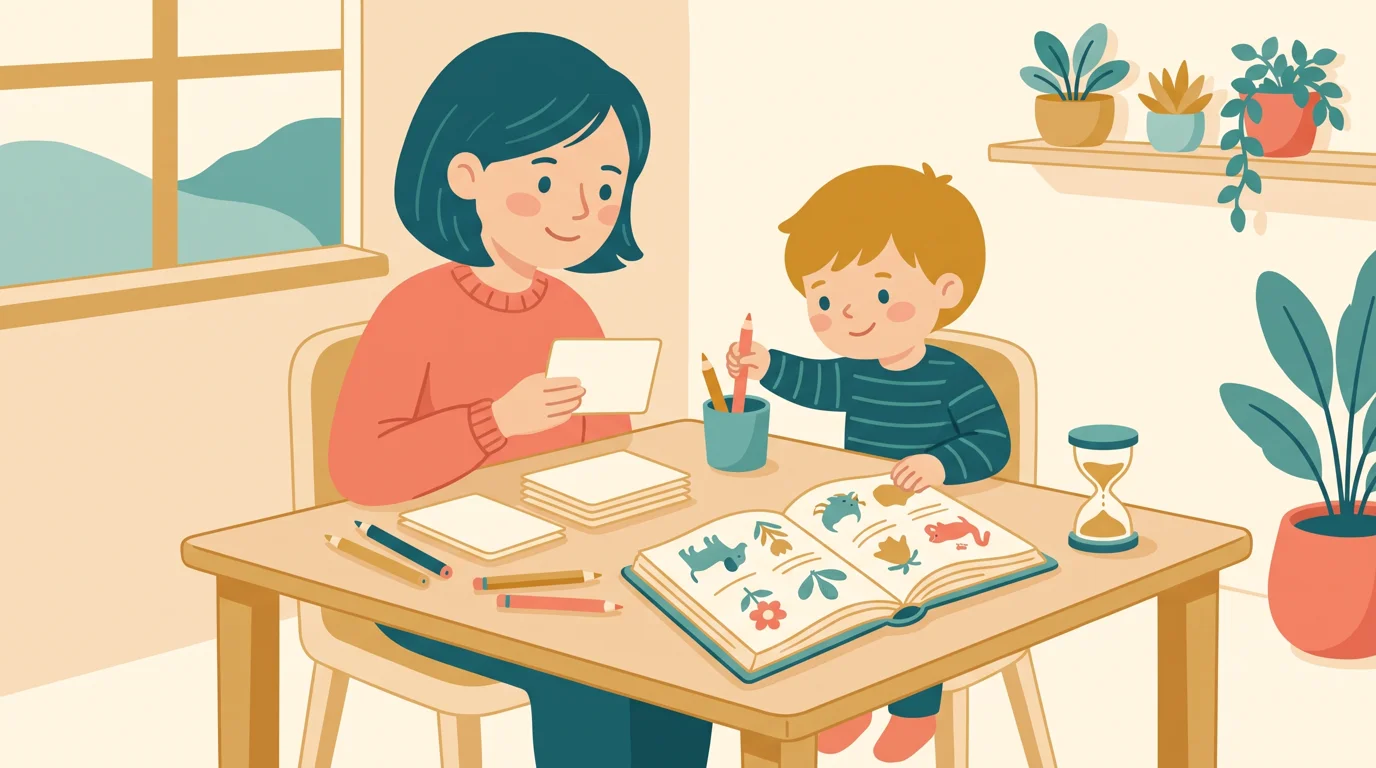
Encourage what’s changed, not just the result
Instead of “Well done, you’re a genius!”, you could say: “You reread the question before starting” or “You spotted your mistake and fixed it.” Encouragement describes a real action. It still counts even if the whole exercise isn’t finished.
Acknowledge the effort even if it wasn’t enough: “You tried this method, but this part is still tricky. Let’s see how to ask for help.” Praising doesn’t mean pretending everything went perfectly. You can be warm and specific at the same time.
Keep a simple record: a sentence read more easily or an instruction better understood. Avoid turning it into a family ranking. Your child’s progress is best compared to what they did before, not to others.
Adjust how you work without making the evening longer
Ask how your child goes about things, without grilling them. Do they just reread the lesson? Try to explain it? Understand the instructions? From there, you can try a small tweak that fits with how things are done in class.
For example, after rereading a short passage, suggest they tell you what they remember, then check together. For an exercise, have them explain the first step instead of giving the answer straight away. If they’re stuck, go back to the example in their book or write down the question for the teacher.
Don’t let this help turn into a never-ending session. Our guide on homework time in primary school can help you observe and prepare for a chat. If refusal is a big issue, the guide my child doesn’t want to do homework offers other starting points.
Working together with the teacher
Come with facts: your child’s own words, an example exercise, and what you’ve already tried. Ask: “What do you notice in class? What should we focus on first? How can I help without doing it for them?” You’re looking for a shared approach, not a complete answer in one meeting.
If possible, agree on a small goal and a time to talk about it again. If the difficulties continue, ask what support might be available at school. Don’t try to make your own diagnosis. If you’re really worried, it’s worth talking to a suitable professional, rather than waiting until you’ve tried every possible tip.

Make space for things outside school
Shared time doesn’t have to become a lesson: cooking, drawing, making things or reading for fun can simply be enjoyable activities, with no pressure to perform. Your child can love something without having to be especially good at it.
When you plan the evening, make sure to include time to rest and wind down. If stopping a video makes it hard to move on to something else, you’ll find ideas in our article on setting screen time boundaries. There’s no need for a perfect schedule: start with a manageable change, then see together what difference it makes.
Want to put these tips into practice?
Every day, a new adventure workbook adapted to your child's school level — to print or do on screen. No commitment.
Your questions
What should I say when my child says, “I’m rubbish”?
Ask what was difficult and listen to their example. You can acknowledge their disappointment without accepting the label: this exercise doesn’t define them. Come back to the conversation later if they don’t want to talk straight away.
Should I add extra exercises to boost their confidence?
Not automatically. Start by understanding what’s getting in the way and what the class is focusing on. A short, suitable goal may be enough for the session; ask the teacher for advice if the work still feels out of reach.
How can I encourage my child without ignoring mistakes?
Describe something real they did: rereading the instructions, asking for help, correcting a step. You can recognise their effort and calmly point out what still needs to be understood.
When should I ask the school for help?
You can bring it up as soon as you’re concerned. Give clear examples and ask what’s been noticed in class. If the difficulties continue, discuss what support is possible, without trying to make your own diagnosis.
Next up
 Parent guide
The ‘summer slide’: why your child forgets, and what to do
Losing skills over the school holidays isn’t inevitable: here’s how to avoid it in just 10 minutes a day…
 Parent guide
“My child is bored in the holidays”: what to do (without guilt)
My child is bored in the holidays: why boredom is actually healthy, a box of anti-boredom ideas and a simple ritual…
 Parent guide
Back-to-school budget: saving money without making it hard for your child
Back-to-school budget: sorting supplies, second-hand bags, CAF support — practical tips to pay less without stress…