🏰 Free printable CM2 summer workbook: preparing for entry into 6th grade
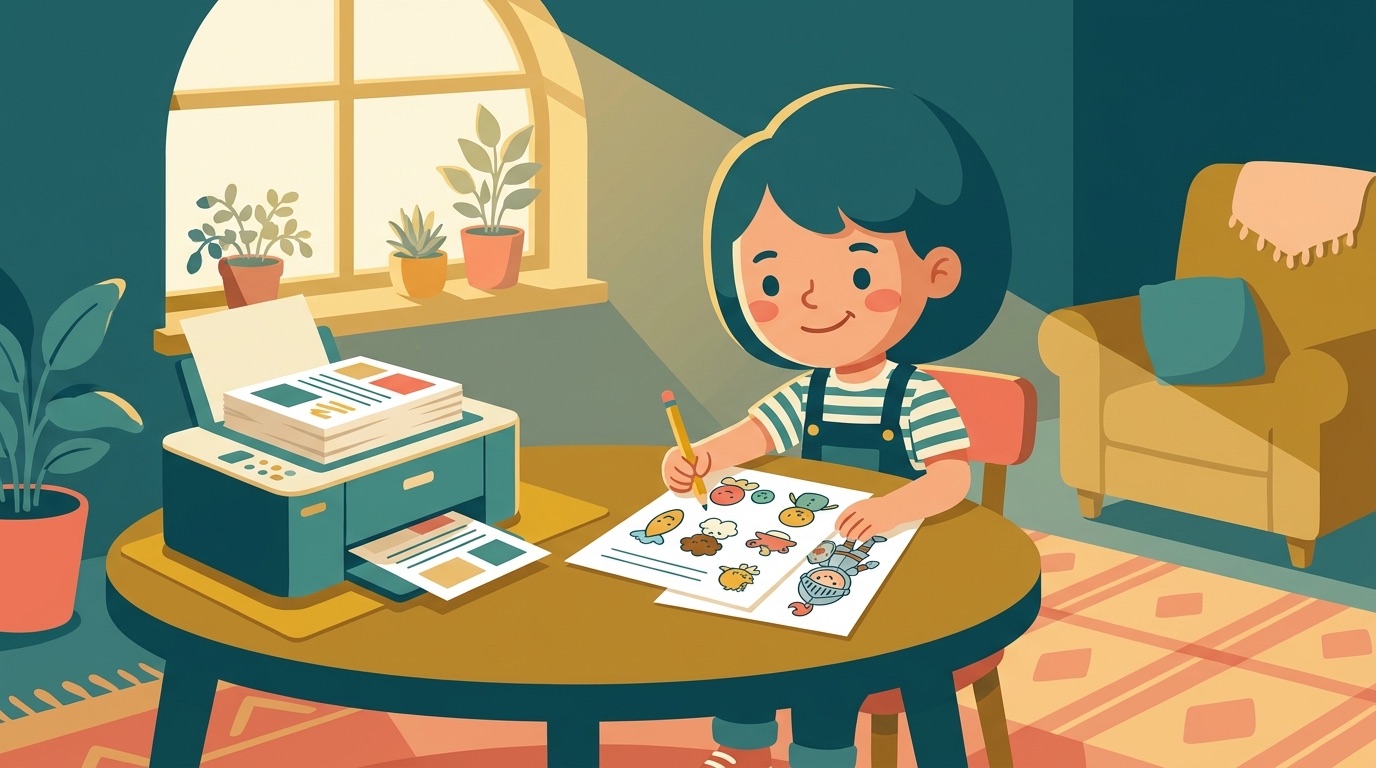
There are ordinary summers, and then there is this one. In September, your child will not return to the playground of "their" school: they will cross the gate of middle school, with a schedule, a locker, and about ten teachers. This last summer before 6th grade has a special flavor — a bit of pride, a twinge of nostalgia, and this question running through every parent's mind: "Are they ready?" Good news: no need for intensive courses or expensive big workbooks. A free printable CM2 summer workbook, twenty minutes each morning and some organizational habits are enough to prepare for entry into 6th grade — while still keeping real holidays.
Where to download a free printable CM2 summer workbook?
Let's start with the promise of the title. At Kidibook, the principle is simple: you download the free holiday workbook in one click, in PDF format, without leaving an email address or creating an account. You print it at home, page by page, at your child's pace.
This printable format has a decisive advantage in CM2: it allows you to target. At 10-11 years old, there is no need to redo the entire year's program. Print the pages that correspond to still fragile concepts — often fractions or the passé simple — and skip cheerfully what is already solid. To refine your choice of material, our guide how to choose a summer workbook adapted to your child reviews the criteria that really matter.
What to revise in CM2 to approach 6th grade calmly?
Let's reassure first: 6th grade teachers know very well that they welcome students coming from primary school, and the first weeks of middle school are precisely for consolidation. But they rely on fundamentals that CM2 is supposed to have established. These are — and only these — worth maintaining this summer.
In math: fractions, decimals and proportionality
Three CM2 concepts come back again and again in 6th grade. The fractions and decimal numbers first: knowing that 1/2 and 0.5 are the same number, placing 3.25 on a number line, comparing 2.7 and 2.58 without being tricked. The proportionality next: "if 3 baguettes cost €3.60, how much do 5 baguettes cost?" — the classic problem that structures a large part of middle school math. And of course the four basic operations with written calculations, division included, with multiplication tables recited without hesitation: in middle school (ages 11-12), they are used every day and no one will take the time to review them anymore.
In French: complete conjugation and agreements
In 6e (first year of middle school, age 11-12), the conjugation becomes a tool that one is supposed to master: present, future, imperfect, past tense, and the passé simple at least in the third person — the tense of all novels. Summer is perfect to review one tense per week, gently. Add the agreements subject-verb and within the noun phrase, as well as common homophones (a/à, et/est, on/ont), and you cover the essentials of what causes point loss in dictation at middle school. A short dictation of three sentences, twice a week, is enough to keep the skill. For endings that resist, pick from our essential mnemonic devices : a clever trick is worth ten repetitions.
Long reading and writing: the hidden muscles of 6e
This is the big silent change in middle school: no longer reading excerpts, but entire works. The best summer training is therefore not one more worksheet, but a real novel, chosen by the child, read chapter by chapter — reading endurance is built like running endurance. On the writing side, 6e requires writing : complete sentences, with capital letters, periods, and a minimum of organization. A holiday journal, three postcards to grandparents, or a summary of the previous chapter work perfectly.
The last summer's program, week by week
Here is a realistic schedule for a child finishing CM2 (last year of elementary school, age 10-11): first relax, then maintain skills, and prepare for middle school at the very end. If you fear that two months without school will erase the year, our article on the "summer slide" explains why a few minutes a day are enough to avoid it.
| Period | Goal | The 20 minutes in the morning |
|---|---|---|
| Early July | Real break | Nothing mandatory. Choose the summer novel at the bookstore or library. |
| Mid-July | Gentle restart | 10 minutes reading the novel + multiplication tables in a timed challenge. |
| End of July | Morning ritual | One notebook page with Gauvain: fractions, decimals, conjugation. |
| Early August | Sensitive points | Proportionality in cooking, written postcard, short dictation. |
| Mid-August | Heading towards middle school | A notebook page + an organizational action (planner, bag, alarm clock). |
| End of August | A calm back-to-school | Sleep schedule adjusted, middle school route identified, backpack prepared independently. |
How to prepare for middle school organization and autonomy?
Let's be frank: what unsettles a 6th grader in September is almost never the academic level. It's theorganization. About ten teachers instead of a single teacher, a different classroom every hour, a planner to keep, a locker to manage, a bag to prepare each evening according to the next day's schedule. All of this is learned — and summer is the ideal training ground, with no pressure or report cards.
- Keeping a summer planner : outings, training sessions, notebook days. The reflex “I write it down so I don't forget” is THE number one skill for a middle schooler.
- Preparing the bag the night before for swimming or a picnic, without a checklist dictated by an adult.
- Reading a timetable : tides, trains, cinema sessions — the 6th grade schedule is nothing more than a two-way table.
- Waking up with your own alarm clock one week before school starts, so autonomy is not discovered on the first day.
- Identifying the middle school route together, then doing it again “as if”: it's amazing how ten minutes of repeated walking removes anxiety.
For the “learning to learn” part, Le Grand Livre des Pense-Bêtes is full of memorization tips that will be useful from the first lessons: mnemonic devices for tables, dates, spelling rules. And for children (and parents!) who like to know where they stand, the Grand Manuel de Sixième (€22.99) from our middle school textbook collection gathers the entire 6th grade program in a single volume to browse calmly — the best antidote to fantasies about “middle school is hard.”
The Kidibook CM2 summer workbook: the last quest of the Château world
A workbook is only useful if the child wants to open it — and at 10 years old, the level of expectation has risen. That’s why Kidibook’s CM2 level is experienced as a knightly adventure : heading to the Château world, alongside Gauvain, the little knight of the workbooks. Fractions assembled like ramparts, coded messages to conjugate, dungeon maps in proportionality: your child is not “reviewing,” they are finishing the quest started years earlier, from the Ocean world in CP (around 6 years old) to the Château in CM2 (around 10 years old). Ending primary school beautifully, literally.
If the formula is liked, the Kidibook CM2 subscription (€7/month, no commitment) delivers a new adventure workbook to print every day: enough to keep the morning ritual all summer, then all year. Prefer ready-made paper? The printed version of the CM2 summer workbook (€14.99) arrives bound at home — and ordered with the Grand Manuel de Sixième, the free shipping from €25.
And after the summer? To build on your progress starting in September, My Super Year extend the morning ritual into a daily challenge throughout the school year — the ideal companion for a well-started 6th grade.
This last summer as a schoolchild won't come back: enjoy it. Print the first page of the free CM2 summer workbook tomorrow morning, place it next to the cereal bowl, and let Gauvain lead the final quest. In September, your child will enter middle school with solid fundamentals, a planner already tamed — and you, with the quiet certainty of having prepared for 6th grade without sacrificing the holidays.
Want to put these tips into practice?
Every day, a new adventure workbook adapted to your child's school level — to print or do on screen. No commitment.
Your questions
Is my child ready for 6th grade?
In the vast majority of cases, yes. If they read fluently (including long texts), know their multiplication tables, can perform the four operations, and write complete sentences, they have the expected skills. 6th grade is designed as a year of consolidation: teachers know how to welcome students coming from primary school. If a significant difficulty remains, especially in reading, discuss it with the CM2 teacher before summer or the homeroom teacher in September.
Is the Kidibook CM2 summer workbook really free?
Yes: the free workbook downloads as a PDF in one click, with no email or credit card required. You print it at home, page by page. The subscription (7 €/month, one adventure workbook per day) and the bound paper workbook (14.99 €) exist but are entirely optional.
What should a student know by the end of CM2?
By the end of CM2 (typically for children aged 10-11), a student reads long texts fluently, conjugates common tenses (present, future, imperfect, past perfect, simple past in third person), applies main agreements, performs the four operations, handles simple fractions and decimals, and solves initial proportionality problems. They also begin to organize themselves independently: this autonomy is what 6th grade will require.
How much time per day to review during summer before 6th grade?
Twenty to thirty minutes in the morning, four or five days a week, is more than enough — provided it is regular. Keep a real break at the start of July: rest is part of preparation. Better one page of workbook and ten minutes of reading each morning than a big catch-up session at the end of August.
Should you get ahead of the 6th grade program?
No, and it is even counterproductive: a child who crams during summer arrives tired and then gets bored in class. 6th grade teachers review the basics before moving forward. Consolidating CM2 skills pays off much more than anticipating. However, browsing a 6th grade textbook to get an idea and reduce anxiety, without memorizing anything, is an excellent idea.
To read next
 Holiday workbooks
Holiday workbook: how to choose well, grade by grade (GS → CM2)
Level, duration, answer keys: the 5 criteria to choose a holiday workbook really adapted to your child, grade by g...
 Holiday workbooks
Free printable CP holiday workbook: what to review before CE1
A real free printable CP holiday workbook, no email required: what to review before CE1 (reading, writing, calculation) without...
 Holiday workbooks
Free printable Grande Section holiday workbook: prepare for CP without pressure
A real free printable Grande Section holiday workbook, no email required: handwriting, letters, sounds, counting up to 10...