🌊 Free printable CP summer workbook: what to review before CE1
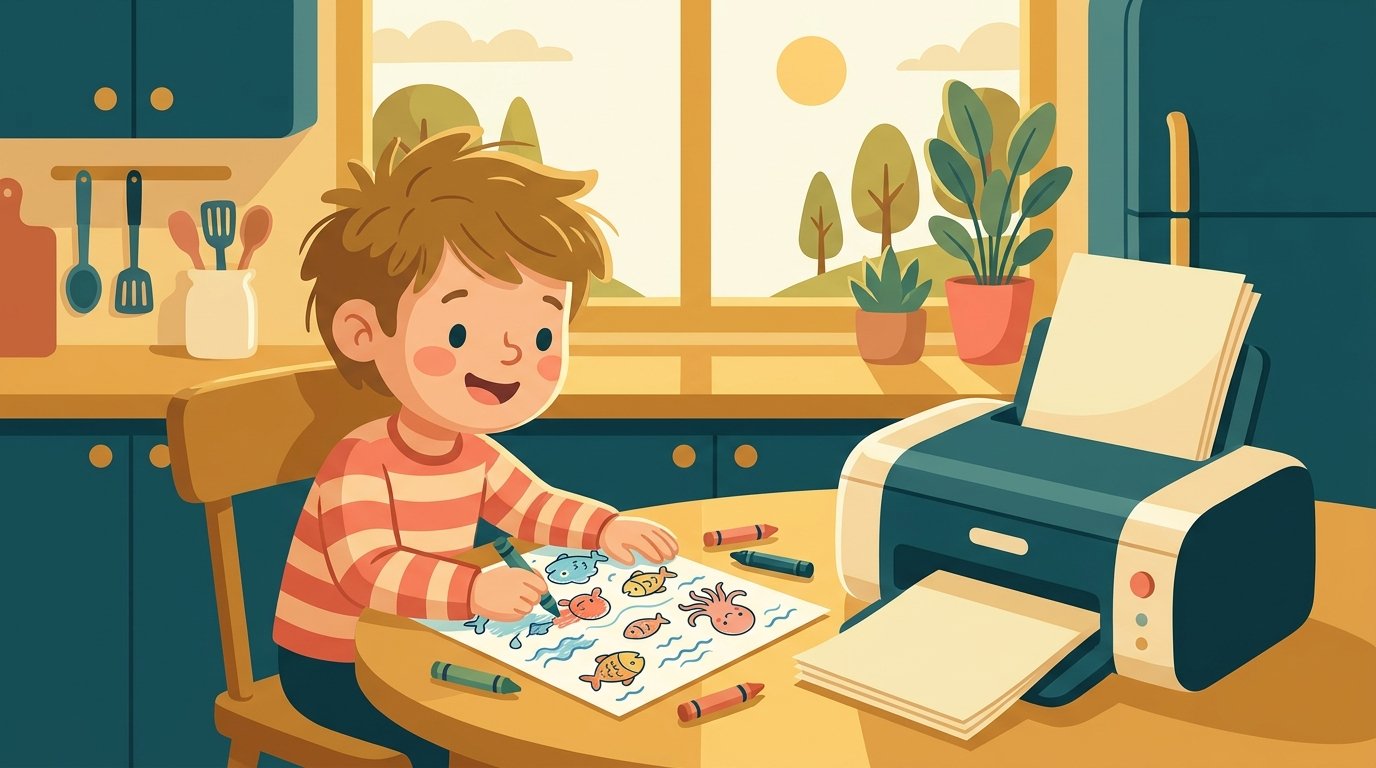
Your child is finishing their year of CP (6-7 years old) and you are looking for something to keep them smartly occupied this summer, without breaking your budget or your patience? Good news: no need to buy the big supermarket workbook. You can print a free CP summer workbook at home, page by page, and only use what your child really needs. Here we explain what to review before CE1, how much time to spend, and where to download a free workbook right now — no email address required.
Where to download a free printable CP summer workbook
Most of the “free workbooks” on the web are not really free: they require registration, an email, sometimes a credit card “for verification.” At Kidibook, the principle is simple: you download the free holiday workbook download it in one click, in PDF format, and print it on your home printer. Zero forms, zero advertising.
The advantage of the printable format is flexibility: one page per morning is enough. You print as you go, the child is not discouraged by an 80-page block, and you don’t waste paper on exercises already mastered. To choose your support well, we gathered all our advice in the guide how to choose a summer workbook adapted to your child.
What to review with a CP summer workbook before CE1
CP (Cours Préparatoire) is the year of all major learnings: reading, writing, counting. Before entering CE1 (Cours Élémentaire 1, typically for children aged 7), three areas deserve gentle maintenance during summer.
Reading: consolidate complex sounds and fluency
By the end of CP, your child normally can decode alone words and short sentences. Summer is for not losing this fresh skill. Two points to watch out for: complex sounds (ou, on, an, in, oi, ch, gn, eau…) which sometimes remain fragile, and the fluency, that is to say reading faster and faster without stumbling. The unbeatable recipe is: 5 minutes of reading aloud per day, from a picture book the child likes.
Writing: maintaining the cursive gesture
CP is also the year ofcursive writing (joined letters). Without practice, the gesture rusts quickly. A few lines of copying, a small postcard to grandparents, a shopping list copied: that is enough to keep handwriting legible for the new school year.
Math: numbers up to 100 and additions
In math, a student at the end of CP can count, read and write numbers up to 100, do small additions, and above all mobilize two precious reflexes: the complements to 10 (7 + 3, 6 + 4…) and the doubles. These automatisms are the foundation for CE1 and the multiplication tables to come. Like a sports reflex, it is maintained in small doses.

How much time per day on a CP holiday workbook
At 6 or 7 years old, attention span is short: no need to aim for half an hour. The golden rule is regularity rather than duration. Ten to fifteen minutes each morning, at the same time, is much better than an hour imposed on Sunday evening in tears.
And don't forget the essential: summer is first and foremost for resting, playing and getting a little bored. A holiday workbook is a maintenance, not catch-up. If you want to explore the subject of the right dosage, we discuss it in detail in our article on the “summer slide” and the 10 minutes that are enough.
The free printable CP holiday workbook Kidibook: focus on the Ocean world
A workbook is only useful if the child wants to open it. This is the whole logic of Kidibook workbooks: each level becomes an adventure. In CP, head to the Ocean world, guided by Plouf, the little mascot of the seabed. Reading, writing and math exercises turn into underwater missions — counting bubbles, reading the logbook, helping Plouf find his treasure.
This red thread changes everything for a 6-year-old child: they are not “doing their revisions,” they continue their story. If the formula is liked, the Kidibook subscription offers each day a new adventure workbook adapted to their class, from GS to CM2. And to help children whose reading remains hesitant, our 1950s style syllabic reading manual reviews the sounds step by step, the old-fashioned way.

The summer program, week by week
Here is a realistic schedule for a child finishing CP (Cours Préparatoire, ages 6-7). The idea: relax first, maintain skills next, prepare for CE1 (Cours Élémentaire 1, ages 7-8) at the very end.
| Period | Goal | The 10-15 minutes in the morning |
|---|---|---|
| Early July | Relaxation | Nothing mandatory. Pleasure reading in the evening, if the desire is there. |
| Mid-July | Gentle restart | 5 minutes of reading aloud + a complements to 10 game. |
| End of July | Establish the ritual | One workbook page every morning, with Plouf and the Ocean World. |
| Mid-August | Automatic skills | Additions and doubles, then timed re-reading of a sentence. |
| End of August | Heading towards CE1 | One workbook page, a few lines of handwriting, bedtime postponed. |
In summary: a free printable CP summer workbook costs nothing, fits in a cardboard folder and is more than enough to keep skills warm. Print the first page tomorrow morning, set a timer on the breakfast table, and let Plouf do the rest. At the start of school, your child will approach CE1 with confidence — and you will have kept the summer light.
Want to put these tips into practice?
Every day, a new adventure workbook adapted to your child's school level — to print or do on screen. No commitment.
Your questions
Is the Kidibook CP summer workbook really free?
Yes, the free summer workbook can be downloaded as a PDF in one click, with no email or credit card required. You print it at home, page by page. The Kidibook subscription is paid and offers a new adventure workbook every day, but it is not necessary to enjoy the free workbook.
What should a child know how to do at the end of CP?
At the end of CP (ages 6-7), a child generally can decode short sentences alone, read complex sounds (ou, on, an, ch, oi…), write in cursive, and count up to 100 by doing small additions. Complements to 10 and doubles are key automatic skills to maintain before CE1.
How much time per day should a CP child revise in summer?
Ten to fifteen minutes per day is more than enough at this age, provided it is regular. Better a small page each morning than a long session once a week. And always leave a few days of real break at the start of summer: rest is also part of learning.
Should a CP child do a summer workbook every day?
No, it is not mandatory. You can alternate a workbook page with reading aloud, a calculation game with dominoes, or even cooking (counting eggs, weighing flour). The important thing is to keep a short and regular rhythm, without making it a chore.
To read next
 Holiday workbooks
Holiday workbook: how to choose well, grade by grade (GS → CM2)
Level, duration, answer keys: the 5 criteria to choose a holiday workbook really adapted to your child, grade by g...
 Holiday workbooks
Free printable Grande Section holiday workbook: prepare for CP without pressure
A real free printable Grande Section holiday workbook, no email required: handwriting, letters, sounds, counting up to 10...
 Holiday workbooks
Free printable CM2 summer workbook: preparing for entry into 6th grade
A free printable CM2 (5th grade) summer workbook, no email required, to prepare for 6th grade: fractions, conjugation, writing…