🦁 Free CE1 summer workbook to print: heading towards CE2
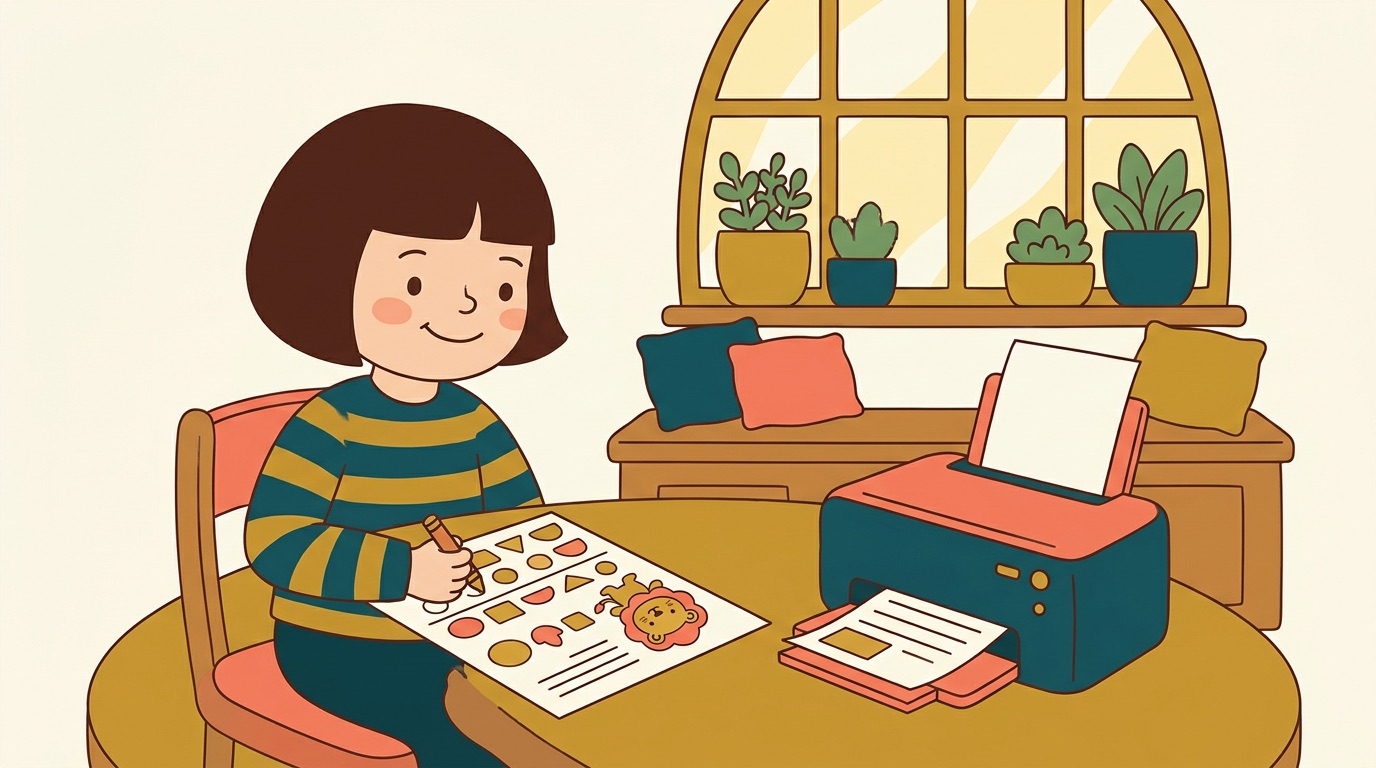
The year of . is ending, and what a year: your child has done their first written calculations, conjugated their first verbs in the present tense, discovered multiplication… and their reading has finally become fluent — or almost. So, when packing the suitcases, a question arises: how to keep all this fresh until CE2, without turning the campsite into a classroom? Good news: a free CE1 summer workbook to print is more than enough — and we offer you one, downloadable in one click, without giving your email address. In this guide: what a child really needs to retain from their CE1 year, concrete activities for each area, and why reading deserves, that summer more than any other, a little fifteen minutes daily.
What should a child retain from their CE1 year?
CE1 is not just a repeat of CP: it is the year when major learning consolidates and new projects begin. Here, area by area, is what your child takes in their schoolbag — and the summer priority for each.
| Area | Mastered by the end of CE1 | Summer priority |
|---|---|---|
| Reading | Read a short text fluently, understand instructions alone | Fluency: read a little aloud every day |
| Conjugation | Present tense of -er verbs, être and avoir | The “verb of the day,” two minutes at dinner |
| Spelling | Plural in -s, first agreements within the noun phrase | A quick dictation sentence per day |
| Calculation | Written additions and subtractions with carrying, numbers up to 999 | One written operation per day, on real material |
| Multiplication | The meaning of multiplication and the 2 times table (often 5 and 10) | Counting by 2 everywhere: pairs, wheels, flip-flops… |
| Measurements | Money, telling time | Paying with real coins, reading the departure time for the beach |
If your child has just finished CP (Cours Préparatoire, ages 6-7) and is heading to CE1 (Cours Élémentaire 1, ages 7-8) in September, this is not the right article: instead, go read our guide for free printable CP summer workbook, designed to review complex sounds and complements to 10.
Why the “summer slide” mainly threatens struggling readers
Every September, CE2 (Cours Élémentaire 2, ages 8-9) teachers notice: some students come back as they left, others have lost part of their skills over the summer. Anglo-Saxon studies have measured this phenomenon for a long time — it’s the famous “summer slide”, which we detail in our article on loss of skills during vacations.
What is less said is that it doesn’t affect everyone the same way. A child whose reading is fluent keeps reading without noticing: highway signs, restaurant menus, comic book bubbles. A still struggling readeravoids what costs effort: they don’t read anything all summer, and it’s precisely they who fall behind. Between CE1 and CE2, the gap silently widens. The solution is not heroic: fifteen minutes a day, well chosen, is enough to keep the engine running.

CE1 revisions, domain by domain (without a blackboard)
Forget the classroom recreated in the kitchen. Here’s how to maintain each CE1 skill with what summer provides.
Reading: aim for fluency, not quantity
The fluency — reading quickly, without stumbling, with expression — is THE big project between CP and CE2; teachers use benchmarks around 70 words per minute at the end of CE1. The most effective technique is also the simplest: repeated reading. Choose a short text, the child reads it aloud three days in a row, stopwatch in hand, and watches their score climb. They only compare to themselves — and love beating their record. Add paired reading (one paragraph each), dialogues acted out with character voices, and remember that a comic book, a recipe, or board game rules count as much as a “real” book.
Conjugation: mastering the present tense
CE1 is the first real year of conjugation: the present tense of -er verbs, d'être andavoir. These brand-new endings fade quickly if never used. Two painless rituals: the dinner verb (“tonight, verb chanter: je chante, tu chantes…” — each person, one minute timed) and the pronoun dice (1 = je, 2 = tu, 3 = il… the child conjugates the verb drawn). Finally, postcards to grandparents remain the best disguised lesson: “nous visitons, il pleut, je me baigne” — three verbs in the present, one stamp, zero protest.
Written calculation: don’t let the carry slip away
Setting up an addition or a subtraction with borrowing, it is a precision mechanism learned this year — and it is exactly the kind of technique that rusts in eight weeks. No need to line up pages of operations: just one per day, carefully set, is enough. Vary the supports: add two items from the receipt, count the scores in pétanque, check the points in the board game. And bring out the change, a great discovery in CE1 (7-8 years old): paying for bread with real coins and checking what you get back on 5 €, these are subtractions that don’t say their name.
Multiplication: the 2 times table as a playground
In CE1 (7-8 years old), your child discovered the meaning of multiplication — 3 × 2 is 2 + 2 + 2 — and learned the 2 times table, often accompanied by the 5 and 10 tables. It is a treasure to protect: CE2 (8-9 years old) will tackle all the tables, and a child who arrives with a solid 2 times table has a head start. Summer is wonderfully suited for this, as the world is full of pairs: socks to hang, family bike wheels, flip-flops lined up by the door. Also connect with the doubles learned in CP (6-7 years old): 2 × 7 is the double of 7 — and there’s half the work already done.
How much time per day on a CE1 holiday workbook?
At 7 or 8 years old, you can aim for 15 to 20 minutes per day — a little above the 10-15 minutes of CP, but no more. The regularity beats duration : four to five mornings per week, at the same time — just after breakfast — is better than one hour of forced catch-up at the end of August. Also allow a real break of one to two weeks at the beginning of summer: a rested brain relearns faster. And keep the course: a holiday workbook is for maintaining, not finishing the program — summer is primarily for dens, friends, and ice pops.

A free printable CE1 holiday workbook, no email or registration required
On paper, the web is full of “free” workbooks. In practice, many require an email address, a newsletter subscription, sometimes worse. At Kidibook, it’s shorter: you click, you download the free holiday workbook in PDF format, and you print. That’s all.
The printable format has another merit that no commercial workbook offers: the failed page can be reprinted. A scribbled subtraction? Restart the printing and try again without drama. You can also print only one sheet per morning — a finished page displayed on the fridge motivates more than a big workbook that never “goes down” — and skip concepts already mastered.
Leo the lion cub and the Jungle world: revise like an expedition
The real difficulty remains: making the child want to open the workbook on the twelfth morning, when the novelty has worn off. That’s where Kidibook plays its card: each level is a world, and CE1 is the Jungle, with Leo the lion cub as expedition companion. In Leo’s Great Journey, operations are done to cross the river, verbs are conjugated in the present to talk to parrots, the 2 times table is recited to count monkeys hidden in the trees. The child does not “do homework”: they advance toward the jungle throne.
If the formula works, the Kidibook subscription for CE1 level delivers a new printable adventure workbook every day, for 7 €/month — enough to last all summer and then accompany the CE2 year. Do you prefer a real book to slip in the suitcase, without a printer? The CE1 holiday workbook in paper version available at Kidibook Editions at 14,99 €, free shipping from €25 purchase. And to continue the morning ritual after the start of school, take a look at My Super Year, our daily challenge book that follows the child throughout their CE2 year.
In summary: between CE1 and CE2, the useful summer boils down to three lines — read aloud every day, do a written calculation, play with the 2 times table and the present tense. A free CE1 summer workbook to print, fifteen minutes at breakfast, and Léo takes care of the rest: in September, your explorer will enter CE2 with their mane blowing in the wind.
Want to put these tips into practice?
Every day, a new adventure workbook adapted to your child's school level — to print or do on screen. No commitment.
Your questions
Is the free CE1 holiday workbook really free?
Yes: the workbook downloads as a PDF in one click, no email required, no registration or credit card, and prints at home page by page. The Kidibook subscription (€7/month) and the paper workbook (€14.99) exist alongside, but they are not necessary to enjoy the free workbook.
Which multiplication tables to review during the summer after CE1?
Focus on the 2 times table, discovered in CE1, building on the doubles learned in CP (2 × 7 = the double of 7). If they have been seen in class, also maintain the 5 and 10 times tables. No need to anticipate the others: CE2 will cover them all, and it is better to understand the meaning of multiplication than to recite without understanding.
My child still reads slowly at the end of CE1: should I worry?
No panic: fluency develops at very variable rates, and summer is a good opportunity to strengthen it gently, through short, repeated, and timed readings. However, if decoding itself is still blocking (syllables, complex sounds), review these basics without forcing and inform the CE2 teacher at the start of school.
How much time per day should a CE1 child spend reviewing during the summer?
Fifteen to twenty minutes per day is enough, four to five days a week, preferably in the morning. Regularity matters more than duration: a small page daily is better than a long session under pressure. And keep a real break of one to two weeks at the start of summer before beginning.
Printable workbook or purchased paper workbook: what to choose for CE1?
Both complement each other. The free printable PDF is flexible: one page per day, reprint possible in case of mistakes, zero cost. The bound notebook (€14.99 at Kidibook Editions, free shipping from €25) is practical when traveling without a printer: the whole summer fits in a book to slip into the suitcase.
To read next
 Holiday workbooks
Holiday workbook: how to choose well, grade by grade (GS → CM2)
Level, duration, answer keys: the 5 criteria to choose a holiday workbook really adapted to your child, grade by g...
 Holiday workbooks
Free printable CP holiday workbook: what to review before CE1
A real free printable CP holiday workbook, no email required: what to review before CE1 (reading, writing, calculation) without...
 Holiday workbooks
Free printable Grande Section holiday workbook: prepare for CP without pressure
A real free printable Grande Section holiday workbook, no email required: handwriting, letters, sounds, counting up to 10...