🎯 COD COI: the right questions to spot them every time
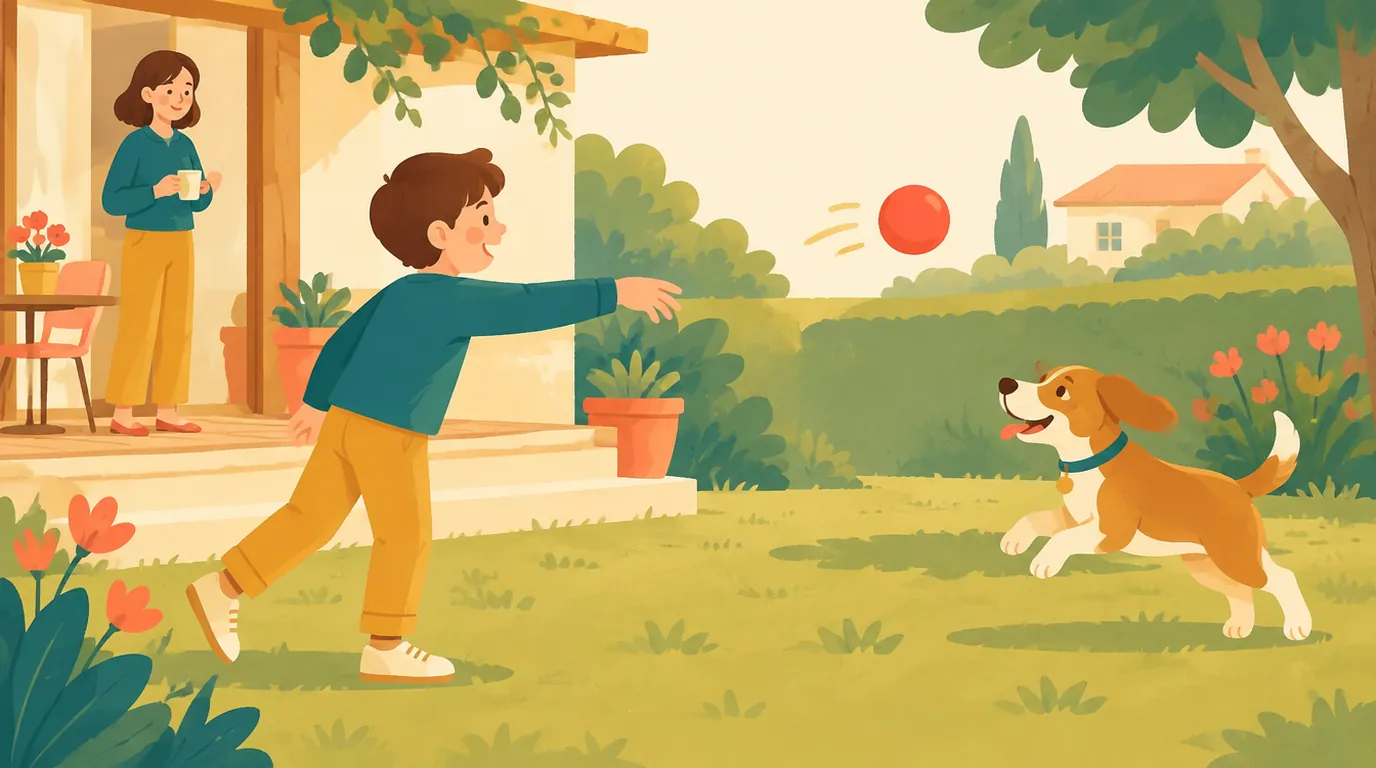
COD and COI: these two abbreviations will appear in your child’s grammar book, usually in CM1, and they have a reputation for causing confusion. But the idea behind them is actually simple. The direct object (COD) and indirect object (COI) both complete the verb, and what sets them apart is just one small thing: the preposition, which is either present or absent.
In this article, you’ll find the key questions to ask, a pronoun test to help with tricky cases, a summary table, common pitfalls to avoid, and a short quiz with answers you can do together at home in ten minutes.
What are COD and COI?
In a sentence, the verb expresses the action. Many verbs need something to complete that action: « Hugo lance… » clearly needs more. This extra bit, which tells us what or who the action is about, is called the object complement.
- The COD (direct object) is attached to the verb directly, with nothing in between: « Hugo lance la balle. »
- The COI (indirect object) is linked to the verb by a preposition, most often à or de: « Hugo parle à son chien. » « Hugo rêve d'un vélo. »
That’s the key: direct means no preposition; indirect means there is a preposition. If your child is still unsure about verbs, nouns or prepositions, our article on the nature of words will help clarify these basics.
One important point: COD and COI are functions, not types of words. The same group of words can be the subject in one sentence and the COD in another. « Le chien court »: le chien is the subject. « Hugo appelle le chien »: le chien is the COD. So you never look for the COD in a list of words, only in the sentence, starting from the verb.
The questions that help you find the COD and COI
The method taught in class has two steps: find the verb and its subject, then ask a question right after the verb.
For the COD: « who? » or « what? »
- « Hugo lance la balle. » Hugo throws what? The ball: COD.
- « Maman appelle ma sœur. » Mum calls who? My sister: COD.
- « Nous regardons un dessin animé. » We watch what? A cartoon: COD.
For the COI: « to whom? » « to what? » « of whom? » « of what? »
- « Léna téléphone à son grand-père. » Léna calls to whom? To her grandfather: COI.
- « Tom pense à son match. » Tom thinks about what? About his match: COI.
- « Ils parlent de leurs vacances. » They talk about what? About their holidays: COI.
Notice that the preposition is part of the answer: you don’t just say “her grandfather”, but “to her grandfather”. That little word is what marks the COI.
The pronoun test for tricky cases
The questions work well most of the time, but not always. Here’s a second, more reliable tool: replace the complement with a short pronoun. Each type of complement has its own set.
- A COD can be replaced by le, la, l' or les, placed before the verb: « Hugo lance la balle » becomes « Hugo la lance »; « Je lis ces livres » becomes « Je les lis ».
- A COI referring to a person is usually replaced by lui or leur: « Léna téléphone à son grand-père » becomes « Léna lui téléphone »; « J'écris à mes cousins » becomes « Je leur écris ».
- A COI referring to a thing is often replaced by y (à + thing) or en (de + thing): « Tom y pense », « Ils en parlent ».
A small detail to remember: with a few verbs like penser, you say « je pense à elle » and not « je lui pense ». The complement is still a COI, but it keeps its preposition.
| COD | COI | |
|---|---|---|
| Link to the verb | direct, no preposition | with a preposition (à, de…) |
| Questions | who? what? | to whom? to what? of whom? of what? |
| Pronouns | le, la, l', les (and me, te, nous, vous) | lui, leur, y, en (and me, te, nous, vous) |
| Example | Hugo throws the ball → Hugo throws it. | Hugo talks to his dog → Hugo talks to him. |
| Typical verbs | watch, listen, throw, eat, like | obey, look like, think about, talk about, dream about |
Me, te, nous, vous appear in both columns: « Il me regarde » (direct object), « Il me parle » (indirect object). The verb decides which it is.
One verb, two objects: the gift example
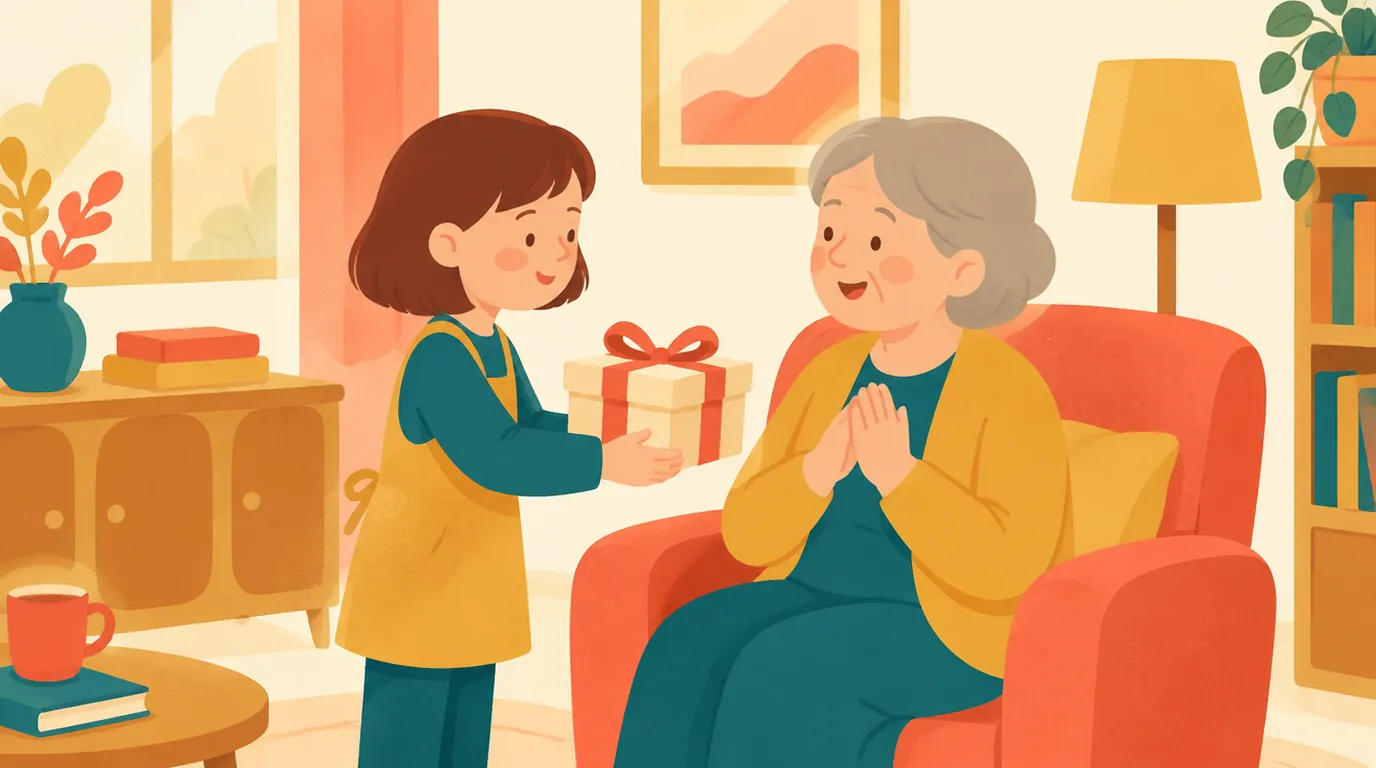
« Lina offre un cadeau à sa grand-mère. » Lina offers what? Un cadeau: direct object. Lina offers a gift to whom? À sa grand-mère: indirect object. Verbs like donner, offrir, prêter, envoyer, montrer or dire often take both at once. The pronoun test replaces both: « Lina le lui offre. »
Depending on the textbook, this second object is called either indirect object or COS (second object). Don't worry if your child's exercise book uses one or the other: they're the same thing. At home, just use the term their teacher prefers.
Another useful tip: it's the verb's construction that matters, not the meaning. « J'écoute mes parents » and « J'obéis à mes parents » mean almost the same thing, but mes parents is a direct object in the first and à mes parents is an indirect object in the second, because you listen to someone but you obey à someone. Similarly, « Il joue une chanson » (direct object) is different from « Il joue au ballon » (indirect object).
Common pitfalls for children
- Mixing up indirect objects and adverbials. « Hugo joue dans le jardin »: dans le jardin answers the question 'where?'. It's an adverbial of place. Same for « Nous nageons à la piscine »: even though there's an à, it answers 'where?'. The test: you can move or remove an adverbial easily (« Dans le jardin, Hugo joue »; « Hugo joue »), but you can't do this as easily with a direct or indirect object.
- Mistaking the subject complement for a direct object. « Mon chien est un labrador. » You might ask 'Mon chien est quoi?'. But after être (and paraître, sembler, devenir, rester), the complement refers to the subject itself: it's a subject complement, not a direct object.
- Getting confused by du, des, au, aux. « Il boit du lait »: du is just an article here, so the group is a direct object. « Il parle du film »: du means de le, so there's a hidden preposition, making it an indirect object. The test: try replacing with le or les. « Il boit le lait » works, so it's a direct object; « Il parle le film » doesn't make sense, so it's an indirect object. Same for « Je mange des fraises » (direct object) and « Je parle des fraises » (indirect object). Here, the pronoun en doesn't help, since you say « il en boit » and « il en parle ».
- Mixing up indirect objects and noun complements. « Léo lit le livre de sa sœur »: de sa sœur doesn't complete the verb, it completes the noun livre. The direct object is the whole group le livre de sa sœur (Léo le lit). Our article on noun complements explains this in detail.
- Looking for the direct object only after the verb. In « Hugo la lance », the direct object is la, placed before the verb. This matters: with avoir, the past participle agrees with a direct object placed before (« La balle? Il l'a lancée. »), but never with an indirect object (« Ses cousines? Il leur a téléphoné. »). This is the key point in past participle agreement with avoir, which your child will revisit later.
Mini quiz with answers for tonight
Read each sentence aloud and let your child find the direct object, indirect object, or neither. Answers are in brackets.
- « Le chien rapporte la balle. » (la balle: direct object, le chien la rapporte.)
- « Nina ressemble à sa mère. » (à sa mère: indirect object, Nina lui ressemble.)
- « Papa lit le journal chaque matin. » (le journal: direct object; chaque matin: adverbial of time.)
- « Nous parlons de notre sortie. » (de notre sortie: indirect object, nous en parlons.)
- « Le chat dort sur le canapé. » (Neither direct nor indirect object: sur le canapé is an adverbial of place.)
- « Mon frère est pompier. » (pompier is a subject complement, not a direct object.)
- « Elle boit du jus d'orange. » (du jus d'orange: direct object, because you can say « elle boit le jus d'orange ».)
- « Julie prête son feutre à son voisin. » (son feutre: direct object; à son voisin: indirect object, or COS depending on the textbook.)
Two or three mistakes are normal: just go over the sentences they missed, asking the full question and then using the pronoun.
Building the habit over time
Three sentences a day for two weeks is better than a whole page on Sunday. To mix things up, our printable CM1 exercises offer sentences to analyse at home, and you can also make up your own from daily life: « Tu ranges quoi? », « Tu téléphones à qui? ».
This topic comes up again in middle school, with pronouns and past participle agreement. To keep grammar rules close at hand without reopening the whole textbook, our middle school Memory Tricks bring together short tips to review before a test.
Want to put these tips into practice?
Every day, a new adventure workbook adapted to your child's school level — to print or do on screen. No commitment.
Your questions
When do children learn about direct and indirect objects?
Most often in CM1, once verbs and subjects are well understood. The topic comes back in CM2 and again in middle school, where it's used for pronouns and past participle agreement. The exact timing depends on each teacher's approach.
Can a verb have both a direct and an indirect object at the same time?
Yes, it's common with verbs like give, offer, lend or say. In « Lina offre un cadeau à sa grand-mère », un cadeau is the direct object and à sa grand-mère is the indirect object. Some textbooks call this second object COS (second object).
Is the direct object always after the verb?
No. When it's replaced by a pronoun like le, la or les, it comes before the verb: in « Hugo la lance », la is the direct object. This is the case that matters for past participle agreement with avoir.
How do I know if « à la piscine » is an indirect object?
Ask 'where?': if that works, it's an adverbial of place, not an indirect object. Try moving or removing it: you can do this easily with an adverbial, but not with an indirect object.
Read next
 Study methods
The syllabic method for learning to read: why it’s making a comeback
Phonics Method for Learning to Read: how it differs from the whole-word approach, what official guidelines say, and…
 Study methods
The Pomodoro Method for Children: Study in 10-Minute Bursts
The Pomodoro Technique for Kids: best block length by level, which timer to use, and a sample homework session…
 Study methods
Mind Maps: How to Help Your Child Learn
Mind mapping explained for parents: how to create one with your child, a real lesson example, and practical tips.