➕ Mental maths in CE1: 6 strategies and games to practise as a family

CE1 is the year when your child starts to put their fingers away for mental maths. In CP, they often counted one by one; now, they're expected to know instantly that 7 + 3 makes 10, that double 6 is 12, or that 34 + 9 makes 43. There's no magic to it: it's a mix of memorised facts and a few clever strategies.
At home, there's no need to pile on worksheets. At age 7, mental maths is best practised out loud and through play—on car journeys or with a quick dice game. Here’s what your child will learn this year, the strategies you can show them, and some easy games to practise for a few minutes each day.
What your child learns in mental maths in CE1
In CE1, numbers go beyond 100 and mental calculations become more frequent. In class, your child will practise:
- knowing number bonds to 10 by heart (3 and 7, 4 and 6…), then working out what’s needed to reach the next ten (from 36 to 40, you need 4);
- mastering doubles up to 10 + 10 and halves of simple even numbers;
- adding or subtracting 10 to any number, then whole tens;
- adding with crossing a ten, like 8 + 5 or 27 + 6;
- understanding what multiplication means (3 times 4 is 4 + 4 + 4) and learning the first tables, often 2 and 5.
Everything builds on the first two points. A child who instantly knows 6 + 4 = 10 and 7 + 7 = 14 has a strong foundation for everything else. That’s where to start, even if it seems 'too easy' for their age.
6 mental maths strategies to show your child
In CE1, a mental maths strategy is a way to turn a tricky calculation into easier ones they already know. Show one at a time, using objects if needed (counters, pasta, buttons), then move to doing it out loud once they’re ready.
| Strategy | How it works | Example |
|---|---|---|
| Make 10 | First make 10, then add what’s left | 8 + 5 = 8 + 2 + 3 = 13 |
| Doubles | Learn them by heart, like a rhyme | 6 + 6 = 12 8 + 8 = 16 |
| Near doubles | Start from the closest double, then adjust | 6 + 7 = 6 + 6 + 1 = 13 |
| Plus 10, minus 10 | The tens digit changes by 1, the units stay the same | 47 + 10 = 57 63 − 10 = 53 |
| Add 9 | Add 10, then take away 1 | 34 + 9 = 34 + 10 − 1 = 43 |
| Break it down | Add the tens, then the units | 25 + 13 = 25 + 10 + 3 = 38 |
For subtraction, one tip can make all the difference: count up instead of down. For 52 − 48, don’t take away 48; count from 48 up to 52. From 48 to 50 is 2; from 50 to 52 is another 2. Answer: 4. This is exactly how shopkeepers give change, and it’s often much easier than a long subtraction.
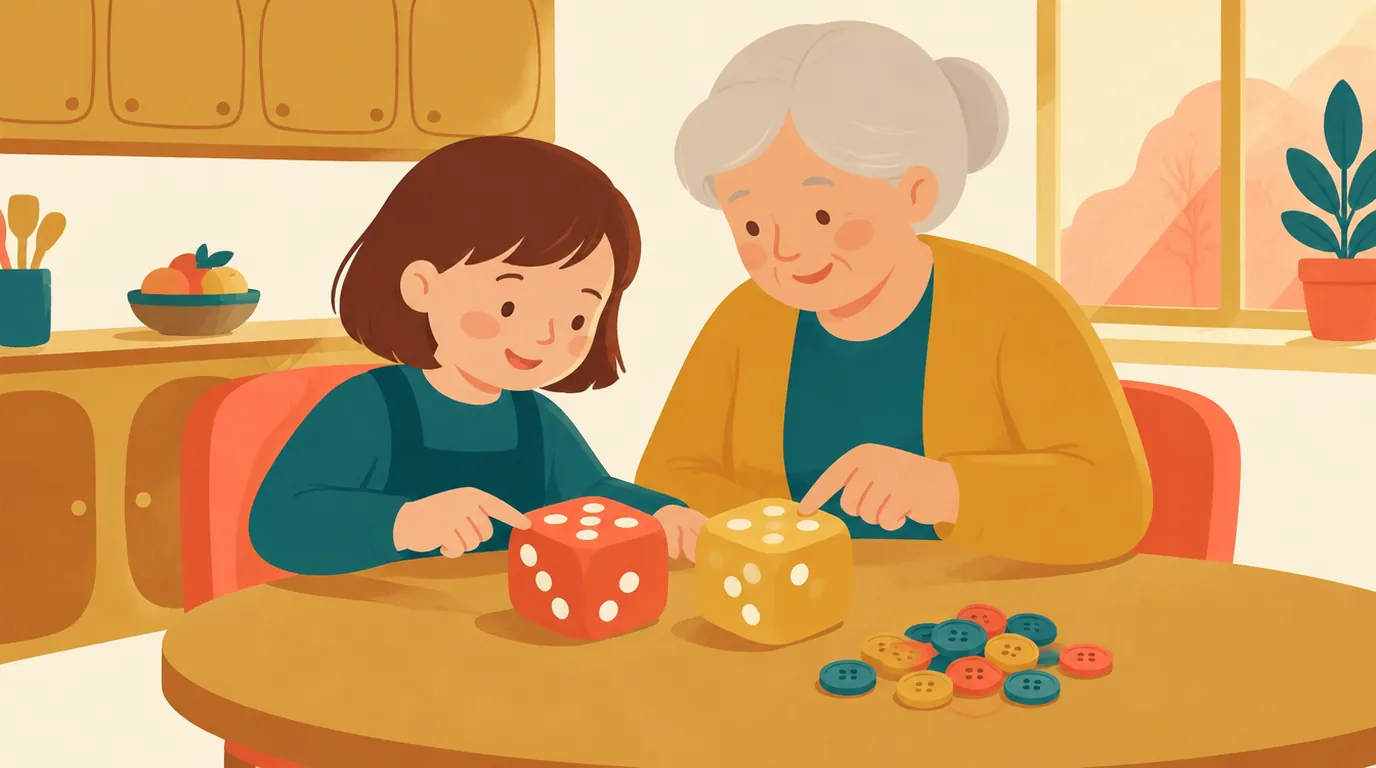
Dice and card games: the best practice
At age 7, repetition comes through play. Two dice, a pack of cards and some buttons are enough for weeks of practice with you, an older sibling or a grandparent:
- Double dash. Roll two dice and add them up. A double (like 4 and 4) should be answered in a second; a near double (like 5 and 6) is worked out by using the double: 5 + 5 + 1 = 11.
- Make 10. Lay out cards from 1 to 9 face up. Take turns picking two cards that add up to 10 (3 and 7, 2 and 8, 5 and 5…). Whoever has the most pairs at the end wins.
- Groups of ten. For each roll, take as many buttons as the total. As soon as you have ten, swap them for a 'group': a small bag or an elastic band. At the end, “I have 3 groups and 4 buttons”, so 34. That’s real-life place value.
- Addition battle. Each player turns over two cards and adds them; the highest total wins all four cards.
Once doubles are well learned, games naturally move towards multiplication. Our selection of games for learning times tables is perfect for when the first tables are introduced in class.
Mental maths in the car and everyday life
Journeys are ideal: your child is sitting still, ready to listen, and there’s no need to get out any books. Here are some ideas you can play with no equipment:
- Number plate game. Add up the three numbers on a car number plate: on AB-123-CD, 1 + 2 + 3 = 6. Whoever finds the answer first scores a point.
- Plus 10, minus 10. You say a number, your child answers "10 more", then "10 less". 46? 56 and 36.
- The mystery number. "I'm thinking of a number. If I add 5, I get 12." Answer: 7.
- Countdown. "The journey takes 20 minutes, we've been driving for 5 minutes: how much longer?" Answer: 15.
You'll find more ideas in our 15 car games for children, many of which can easily be turned into maths games.
At home, the kitchen and shopping are just as good for practising. Laying the table for 4 with a fork and knife each makes 8 pieces of cutlery. Doubling a recipe with 3 eggs means you'll need 6. And in a pretend shop, if you pay €1 for something that costs 60 cents, you'll get 40 cents change. Mental maths suddenly makes sense: it’s useful in real life.
A quick 5-minute routine, and worksheets if you need them
Alongside games, a very short routine helps build good habits: five minutes, three or four evenings a week, always at the same time.
- One minute of pairs to 10 in a ping-pong style: you say 7, your child answers 3.
- Two minutes on the week's strategy: five sums out loud, for example five "+ 9" questions: 15 + 9, 28 + 9, 43 + 9, 56 + 9 and 71 + 9 (answers: 24, 37, 52, 65 and 80).
- Two minutes of writing: three sums on a whiteboard, which your child then checks with you.
On evenings when you run out of ideas, our printable CE1 worksheets offer free, ready-to-use sets. For a change, CE1 colour-by-number activities are a fun reward: each part of the picture hides a sum, and mistakes show up straight away in the colours. When you’ve finished, a round of The Big Jump, Kidibook’s free game, is a lovely way to end the session.
When things get tricky, and what comes next
If your child still counts on their fingers, don’t ban it suddenly: fingers are a normal step. Instead, help them use their fingers less, for example by starting from the bigger number (for 3 + 8, start at 8 and count on 3). The fingers will disappear on their own once pairs to 10 and doubles become automatic.
If they get "+ 9" wrong and say 34 + 9 = 45, it means they added 10 and then added 1 instead of taking 1 away. Try the sum with real coins: adding 9 cents means giving a 10-cent coin and taking 1 cent back.
If your child gets frustrated, go back to just playing games for a few days, with no worksheets. The motivation often returns much faster than you expect when maths feels like a dice game again.
These basics are the foundation for what comes next. In CE2 and then CM1, the same ideas return with bigger numbers: "add 9" becomes "add 29", and doubles help with multiplying by 4. To see where this leads, have a look at our article on mental maths in CM1 and its 7 strategies.
Want to put these tips into practice?
Every day, a new adventure workbook adapted to your child's school level — to print or do on screen. No commitment.
Your questions
Is it a problem if my child in CE1 still counts on their fingers?
No, it’s a normal stage. The aim is for them to use their fingers less and less, by knowing pairs to 10 and doubles by heart. Help them start from the bigger number rather than counting up from 1 each time.
How much mental maths should my child do each day in CE1?
Five minutes, three or four times a week, is plenty at home. The key is regularity and enjoyment: a quick dice game or a car game counts just as much as a worksheet. Always stop before your child gets bored.
Where should I start if my child struggles with mental maths?
With pairs to 10 and doubles, even if they seem too easy. These are the building blocks for all other strategies. Once they come without thinking, crossing tens and "+ 9" sums become much easier.
Read next
 Revision methods
The phonics method for learning to read: why it’s making a comeback
Phonics for learning to read: how it differs from the whole-word approach, and what official recommendations say…
 Revision methods
The Pomodoro technique for children: revising in 10-minute bursts
The Pomodoro technique for children: the right block length for each level, which timer to choose, and a homework session…
 Revision methods
Mind maps: a method to help your child learn
Mind maps explained for parents: how to make one with your child, a real lesson example, and practical tips…