🔤 The syllabic method for learning to read: why it’s making a comeback

On the workbook page, it says “papa a mis le sac dans la valise”. Your child looks at the sentence for two seconds and confidently announces: “papa a pris le sac dans la voiture”. They haven’t read it. They’ve guessed.
Guessing is exactly the habit that comes from learning to read by whole words. The syllabic method does the opposite: it teaches children to build words, sound by sound, never relying on context. Long dismissed as “old-fashioned”, it’s been the official approach for CP since 2018. Here’s what it really is, and how to support it at home—without turning your living room into a classroom.
Syllabic, global, mixed: the difference in three sentences
Three words come up after every school run, and almost everyone means something different by them.
- The syllabic method (also called alphabetic or graphemic) starts with the smallest building block: a letter or group of letters, a sound. You put them together: m + a = ma. That’s the classic b-a ba.
- The global method starts with the whole word, memorised like a picture, hoping the child will figure out the logic of the letters on their own.
- The mixed method (or semi-global) combines both: a few words learned by heart from the start, and sound study alongside.
A useful point to settle playground debates: pure global method has never been widely used in France. The real debate is about mixed textbooks, which are very common, and about how much guessing is involved: how many words should a child be expected to guess before they can actually decode them?
| Approach | What the child is asked to do | The risk |
|---|---|---|
| Syllabic | Recognise a sound, match it to a letter, blend: s+a = sa | Texts are a bit basic in the first weeks: make up for it with stories read aloud by an adult |
| Global | Memorise the shape of whole words | The child guesses from the first letter and the picture; they get stuck as soon as they meet an unfamiliar word |
| Mixed | A bit of both, often with a “word bank” to learn by heart | It all depends on the pace of code introduction: if it’s too slow, struggling pupils get stuck in guessing mode |
Why the syllabic method for learning to read is making a comeback
This return isn’t just nostalgia. It comes from three different places that, for once, all agree.
Research. In the United States, the major National Reading Panel review (2000) already found that systematic code teaching is effective. In France, neuroscientist Stanislas Dehaene spread the same idea in Les Neurones de la lecture (2007): learning to read means building a connection in the brain between the visual shape of letters and the sounds of the language. This connection is taught; it can’t be guessed.
The institution. Since 2018, the Ministry of Education’s recommendations—especially the guide Pour enseigner la lecture et l'écriture au CP, given to all CP teachers—call for explicit and systematic teaching of letter-sound correspondences, and reject starting with whole-word recognition.
On the ground. The “Lire et écrire” study, led by Roland Goigoux in over a hundred CP classes, measured the effect of tempo: the number of letter-sound correspondences actually taught each week. Who benefits most when the code comes early and fast? The most vulnerable pupils—those who don’t have anyone at home to fill in the gaps.
One thing is worth saying clearly, because it’s reassuring: decoding isn’t the same as understanding. The code isn’t the goal, it’s the tollgate. As long as a child spends all their energy working out the words, there’s none left for understanding the sentence. That’s why reading aloud by an adult in the evening never stops: that’s where vocabulary and a love of stories are built.
Learning to read with the syllabic method at home: 15 minutes, in order
Golden rule: follow the order of sounds taught in class, not your own. Getting ahead doesn’t save time; it just creates two clashing systems. The evening workbook shows you the current progression.
This progression almost always follows the same logic: first the vowels (a, i, o, u, é), then the consonants that “sing” and can be stretched out without extra noise (s, l, m, r, f, v, ch, j), then the ones that are sharp (p, t, b, d, c, g), and only after that the complex sounds: ou, oi, an, on, in, eu, au/eau, ill, gn.
The home routine has five steps and takes a quarter of an hour, always in this order:
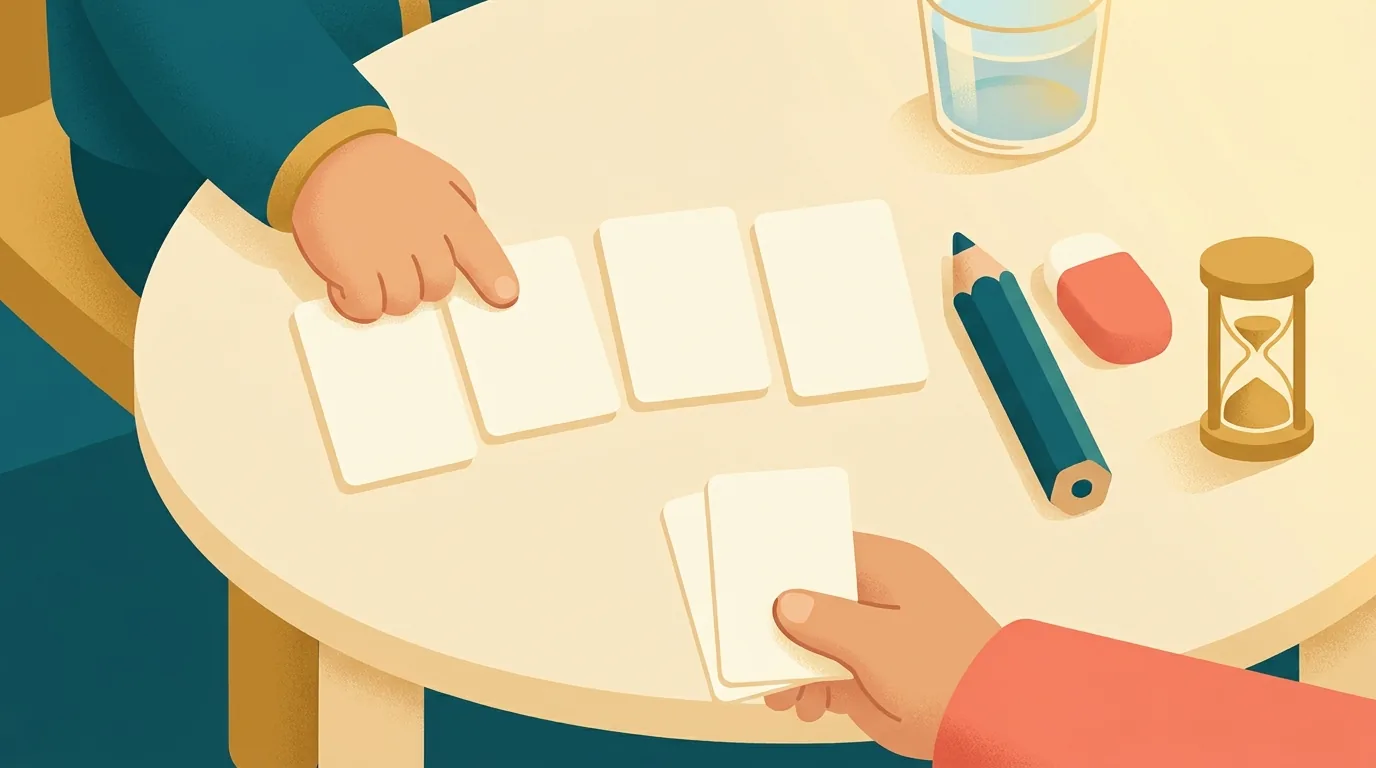
- Revise known sounds (2 min): show letter cards in random order, your child says the sound. Quick, standing up, like a game.
- Blend (3 min): slide your finger under ma, mi, mo, mu, stretching the consonant into the vowel. It’s this action that triggers reading, not memorising syllables.
- Read five or six words (3 min) made up only of sounds already learned.
- Write two syllables and one word from dictation (3 min). Writing fixes the code much faster than rereading: it’s the same principle explained in our article on how to help a child who refuses to revise—you produce, not just look.
- Listen to a story read by you (5 min or more). Non-negotiable.
No need to buy anything: our free printable Kidibook workbook is enough for the first weeks, and the Collection de l'Écolier brings back the spirit of 1950s textbooks: sounds in order, one page per sound, texts using only what the child can already decode. That’s exactly what the syllabic method requires.
The five mistakes that stall reading progress
- Mixing up letter names and sounds. The name (bé, cé, dé) is for spelling, not reading. Children do need to know it, but it’s not useful for blending sounds together.
- Rushing into complex sounds. If a child still hesitates between p and b, they’re not ready for oin. Complex sounds take months to settle in, not just a weekend.
- Giving a book that’s too hard. A story full of sounds they haven’t learned yet forces the child to guess—exactly the habit we want to avoid. The rule: they read what they can decode, you read the rest.
- Correcting every mistake instantly. Give them three seconds of silence. If they’re stuck, just give the tricky sound—not the whole word.
- Stopping bedtime stories “because they can read now”. This is actually when you should keep going: for years, their listening comprehension will be far ahead of what they can read alone.
What if it’s still not working?
Many worries in CP are really about timing. Mixing up b and d, swapping or and ro, reading slowly in January—these are common and usually temporary. Every child finds their own pace for decoding.
But do seek help straight away if: a child, halfway through CP, still can’t match a sound to a letter; forgets everything from one session to the next; or is exhausted or refuses whenever a book comes out. The first person to talk to is the teacher, who has class assessments and can contact the RASED; your GP can refer you for a speech and language assessment if needed. Try not to use the word “dyslexia” yourself: this diagnosis is only made after a lasting delay, and rarely before the end of CE1 (age 7-8).
Remember, the CP year is prepared well in advance, in grande section, through sound games—not forced decoding: that’s exactly what our guide for getting ready for CP is all about.
Key points to remember
The syllabic method isn’t strict or old-fashioned: it’s simply how the brain learns to turn symbols into language. It needs regular practice—fifteen minutes a day, following the order of sounds—and something we often forget: keep reading wonderful stories aloud to children who can already read themselves.
To make this routine easy, the Collection de l'Écolier introduces new sounds step by step, page by page, and L'Aventure 31 jours takes over with a daily adventure workbook tailored to your child’s class.
Want to put these tips into practice?
Every day, a new adventure workbook adapted to your child's school level — to print or do on screen. No commitment.
Your questions
At what age should you start the syllabic method?
Systematic decoding is the work of CP. In grande section, you prepare in other ways: rhyming games, spotting the first sound in a word, recognising letters and their sounds, writing their name. If a GS child wants to read, support them—but never force it.
How can I tell which method my child’s teacher uses?
The easiest way is to ask at the start-of-year meeting, without making accusations. You can also look at the texts brought home: if they only use sounds already learned, the class is working systematically on decoding. If there are words that can’t be sounded out with what’s been taught, the child is being asked to memorise some words as wholes.
Should we learn letter names or their sounds?
Both, but for different reasons. The sound is for reading and writing: that’s what you use to blend. The letter name is for spelling, looking things up in a dictionary, and talking about the alphabet. For reading practice at home, use only the sound.
My child can decode but doesn’t understand what they read—what should I do?
This is common in CE1, when all their energy still goes into recognising words. Two tips: read the same text together, taking turns, two or three times to build fluency; and after each paragraph, ask just one simple question (“Who’s speaking? Where are they?”). Keep reading them stories that are harder than what they can read alone—this is still the best way to boost understanding.
Read next
 Revision methods
Does your child refuse to revise? 7 methods that really work
Refusal, tears, conflict? Discover 7 parent-tested ways to help your child revise without drama: short sessions, rit…
 Revision methods
Helping your child concentrate: 10 practical strategies at home
How to help your child focus: realistic session lengths by level, 10 strategies you can use tonight, and the si…
 Revision methods
The Pomodoro method for children: revising in 10-minute bursts
The Pomodoro method for children: the right session length for each level, which timer to use, and a homework session exa…