🟩 Area of a rectangle: understanding L × l and square units
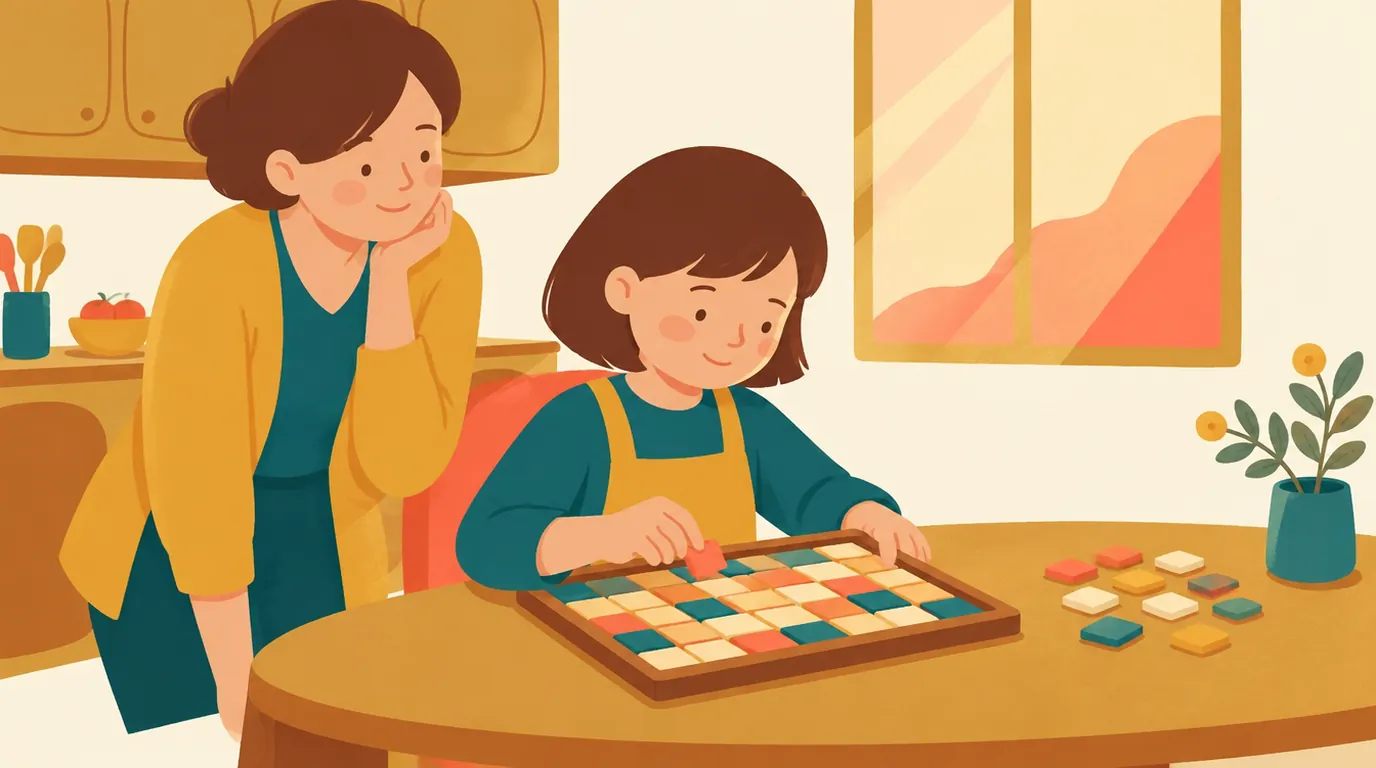
The area of a rectangle is the space it covers inside its edges: the surface you could paint, tile, or carpet. You find it by simply multiplying the length by the width, but this comes with something new that often confuses children: square units, those cm² and m² with the little '2' at the top right.
Rather than just memorising the formula, it's much more effective to show where it comes from. Once your child understands that you're counting squares, the multiplication and the idea of square units become obvious. Here’s how to guide them, with clear examples and a once-and-for-all explanation of the difference between area and perimeter.
Area means the space inside
Start with something practical. Place your hand flat on a sheet of paper, a placemat, or a closed book: the part your hand covers is the surface. Area answers the question “how much space does it take up?”, not “how long is the edge?”.
To measure a surface, you fill it with identical little squares and count them. If the squares are 1 cm on each side, each one is 1 square centimetre, written as 1 cm². So a surface of 20 cm² can be covered exactly with 20 squares, each 1 cm across.
Squared paper is perfect for this first step. Draw a rectangle along the lines and ask your child to colour in and count the squares one by one. They’ve just measured an area, no formula needed.
Why we multiply: the L × l formula
Counting every square soon gets tedious. Look together at how the squares are arranged: in identical rows. A rectangle 8 cm long and 4 cm wide has 4 rows of 8 squares. Instead of counting to 32, you calculate 8 × 4 = 32. The area is 32 cm².
That’s the whole formula: area of a rectangle = length × width, often written as A = L × l. The length tells you how many squares in each row, the width tells you how many rows. And since you can multiply in any order, 8 × 4 and 4 × 8 give the same answer.
Multiplication tables become really useful here. A rectangle 7 cm by 6 cm? 7 × 6 = 42 cm². If that doesn’t come easily, our article on the 7 times table can help. A square is just a special rectangle with equal sides: its area is side × side. So a square 7 cm on each side has an area of 7 × 7 = 49 cm².
Square units: cm², m² and the big conversion trap
The little '2' in cm² reminds us we’ve multiplied two lengths together: centimetres by centimetres gives square centimetres, metres by metres gives square metres. We say “square centimetre” and “square metre”. A drawing in a workbook is measured in cm², a bedroom or garden in m².
The real trap is conversions. Your child knows 1 m = 100 cm. It’s tempting to think 1 m² = 100 cm². That’s not true: a square 1 m on each side has 100 rows of 100 little 1 cm squares, so 100 × 100 = 10,000 cm². Similarly, 1 dm² = 10 × 10 = 100 cm².
If the question mixes units, convert before multiplying. For a rug 2 m by 60 cm:
- in metres: 60 cm = 0.6 m, so 2 × 0.6 = 1.2 m²;
- in centimetres: 2 m = 200 cm, so 200 × 60 = 12,000 cm².
Both answers are correct, since 12,000 cm² = 1.2 m². But multiplying 2 by 60 and writing “120” doesn’t mean anything: it’s neither m² nor cm².
A real-life calculation: carpeting a bedroom
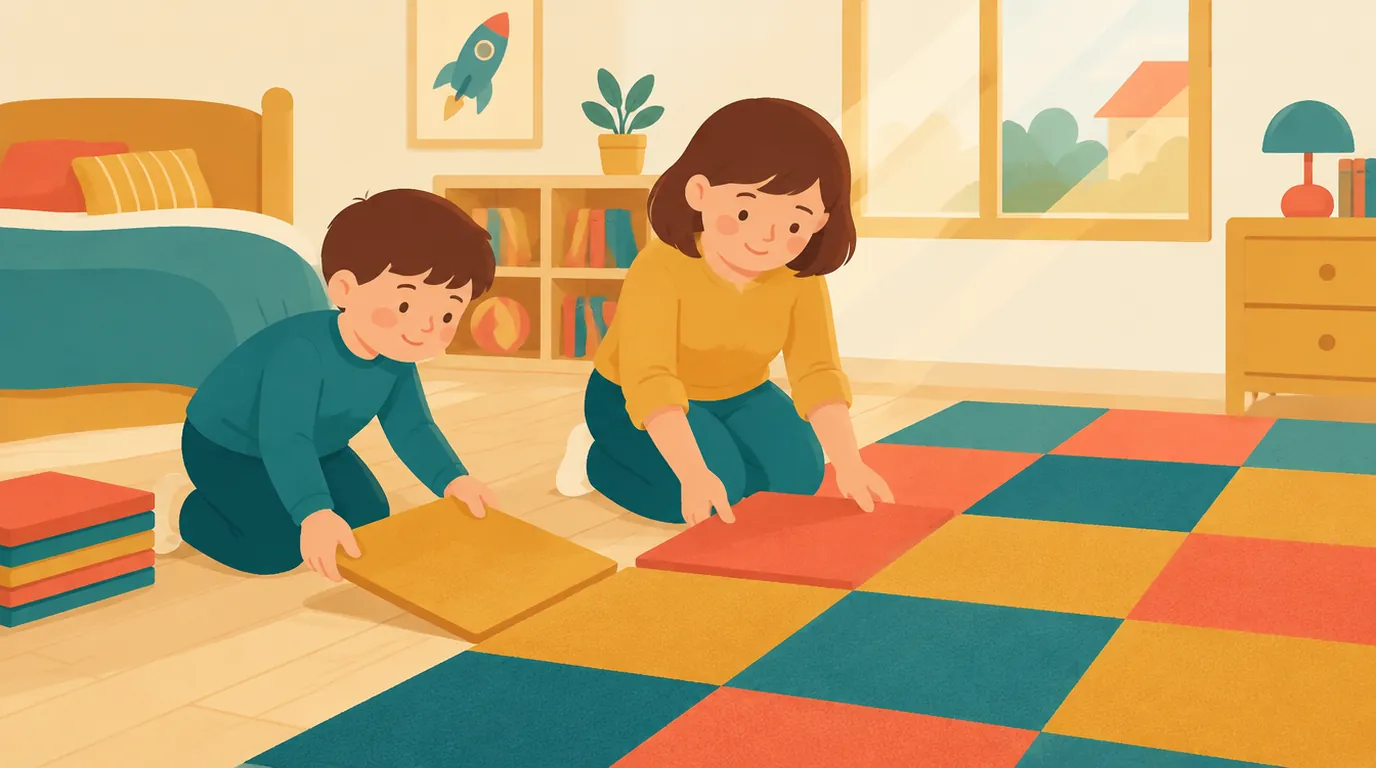
Nothing beats a real project to make the formula meaningful. Imagine a rectangular bedroom 4 m by 3 m, and you want to cover it with square carpet tiles, each 50 cm on a side.
- The area of the bedroom : 4 × 3 = 12 m².
- Number of tiles, by row: in 4 m, you can fit 8 tiles of 50 cm; in 3 m, you can fit 6. So you need 8 × 6 = 48 tiles.
- Checking by area: each tile is 0.5 × 0.5 = 0.25 m², and 48 × 0.25 = 12 m². Both methods agree.
What if you want to fit a skirting board all around the room? This time, it’s not the surface that matters, but the edge: (4 + 3) × 2 = 14 m, not counting the door. That’s a perimeter, measured in metres, not m². The full method is explained in our article on the perimeter of a rectangle.
Area and perimeter: two measures that don’t always change together
You might think that two rectangles with the same edge length have the same area. The table below shows that’s not true. All these rectangles have exactly the same perimeter, 20 cm, because their length and width always add up to 10 cm.
| Length × width | Perimeter | Area |
|---|---|---|
| 9 cm × 1 cm | (9 + 1) × 2 = 20 cm | 9 cm² |
| 8 cm × 2 cm | (8 + 2) × 2 = 20 cm | 16 cm² |
| 7 cm × 3 cm | (7 + 3) × 2 = 20 cm | 21 cm² |
| 6 cm × 4 cm | (6 + 4) × 2 = 20 cm | 24 cm² |
| 5 cm × 5 cm (square) | (5 + 5) × 2 = 20 cm | 25 cm² |
Same perimeter, but the area ranges from 9 to 25 cm²! The more stretched out the rectangle, the smaller its area; the square always wins. The reverse is also true: three rectangles with an area of 12 cm² can have very different perimeters. A rectangle 12 cm by 1 cm has a perimeter of 26 cm, one 6 cm by 2 cm has a perimeter of 16 cm, and one 4 cm by 3 cm has a perimeter of 14 cm.
Getting your child to draw these rectangles on squared paper, cut them out and compare them is a great exercise: it helps them see that area and perimeter are two different things, each with its own calculation.
Finding a side when you know the area
By the end of primary school, the exercises are reversed: you know the area and one side, and need to find the other. Just ask yourself, “What do I need to multiply by?” — in other words, divide.
- A rectangle with an area of 42 cm² has a length of 7 cm. Its width: 42 ÷ 7 = 6 cm. Check: 7 × 6 = 42.
- A vegetable patch covers 36 m² and is 4 m wide. Its length: 36 ÷ 4 = 9 m. Check: 9 × 4 = 36.
- A square has an area of 64 cm². Its side is the number that, when multiplied by itself, gives 64: 8 cm, because 8 × 8 = 64.
Be careful with units: you start with cm² or m², but the side you find is a length, written in cm or m.
Common mistakes and how to fix them
- Adding instead of multiplying. Your child writes 8 + 4 = 12 for the area. Go back to the rows of squares: 4 rows of 8 is not 12.
- Forgetting the “²”. An answer in cm for an area is wrong, even if the number is right. The unit is part of the answer.
- Multiplying different units. 2 m × 60 cm doesn’t give 120 of anything. Convert first.
- Converting m² as if they were m. 1 m² is 10,000 cm², not 100.
- Mixing up with perimeter. Ask your child before each calculation: “Am I filling in or going around?”
These concepts are built up step by step. In CE2 (age 8-9), your child mainly learns to recognise rectangles, draw right angles and measure lengths: we explain these first steps in our CE2 geometry guide. For extra practice with area, our printable CM1 exercises and printable CM2 exercises offer short, progressive sessions. And before a test, a maths revision sheet that puts area, perimeter and units side by side is more useful than reading the notebook ten times.
Want to put these tips into practice?
Every day, a new adventure workbook adapted to your child's school level — to print or do on screen. No commitment.
Your questions
What’s the formula for the area of a rectangle?
The area of a rectangle is found by multiplying the length by the width: A = L × w. For a rectangle 8 cm by 4 cm, the area is 8 × 4 = 32 cm². Both sides must be in the same unit before multiplying.
Why is area written in cm² and not cm?
Because you’re counting squares, not lengths: 1 cm² is the surface of a square with 1 cm sides. The little 2 reminds you that you’ve multiplied two lengths together. Perimeter, on the other hand, is still a length and is written in cm or m.
How many cm² are there in 1 m²?
There are 10,000 cm² in 1 m². A square with 1 m sides contains 100 rows of 100 little 1 cm squares, so 100 × 100 = 10,000. The answer 100 is tempting, but it’s wrong.
Do two rectangles with the same perimeter have the same area?
No. A rectangle 9 cm by 1 cm and a square with 5 cm sides both have a perimeter of 20 cm, but their areas are 9 cm² and 25 cm². The more stretched out the rectangle, the smaller its area for the same perimeter.
Read next
 Revision methods
The syllabic method for learning to read: why it’s making a comeback
Phonics Method for Learning to Read: how it differs from the whole-word approach, what official guidelines say, and…
 Revision methods
The Pomodoro Method for Children: Study in 10-Minute Bursts
The Pomodoro Technique for Kids: best block length by level, which timer to use, and a sample homework session…
 Revision methods
Mind Maps: How to Help Your Child Learn
Mind mapping explained for parents: how to create one with your child, a real lesson example, and practical tips.