👨👩👧 My child refuses to do homework: what can I do tonight?
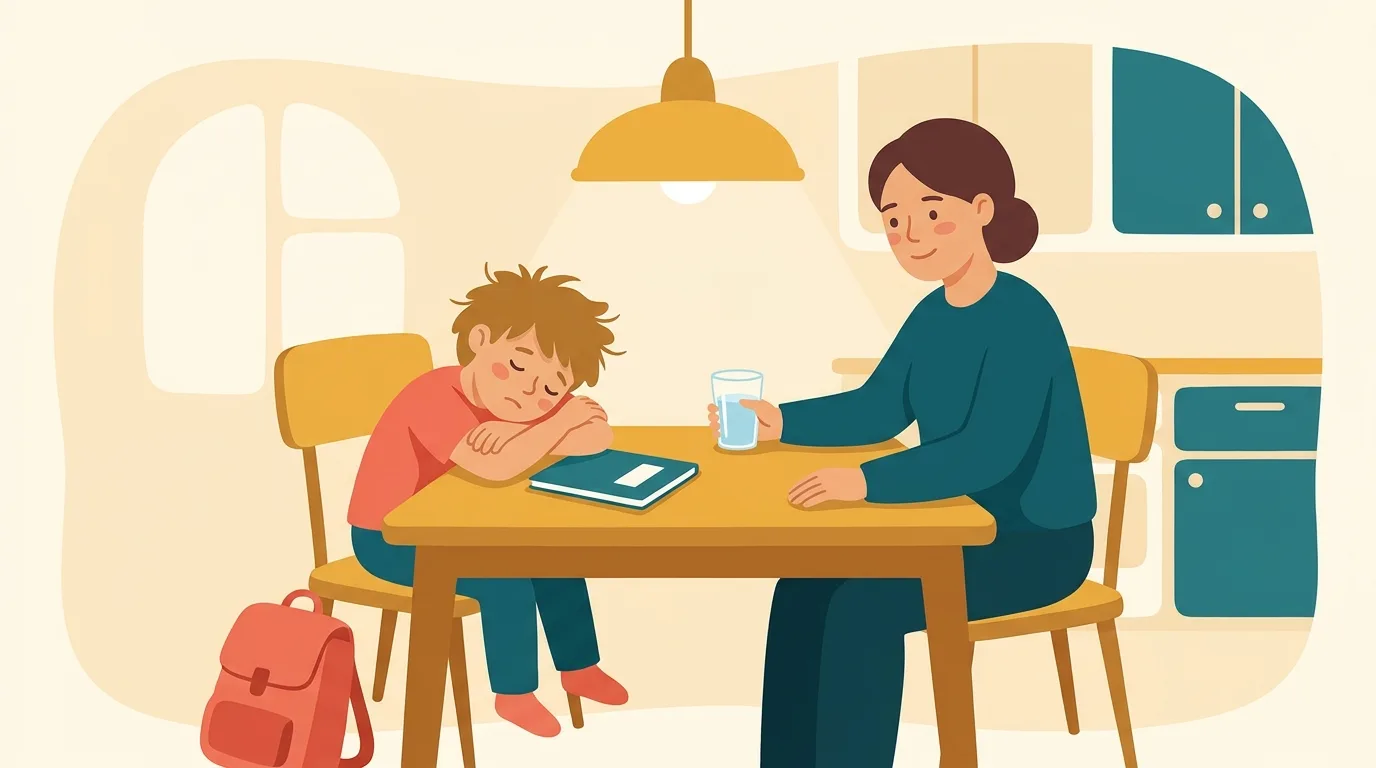
The school bag is still closed. You’ve already asked for the exercise book, and the answer is an even louder "no". When my child refuses to do homework becomes the question every evening, the main aim is just to get through the next fifteen minutes—not to find a miracle solution. Here’s a practical approach: lower the tension, try to understand what’s blocking things, suggest a first step, and know when to hand things over.
This guide is about refusing homework set by the school, in primary. For optional revision and holidays, our article on children who refuse to revise covers a different situation: in that case, you can choose not to add extra schoolwork.
My child refuses to do homework: defusing the crisis
If voices are rising, pause the conversation about the homework. Put the exercise book down and simply say: “We’re both getting upset. Let’s take a break, then we’ll look together at what needs doing.” The break shouldn’t be a threat or a punishment. Having a drink of water, moving around, or just sitting quietly for a moment can help everyone reset.
Try not to ask lots of questions during tears. At that point, getting a detailed explanation isn’t the priority. You can acknowledge their feelings without giving up on boundaries: “You don’t feel like it. I’ve heard you. When you’re ready to talk, we’ll work out how to start.”
Prepare your own go-to phrase: “I’d rather take a break than speak to you unkindly.” It’s useful on evenings when it’s the parent who’s run out of patience too.
My child refuses to do homework: spotting the blockage
Refusal alone doesn’t mean laziness, a disorder, or a lack of authority. Instead, notice exactly when it happens. Is it before the bag is even opened? When reading the instructions? Always with the same subject? The ideas below are just possibilities to explore together, not diagnoses.
| What you notice | A short question | A first step |
|---|---|---|
| They collapse as soon as they get home from school. | “Do you need food, to move around, or some quiet?” | Plan a proper break before starting homework. |
| They say “I’m rubbish” when it’s time to read. | “Show me the tricky bit.” | Go over a familiar passage, then find the obstacle. |
| They flick through the pages without starting. | “What’s the first thing you need to do?” | Read the instructions together and pick just one step. |
| They call you back as soon as you leave. | “Would you like me to stay for the start?” | Stay nearby at first, then let them know you’ll step back soon. |
| They mainly refuse repetitive tasks. | “What feels pointless or too hard?” | Listen and note the difficulty to pass on to the teacher. |
Pick one question, not the whole list. Your child might also say “I don’t know.” In that case, describe what you’ve noticed: “You were fine with the poem, then stopped at this line. Let’s look at it together.”
Offer a limited choice and a really manageable first step
“Do your homework” can feel overwhelming. “Open your planner and show me the reading” gives a clear action. Then offer a choice that doesn’t change what’s required: start with the poem or the reading, sit at the table or at the desk if both are suitable.
Announce a short step, suited to what’s needed: listen to a passage, try one sentence, explain an idea from the lesson. Don’t promise that everything will be finished after this step. Instead, say: “Let’s start with this, then we’ll see how it’s going.” If you use a timer, present it as a guide, never a race.
Stay available without giving the answer straight away. “What have you already tried?” or “Where could you find the example?” gives your child some space. Our guide on helping without doing it for them explains this gradual step-back.
Swap “See, you can do it when you want!” for a specific observation: “You asked for help with the tricky word, then you finished the sentence.” This values their effort without ignoring the difficulty.

What if nothing works, even after a break?
Don’t turn the evening into a test of endurance. If your child is still overwhelmed, stop the struggle and make a note of what you tried. You don’t need to secretly finish the work for them or make up an excuse. Incomplete work with an honest note helps the teacher understand what’s going on.
In France, Service Public reminds us that a primary teacher can’t set written work to be done at home; reading and learning lessons are still allowed. If the homework seems to go against this, ask for clarification calmly, without putting your child in the middle of an adult disagreement.
Avoid adding a worksheet just to 'teach them to obey'. Extra work doesn't solve the real issue. Keep mealtimes, rest, and family time in their place: the evening is about more than just homework.
Preparing a helpful message for the teacher
If your child keeps refusing, contact the teacher before everyone is worn out. Describe what actually happens: the task, when your child stops, what help you tried, and their reaction. Ask what the teacher notices in class and what should be the main focus at home.
Here’s a template to adapt, not a personal story: “Good evening, the reading homework was difficult tonight. After a break and trying again together, our child stopped at the same part and cried. We didn’t finish. Do you see this difficulty in class? How can we adapt our support at home?”
If the refusal comes with strong distress, repeated physical complaints, or a refusal to go to school, talk to a healthcare professional as well. These signs deserve attention; on their own, they don’t provide a diagnosis.

After the crisis, change just one thing
When things are calm, choose one adjustment together for the next evenings: a break after school, having everything ready, or your presence at the start. See what difference it makes before adding more solutions. Our primary homework routine guide can help you set this up outside of stressful moments.
Extra activities are always optional. If your child wants to try another day, you can look at the workbooks offered by Kidibook, but don’t add them to homework to make up for a tough evening. Tonight, the priority is simpler: keep the conversation going and make the next step possible.
References: Service Public, homework at primary school; Mutualité chrétienne, supporting homework without stress. The regulations mentioned are French; adapt the organisational tips to your child.
Want to put these tips into practice?
Every day, a new adventure workbook adapted to your child's school level — to print or do on screen. No commitment.
Your questions
Should you punish a child who refuses homework?
Before deciding on consequences, look for what’s getting in the way and calmly remind them of the rules. Punishment doesn’t clarify instructions or solve reading difficulties. If refusal continues, talk to the teacher to adjust your support.
What should I say when my child cries over their homework?
Acknowledge their struggle, then suggest a break without threats. Afterwards, try just one small, manageable step. If the distress continues, stop the standoff and let the teacher know what you’ve tried.
Can I leave homework unfinished?
If homework turns into a battle or is too much for your child that evening, honestly report what wasn’t finished and the difficulty faced. Agree with the teacher on how to move forward, rather than doing it for them.
Should I buy a workbook to motivate them again?
It’s not needed to solve homework refusal. Start by understanding the school’s expectations and what’s getting in the way. Extra resources can be a chosen activity at another time, but don’t replace talking with the school.
Read next
 Parent guide
The 'summer slide': why your child forgets, and what to do
Losing skills over the school holidays isn’t inevitable: here’s how to prevent it in just 10 minutes a day…
 Parent guide
“My child is bored during the holidays”: what to do (without guilt)
My child is bored during the holidays: why boredom is actually healthy, a box of boredom-busting ideas, and a simple ritual…
 Parent guide
Back-to-school budget: save money without making it hard for your child
Back-to-school budget: sorting supplies, second-hand bags, CAF support — practical tips for spending less…