📚 Helping your child with homework: guide, don’t do it for them

It’s 5:50 pm. The maths exercise has been stuck for four minutes, your child sighs, and you still need to start dinner. So you say, “Hang on, give me your pen, I’ll show you.” Three minutes later, the exercise is neat, correct, finished. And you’re the one who did it.
Every parent knows this moment. It’s not about lacking patience: no one ever explained where our role should end. The good news? That boundary is easy to set—and once it’s clear, evenings become much calmer.
“Helping your child with homework”: where exactly does your role stop?
A parent’s role during homework comes down to three things: set up, unblock, check it’s done—not that it’s all correct. You’re not your child’s second teacher: you don’t need to re-explain the lesson or guarantee a notebook without mistakes.
- Set up. A clear table, the same time each day, phone out of reach. That’s the focus of our primary homework routine, and it’s 80% of the job.
- Unblock. When your child is truly stuck, help them get going again—not finish the task for them.
- Check it’s done. Done—not corrected from start to finish.
A useful reminder: in primary school, official guidelines don’t require written homework at home. What’s expected is to review lessons, read, or learn words. So you’re not meant to be teaching in your kitchen.
The parent-as-corrector trap
This is the most common—and most counterproductive—mistake: correcting as you go, line by line. The parent leans over the notebook, spots a mistake coming, and points it out before the pencil even hits the page.
The problem? The child stops thinking for themselves: they’re not writing to work things out, but to see how you’ll react. They glance at you after every word, watch for a frown, correct, carry on. You become their calculator: they press a button and wait for the answer.
And the evening you’re not there, they don’t know how to start. Not because they don’t understand, but because they’ve never had the chance to make a mistake and fix it themselves.
Guiding without doing it for them: phrases to use instead of correcting
Guiding means sending your child back to what they already have: the instructions, their lesson, their notebook. In practice, it comes down to a handful of phrases. Here are the ones that come naturally, and the ones that really help.
| What comes naturally | What really guides | What it triggers |
|---|---|---|
| “No, that’s wrong.” | “Read the instructions out loud to me.” | They rediscover what’s being asked—half of mistakes disappear at this stage. |
| “Give it here, I’ll do it.” | “Show me where you started.” | They explain their approach; the mistake becomes clear on its own, without you pointing it out. |
| “It’s easy, though!” | “What exactly is blocking you?” | They name their difficulty instead of just feeling stuck—and now you know how to help. |
| “The answer is 42.” | “Is there a similar exercise in your lesson?” | They learn that the answer is in their notebook, not in your head. |
| “Hurry up a bit.” | “How many exercises do you have left?” | They take control of their time instead of just letting it pass. |
| “You never listen in class.” | “Is this something you haven’t seen yet, or have you just forgotten it?” | They learn to tell the difference between not having learned and not having understood—two very different issues. |
Just one rule: three questions before any explanation. You can explain—but only after asking three questions, and only if your child is still stuck. Nine times out of ten, you won’t even need a third question.
If your child always gets stuck on the same subject, the real help isn’t that evening—it’s earlier. We’ve explained this approach in detail for helping your child with maths when you’re not confident yourself.

Leave mistakes visible: why correcting before handing in does your child no favours
A notebook that comes back perfect every evening sends the wrong message to the teacher: “everything’s fine”. They won’t see the confusion over homophones, or that the 7 times table hasn’t been mastered. So they won’t be able to help.
Leave the mistake. And if your child still hasn’t understood the exercise despite your questions, stop the session and write a note in the homework diary: “Exercise 3 not understood, we stopped after 15 minutes.” This is valuable information for the teacher, and a huge relief for your child.
Gradually stepping back: where to sit, from CP to CM2
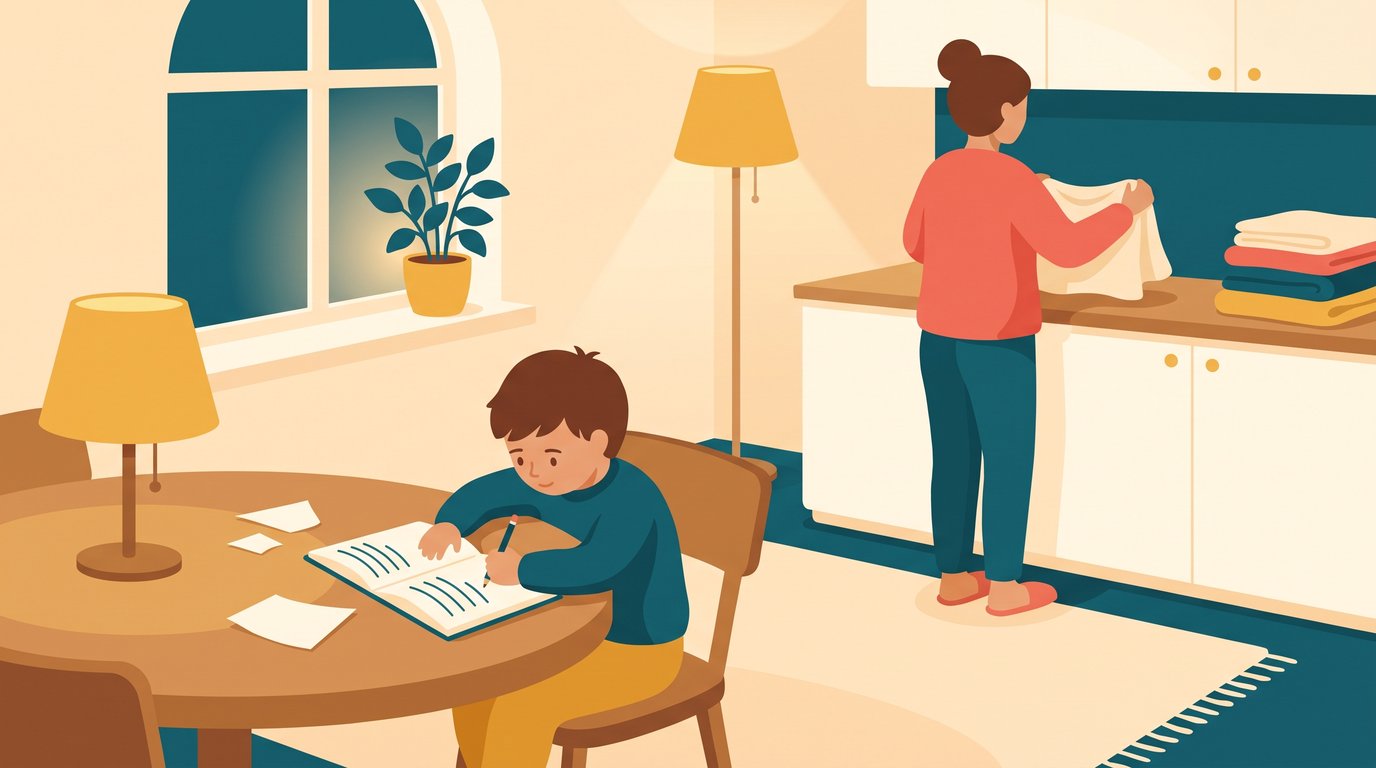
Where you physically sit in the room says more than any words of encouragement. Each year, move a little further away—gently, but for real.
- CP and CE1: sit next to your child. Read the instructions together, stay within earshot. This is normal and necessary: they’re still learning to read.
- CE2 and CM1: be in the same room, but busy with something else. You’re available, but not hovering over the notebook. If your child calls you, come over—then step away again.
- CM2: your child works alone, and you check in at the end. Don’t reread everything: just ask, “tell me what you did.” If they can explain, they’ve got it.
The sign that you can step back another notch: can your child start without you? Not finish—start. Get their things out, open to the right page, read the instructions. The day they do all three on their own, move a metre away.
Helping your child with homework without stress: defusing your own frustration
No one talks about it, but this is where the evening can go wrong. It’s not usually the child who cracks first: it’s often the parent, after the third explanation, at 6:40 pm, after their own long day.
Three habits to avoid a meltdown:
- Notice the warning signs. Your voice gets louder, you repeat yourself. That’s the time to leave the room, not to push on.
- Announce a break instead of letting it happen to you. “I’m going to get a glass of water, we’ll start again in two minutes.” Two minutes is enough, and your child won’t feel abandoned.
- Don’t try to catch up in the evening. A lesson not learned can be caught up the next morning; an evening that ends in tears can’t.
If refusal happens every day, it’s no longer just about your approach: it’s a bigger issue, which we cover in our article on children who refuse to do homework or revise.
Guided session: a sample maths dialogue
The same maths exercise as at the start of the article, but handled differently:
- — I can’t do it.
— Read the instructions out loud to me. - — “Work out the price of 3 notebooks at €2 each.”
— Okay. What are you being asked to find? - — The price.
— The price of one notebook, or three? - — Three… oh, I need to multiply by three.
— Go ahead, I’ll let you do it.
Four exchanges, no answers given, and a child who found the solution alone. It’s slower than just saying “€6”—once. But much quicker, every other evening.
Key points to remember
Helping means making your child able to manage without you. Every time you hold the pen, you delay that day; every time you ask a question instead of giving an answer, you bring it closer.
Start tonight with just one change: hands on your knees, and “read the instructions to me again” before anything else. For more activities your child can do independently, from CP to CM2, check out Kidibook workbooks: they’re designed to be completed without an adult looking over their shoulder.
Want to put these tips into practice?
Every day, a new adventure workbook adapted to your child's school level — to print or do on screen. No commitment.
Your questions
At what age can a child do their homework alone?
There’s no set age—it’s a gradual process. In CP and CE1, sitting next to your child is normal: they’re still working out the instructions. From CE2, aim for the same room rather than the same chair. By CM2, the goal is for your child to work alone and then tell you what they did. The real sign isn’t being able to finish without you, but being able to start: getting their things out, opening to the right page, reading the instructions.
What should I do if my child refuses to do homework?
Don’t turn homework into a power struggle: you’ll lose, and so will tomorrow. First, make the task smaller—just one thing, clearly announced, with a time limit (“let’s reread the history lesson, ten minutes, then we stop”). If refusal happens every night, look for the cause outside homework time: tiredness, working too late, or a hidden difficulty in a particular subject.
Should I correct my child’s mistakes before they hand in their work?
No. A perfect notebook every evening deprives the teacher of the information they need to adapt their teaching. You can point out that something needs checking (“read your third line again”), but don’t say what’s wrong or correct it yourself. If the mistake stays, leave it and write a note in the homework diary: it’s more helpful for your child than a spotless page.
How can I help if I haven’t understood the lesson myself?
That can actually be an advantage: you can’t do it for them. Ask your child to explain the lesson to you as if they were the teacher—explaining is one of the best ways to memorise, and you’ll quickly spot any gaps. If they can’t, stop and write a note in the homework diary. You’re not expected to know: the teacher is.
Read next
 Revision Methods
Does your child refuse to revise? 7 methods that really work
Refusal, tears, arguments? Discover 7 tried-and-tested ways parents help their children revise without drama: short sessions, routines…
 Revision Methods
The Syllabic Method for Learning to Read: Why It's Making a Comeback
Syllabic Method for Learning to Read: How It Differs from the Whole-Word Approach, and What Official Guidelines Say…
 Revision Methods
Helping Your Child Focus: 10 Practical Tips for Home
Helping Your Child Focus: Realistic Attention Spans by Level, 10 Tips to Try Tonight, and Signs to Watch For…