👨👩👧 How much homework in primary school? From CP to CM2

Reading was meant to take just a few minutes. But dinner time is approaching and the workbook is still open. You’re wondering what’s a reasonable amount of homework in primary school, and when it’s time to stop. The best guide isn’t how fast other children finish: it’s the task itself, what your child understands, and the energy they have left after their day.
Here’s how to observe a homework session, adjust your help from CP to CM2, and talk to the teacher if the workload gets too much. The examples below are tools for organising family life, not official timings or targets to be met at all costs.
How much homework in primary school: what are the rules?
The Service Public factsheet on homework in primary school states that teachers cannot set written work to be done at home. Children may be asked to learn lessons or do oral work, such as reading. This guidance does not set a daily time quota for each year group. So, presenting a table like “CP: X minutes, CM2: Y minutes” as a national rule would be misleading.
Start by looking at the exact instruction: read a passage, review a lesson, prepare a few lines? A short page can be a big effort for a beginner reader. A lesson already understood can be reviewed quickly. Time spent isn’t the only measure of quality.
If an instruction seems to require written work, ask the teacher directly for clarification. There’s no need for your child to feel caught between adults: work together to find out what was expected and how best to support them.
Guidelines from CP to CM2, without racing the clock
In CP, you can read the instruction and listen to your child read the passage. In CE1 or CE2, ask them to explain what they need to do before starting. In CM1 or CM2, let them get their materials ready and suggest the order of tasks, then check in briefly. These ideas can be adapted to your child’s progress: moving up a year doesn’t mean instant independence.
| Level | What you can look for | Support to try |
|---|---|---|
| CP | Is the passage familiar? Are there any sounds that are tricky? | Listen to a small section and pinpoint exactly where they get stuck. |
| CE1–CE2 | Is the instruction clear? Can your child find their lesson? | Ask them to rephrase the task and only get out what’s needed. |
| CM1–CM2 | Can they organise the tasks and say what they don’t understand? | Let them suggest the order, then check one thing at a time. |
Whatever the level, set a clear, small step: reread a paragraph, explain a topic, try a verse. “We work until everything is perfect” has no clear end. “Tell me what you understood from this passage” lets you see progress without piling on more work.
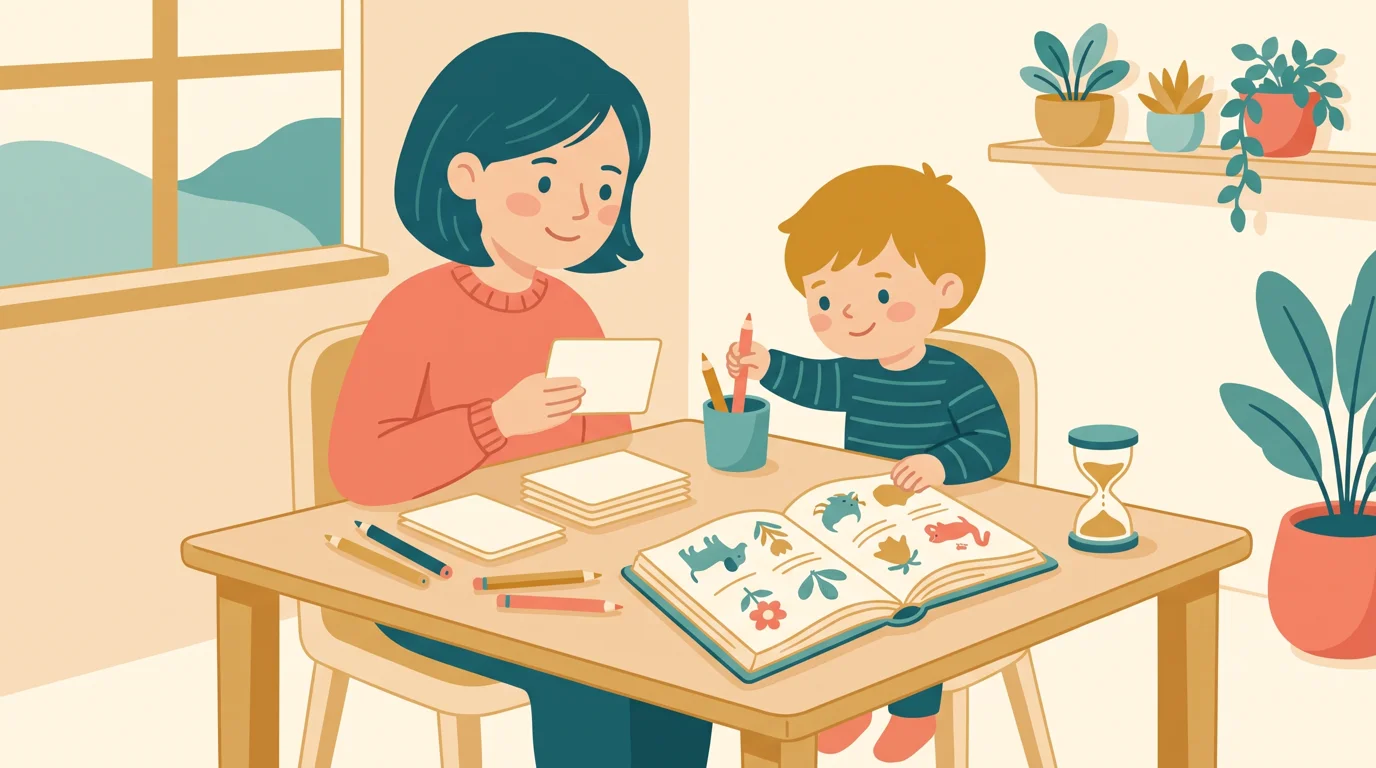
How much homework time is really spent working?
A forty-minute session might include a long search for a workbook, a toilet break, a chat, and just a few minutes of reading. On the other hand, a child might focus for ages on a single tricky sentence. These situations need different responses.
For a few evenings, quietly note three things: the task, the time actually spent on it, and the sticking point. The aim isn’t to monitor every second. You’re trying to spot the difference between getting ready, interruptions, and real effort. Don’t compare siblings.
For example: “Read the set passage: twelve minutes, struggled with three words” is more helpful than “He’s always slow.” Another note: “Understood the lesson, but took ten minutes to find the right page.” In the second case, getting organised may help more than repeating the lesson.
If getting ready takes up all the time, our guide to creating a primary homework routine offers a regular structure. Here, focus on the length and the reason: what’s making this particular session longer?
When should you stop a session that’s dragging on?
Rereading the same line over and over, forgetting an instruction that was just understood, getting upset at every comment: these are signs it’s time for a break. They don’t explain a long-term difficulty, but they do show that carrying on in the same way isn’t helping.
Suggest a drink, a quick move around, or a short change of activity. When you come back, tackle just one small step. If it’s still impossible, note what you tried and what’s blocking progress. Prioritise mealtimes and bedtime rather than working late to hand in a perfect workbook.
Don’t finish the work for your child just to save time. The teacher needs to see what your child can actually do and what help they need. A visible difficulty leads to a more useful conversation than a perfect result completed by a parent.

What should you say to the teacher if this happens often?
Use your notes: “This week, the reading took about twenty-five minutes each evening. We’re mostly rereading the same words. How much time did you expect it to take, and what should we focus on if it goes over?” The numbers describe your experience; they’re not there to set a rule.
Ask what help is expected, what your child should try alone, and how to let the teacher know if work isn’t finished. You can also ask if the same difficulty appears in class. This turns the conversation into a joint search for solutions: reducing the amount, clarifying the instruction, or going over a topic again.
If your child has an agreed arrangement, start with what was decided with the school team. Don’t replace these adaptations with general advice found online. For broader difficulties, our article on helping without doing it for them offers further guidance.
Avoid turning homework into a second school day
Once your child has finished and understood the task, there’s no need to fill the remaining time with extra pages. A child may work well and finish quickly. On the other hand, a long session doesn’t automatically mean you should add more work or another workbook.
Optional activities are best kept separate from homework. Kidibook resources can offer an activity to enjoy at another time; they shouldn’t make an already tough evening even longer. Check the details of each offer before choosing, based on what you actually need.
For tonight, focus on three steps: clarify the task, notice any difficulties, and plan an end point. If the main issue is refusing to start, see our guide my child doesn’t want to do homework. If it’s the length of time that’s a problem, share your observations with the teacher: you’ll have something concrete to work on together.
School guidelines source: Service Public — homework in primary school, facts checked on 25 March 2025, viewed on 19 September 2026. The organisational tips above are editorial suggestions to adapt for your family.
Want to put these tips into practice?
Every day, a new adventure workbook adapted to your child's school level — to print or do on screen. No commitment.
Your questions
Is there an official homework time for each class?
The Service Public factsheet explains the types of work allowed, but doesn’t set a daily time limit for each class. Ask the teacher how long they expect homework to take, and what to prioritise if it runs over.
Should we stop if the homework isn’t finished?
If your child is too tired to make progress, take a break. If the difficulty continues that evening, note what you tried and discuss with the teacher what to do next.
My child finishes very quickly: should I add more exercises?
Not necessarily. Check they’ve understood the task and can explain what they learned. Optional activities should stay separate from set homework.
What should I note before asking for a meeting?
The instructions, the actual time spent, the help given, and the sticking point. A few concrete observations are more helpful than a general comment about motivation.
Read next
 Parent guide
The ‘summer slide’: why your child forgets, and what to do
Learning loss over the school holidays isn’t inevitable: here’s how to avoid it in just 10 minutes a day…
 Parent guide
‘My child is bored during the holidays’: what to do (without feeling guilty)
Why boredom during the holidays is actually healthy, a box of anti-boredom ideas, and a simple ritual to try…
 Parent guide
Back-to-school budget: save money without making it hard for your child
Back-to-school budget: sorting supplies, second-hand schoolbags, CAF support — practical tips to spend less…