🎲 Game to Learn Times Tables: 8 Fun Ideas to Try at Home
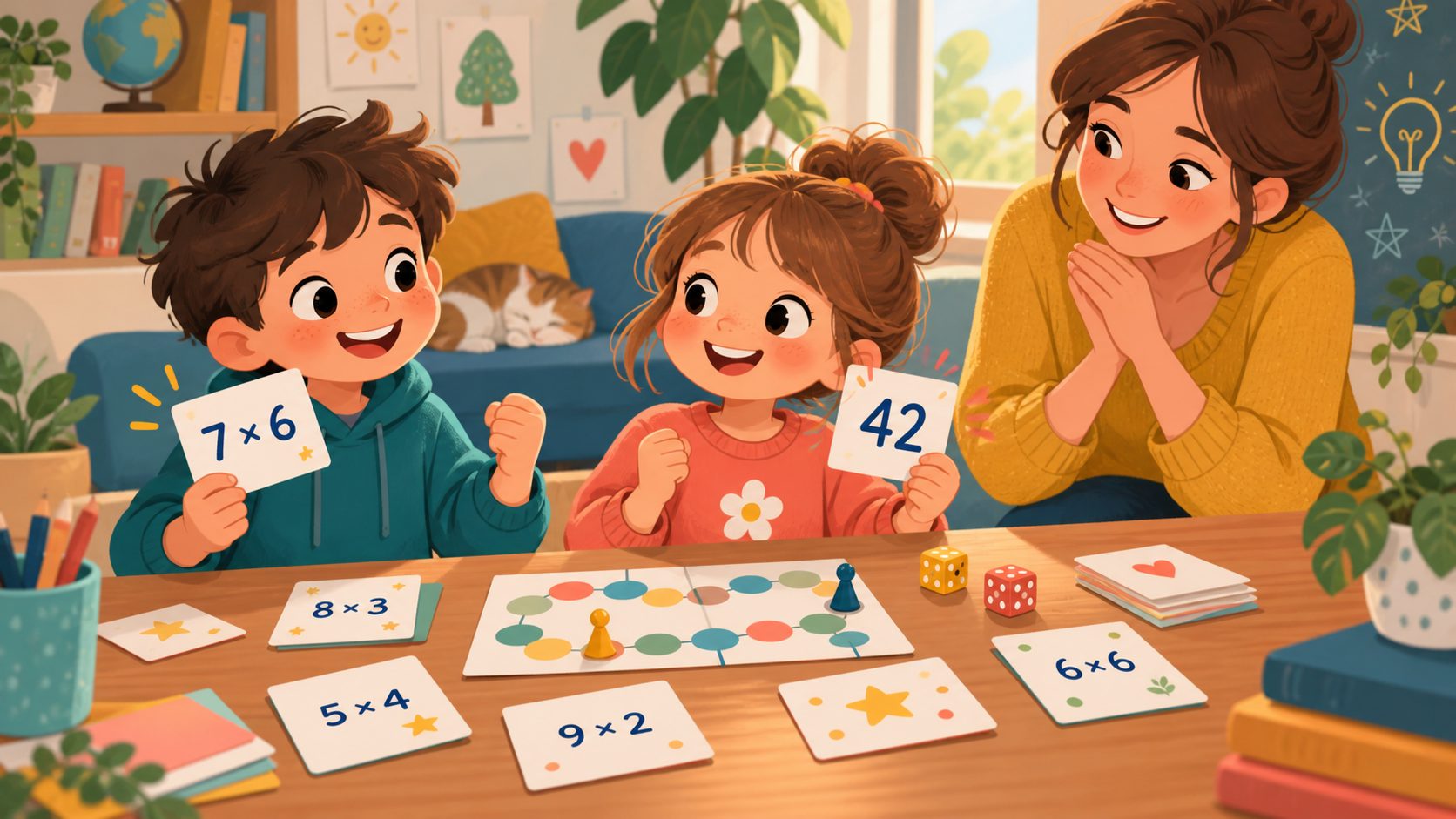
Looking for a game to help your child learn their times tables that doesn’t require buying anything or endless prep? A few scraps of paper, a die, a piece of chalk—or even nothing at all—are enough. Here are some multiplication games to try as a family, with the rules, what you’ll need, and a twist for when your child hesitates. The aim isn’t to beat an adult who already knows the answers: it’s to work out the results, then remember them without help.
These games go hand in hand with our method for learning times tables. There’s no new curriculum here: just pick the calculations already covered at school and a rule your child enjoys.
Which times tables game will you play tonight?
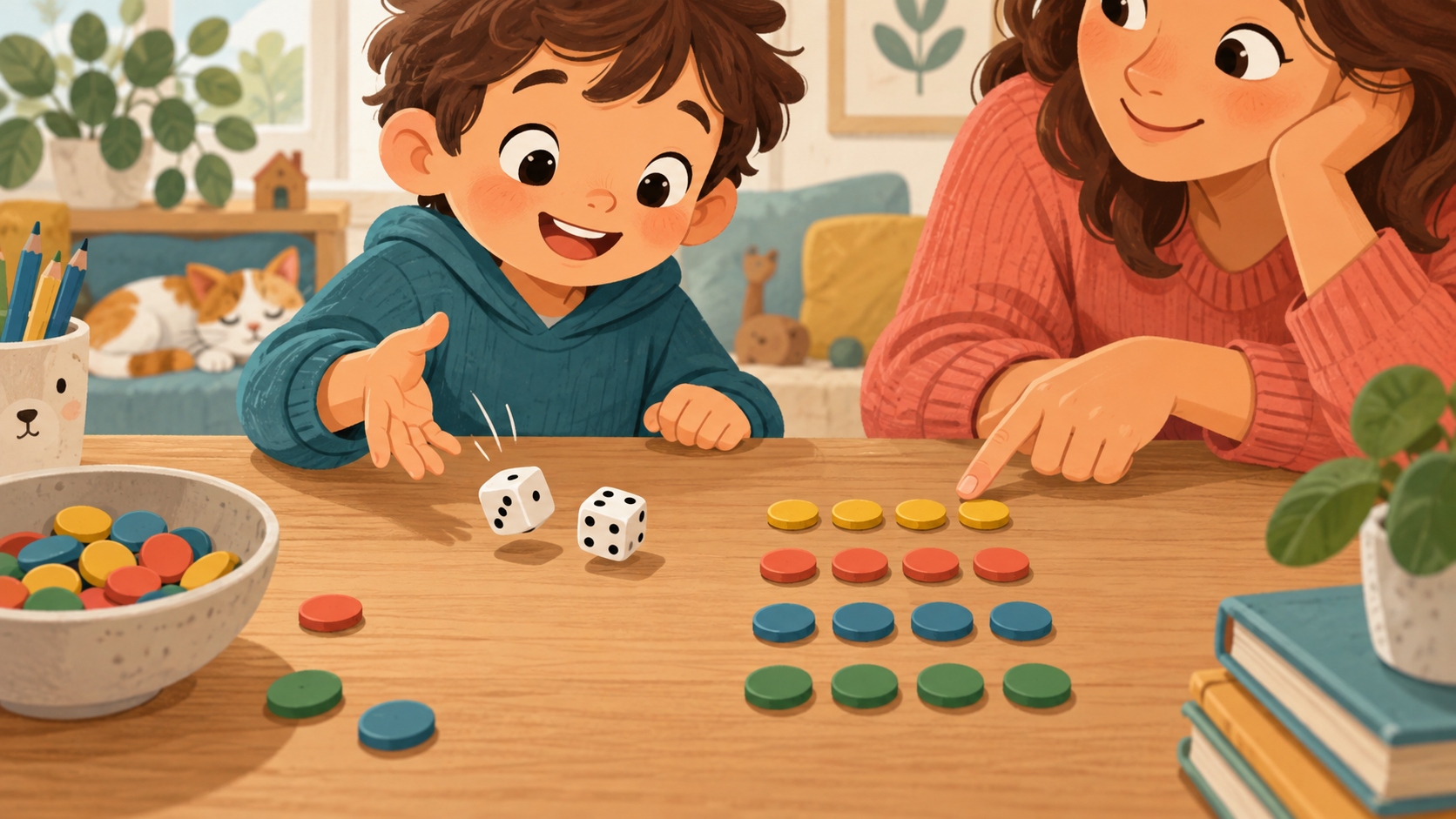
Start by asking: “Do you prefer cards, dice, moving around, or playing without any equipment?” Then choose a table your child knows and a few results to practise. Play for as long as your child wants—better to finish a short game happily than drag out a long one.
| Game | What you need | Tables practised | Best for… |
|---|---|---|---|
| Multiplication Battle | Cards numbered 1 to 10 | Depends on cards chosen | Comparing products |
| Times Table Old Maid | Pairs: calculation and answer | A few chosen calculations | Matching sums and answers |
| Memory | Matching pairs | Start with one table | A calm two-player game |
| Dice and Target Table | One die, one sheet of paper | One table, factors 1 to 6 | Repeating without mixing everything up |
| Results Bingo | Paper grids, counters | One or two tables | Playing with several people, including siblings |
| Times Table Hopscotch | A piece of chalk | Any table | A child who needs to move |
| Cooperative Oral Challenge | None | Any table | Making the most of a journey or waiting time |
Card games for learning multiplication tables
A standard deck of cards, keeping only the cards from 1 (ace) to 10, or small numbered slips of paper, works perfectly. The big advantage of the multiplication tables card game: it's chance that decides, not how fast the adult is.
Multiplication battle: each player works out their cards
Set-up: Take two sets of numbers from 1 to 10. Shuffle and deal the cards into two equal piles. To start, remove any numbers your child hasn't learned yet.
- Each player turns over two cards and says their product.
- Check the answers together: the highest product wins all four cards, which go into a separate pile.
- If there's a tie, each player keeps their two cards. When all cards have been played, count up the cards won.
For example, 3 × 4 makes 12 and 2 × 5 makes 10: the first player wins this round. If someone gets stuck, help them work it out before carrying on. To practise just the 4 times table, keep a 4 in front of each player and draw only one card per turn.
Multiplication 'Old Maid': clear pairs
Make six pairs: one card shows a multiplication, the other its answer. For the 3 times table, use 3 × 1 and 3, 3 × 2 and 6, up to 3 × 6 and 18. Add one odd card, the 'mistigri', which has no partner.
- Deal out all the cards. Each player puts down any pairs, reading the full calculation aloud.
- Take turns picking a card at random from your neighbour's hand and lay down any new pairs you make.
- When all pairs are down, the player left with the mistigri loses… and gets to deal the next game.
For this homemade version, make sure all the answers are different. If you include both 3 × 4 and 2 × 6, two sums have the answer 12: this makes the game less clear. You'll explore these equivalences later, with a special rule.
Memory: match the calculation to its answer
Use the pairs from the mistigri game, but leave out the odd card. Lay the calculations on one side, the answers on the other, all face down. The player turns over one card from each group. If they match, read the equation aloud and keep the pair; if not, turn them back over. Take turns, even after a successful match.
Start with just a few pairs. You can also leave the answers face up: your child then works out the calculation before choosing their answer. This version practises multiplication rather than just remembering where the cards are.
Dice and hands-on games
The dice and target table: watch out for dice limits
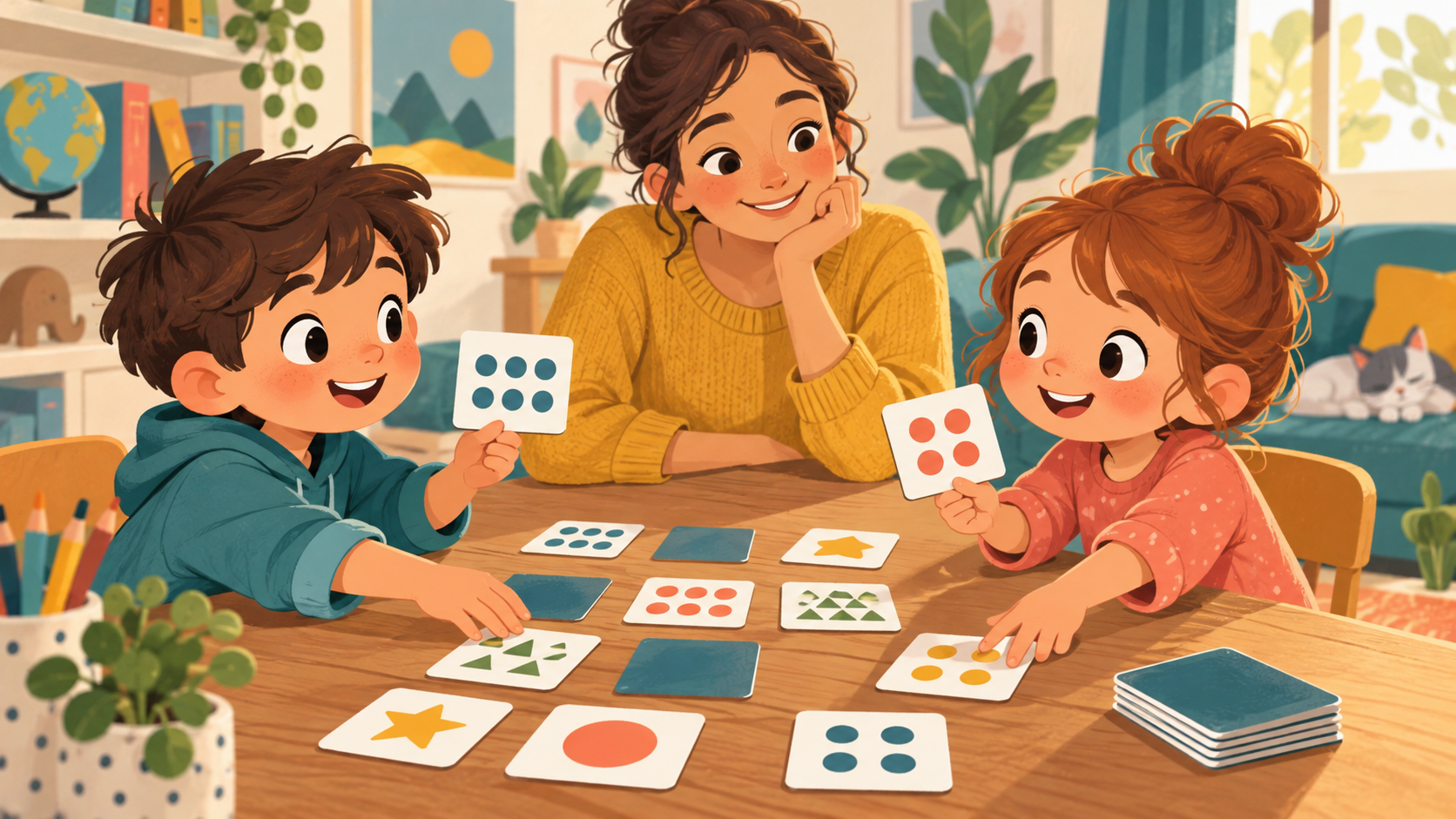
What you need: a regular die and a sheet showing the chosen table. For example, write “× 7” in the middle. Take turns rolling the die, multiply the number by 7, and explain your answer. A roll of 4 gives 4 × 7 = 28.
Keep track of which numbers have come up and try to get them all. Set a limit on the number of turns before you start—no need to wait ages for a missing number. It's a shared challenge, with no losers.
One thing to know: a standard die goes from 1 to 6. Two ordinary dice multiplied together won't practise the 7, 8, 9, or 10 times tables directly. To cover the whole table, swap the die for slips of paper numbered 1 to 10 and draw them from a bowl.
The rows game: seeing that 3 × 4 = 4 × 3
With counters, pasta, or Lego, ask your child to build 3 rows of 4. Count together: 12. Then turn the paper a quarter turn. Now you see 4 rows of 3… and still 12 counters. The order of the numbers doesn't change the answer.
This discovery is very reassuring: if your child knows 3 × 8, they also know 8 × 3. Turn it into a game: one player says a calculation, the other has to 'flip' it and give the answer for both.
Free multiplication games, no need to buy anything
Multiplication bingo
Each player draws a 3 by 3 grid and writes nine answers from the table they're practising, in any order. For the 5 times table: 5, 10, 15, 20, 25, 30, 35, 40, 45. The caller draws a slip from a bowl and reads out the calculation, for example “6 times 5”. Whoever has 30 covers it with a counter. The first to complete a row wins, then swap roles for the next round.
Multiplication hopscotch
Draw a hopscotch grid with chalk and write an answer in each square. Before jumping in, your child gives a calculation that makes that number: for 24, “4 times 6” or “3 times 8”. Here, there are several correct answers—and that's the point: your child sees that the same answer can come from different tables.
Oral challenge: play together instead of racing
In a queue or while walking, an adult suggests a calculation. The child answers, then becomes the caller. In the car, the driver doesn't join in—they need to keep their focus on the road. Avoid firing off questions too quickly and give time to think.
If your child hesitates on 7 × 4, offer a prompt: “You know 7 × 2; can you double that?” That takes you from 14 to 28. Work out a few answers together, then move on to something else. For more practical ideas, see our tips for helping your child with maths and our article on learning through play.
Learning multiplication tables through play: good habits
- One table at a time to start with. Mixing all the tables too soon turns the game into a guessing game.
- No timer at the beginning. Let your child work it out and check. Quick-fire challenges come later, only with answers they already know, and never in competition with a sibling or adult.
- Fewer calculations instead of penalties. If mistakes keep happening, remove some cards rather than adding forfeits.
- Go back to hands-on if needed. If your child doesn't yet understand what multiplication means, return to small groups of objects before asking for answers by heart.
- Say the whole equation. “6 times 7, 42” is easier to remember than just “42” on its own.
To prepare your cards or bingo grids, the printable multiplication tables are a handy reference: just copy the calculations you want. Some tables are trickier than others; for those, a little trick can help, like the finger trick for the 9 times table, which you'll find in The Big Book of Memory Tricks.
A game for learning multiplication tables, not a disguised test
A game should stay fun. If your child sighs as soon as you get the cards out, take a break for a few days or let them choose the rules. If difficulties persist, it's worth talking to their teacher.
If you're after a real break with no sums at all, Le Grand Saut is our free online mini-game: your child picks a Kidibook mascot, jumps over obstacles and collects stars on a computer, tablet or mobile, no sign-up needed. It’s not about practising tables, and that’s just fine — not every game has to be an exercise.
When a times table just won’t stick, even after lots of games, a clever memory trick can make all the difference. The Big Book of Memory Tricks is full of illustrated tips to help remember tricky bits in maths, spelling and other subjects from CP to CM2 (age 6-11). A great addition to games: play to repeat, keep the trick for those calculations that get stuck.
Pick just one game tonight, one table, and play a round. Tomorrow, your child might well ask for a rematch.
Want to put these tips into practice?
Every day, a new adventure workbook adapted to your child's school level — to print or do on screen. No commitment.
Your questions
Which game should I choose if my child doesn’t know their tables yet?
Start with the dice game using just one table already covered in class, or try memory with the answers visible. Allow objects and a reference table. The aim is to help rebuild the answers, not to demand instant recitation.
Can you practise all the tables with two regular dice?
Not directly: a die has faces from 1 to 6. To include 7, 8, 9 and 10, pick numbered slips from 1 to 10 out of a bowl, or use one die for the target table and fill in with slips.
How can I make my own multiplication card game?
Cut out paper rectangles. Write a multiplication on one card and its answer on another, making sure all answers are different. With these pairs, you can play mistigri, memory or battle.
Do you need to time answers to make progress?
It’s not necessary for these games. Let your child take time to work things out and check. If they enjoy quick-fire challenges, only use them for answers already well known, and never compare with a sibling or adult.
Are there free multiplication games to play at home?
Yes: battle, mistigri, memory, bingo, hopscotch and oral challenges only need paper, a bit of chalk or nothing at all. Printable multiplication tables are handy for making cards and grids.
Does Le Grand Saut help revise multiplication tables?
No. Le Grand Saut is a free mini-game where you pick a Kidibook mascot, jump over obstacles and collect stars. For practising multiplication, use the card, dice or oral games described in this article.
Read next
 Learning through play
15 games to keep kids busy in the car (that get their brains working)
15 games to keep kids entertained in the car, with hardly any kit: classics and clever ideas that help revise …
 Learning through play
Free online educational games for primary: which to choose?
Compare free educational games from CP to CM2: reading, maths, ads and sign-up. Simple pointers for …
 Learning through play
Learning through play: helping your child without turning everything into homework
Learning through play from CP to CM2: simple activities, the right role for parents, and tips for balancing fun, …