📐 How to help your child with maths when you’re not confident yourself
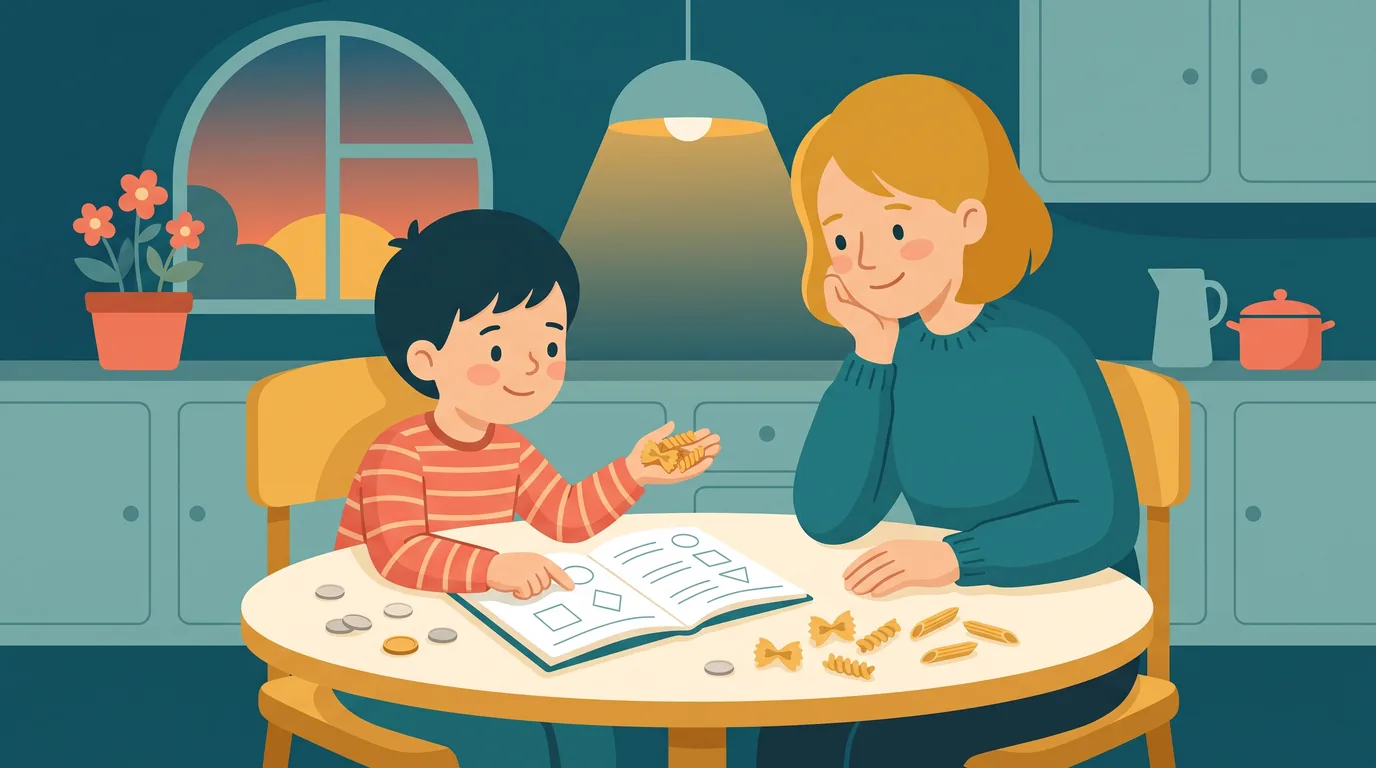
It’s 6:45 pm. Your child hands you their exercise book, points to a fractions question, and waits. You read the instructions twice. And honestly: you have no idea what to do either.
Good news: that’s not a problem. Helping your child with maths doesn’t mean you have to solve the exercise, but rather know what to say while they’re working it out. That’s a parenting skill, not a maths one — and you can pick it up in an evening.
Parents’ maths anxiety: the one phrase to avoid in front of your child
“I never understood maths either.” It’s meant to reassure, to show you’re on their side. But what your child hears is: not understanding maths runs in the family, so there’s no point trying. That gives them a valid excuse to stop making an effort.
This kind of anxiety is easily passed on at the dinner table: you read the question faster, sigh, get frustrated. The right approach isn’t to pretend you love fractions: it’s to stay neutral.
How to help your child with maths without re-explaining the lesson
Helping your child with maths doesn’t mean redoing the lesson for them. The most common instinct is actually the least helpful: explaining it your own way, often using a method that’s no longer taught at school. Your child ends up with two explanations and gets lost.
Instead, four simple steps are enough — and none require you to know how to do the exercise:
- Get them to read the question out loud. Many mistakes come from misreading. Ask: “What are you being asked to find?”
- Ask them to explain before they write. “Tell me what you’re going to do.” When children talk through their thinking, they spot half their own mistakes.
- Get them to draw it. If the question is about 24 marbles in 4 bags, draw the 4 bags. A simple diagram often does the trick.
- Ask “How did you work it out?” even when it’s right. Otherwise, your child thinks only the answer matters, and starts guessing instead of thinking.
One golden rule: never take the pencil. As soon as you hold the pen, it’s no longer their exercise.
The Singapore method: concrete, drawing, calculation
This well-known approach in France starts with real objects, moves on to drawing, and only then to numbers. You don’t need special equipment: pasta, coins and a tape measure cover all of primary school.
The real sticking points, level by level, from CP to CM2
People often talk about “children who struggle with maths” in general. But a CP problem is nothing like a CM1 problem: knowing which stage your child is at saves weeks of revising the wrong thing.
| Level | What’s at stake | Typical difficulty | What parents can do |
|---|---|---|---|
| CP | Building numbers up to 100, adding, subtracting | Counting on fingers one by one, not seeing groups | Use objects: 10 pieces of pasta in a bowl, group them together |
| CE1 | Numbers up to 1,000, first multiplication tables | Mixing up tens and hundreds digits | Write numbers in columns: c / d / u |
| CE2 | All tables, written multiplication, first two-step problems | Tables not automatic: all calculations slow down | 2 minutes of tables a day, not 30 minutes on Sunday |
| CM1 | Simple fractions, decimals, written division | Thinking a quarter is bigger than a half | Cut up a real tart or pizza |
| CM2 | Decimals, proportion, perimeter and area | Mixing up perimeter and area, misplaced decimal point | Measuring a room with a tape measure, comparing |
Two stages are where most children get stuck: number work in CE1 (age 7-8) and times tables in CE2 (age 8-9). If it's the tables, that's almost always the first domino. Our article on learning multiplication tables explains what really works, and the Printable Maths Memory Tricks keep helpful mnemonics in sight during homework.
The 10-minute daily routine (and everyday maths)
Ten minutes a day beats an hour on Sunday evening: maths needs regular practice, not marathons. What works: one topic, ten minutes on the clock, at a set time, and you stop even if it's not finished.
- 2 minutes of mental maths (tables, making 10, doubles).
- 5 minutes on a single topic: fractions this week, division next week.
- 3 minutes of “tell me”: your child explains what they've just done, without their exercise book.
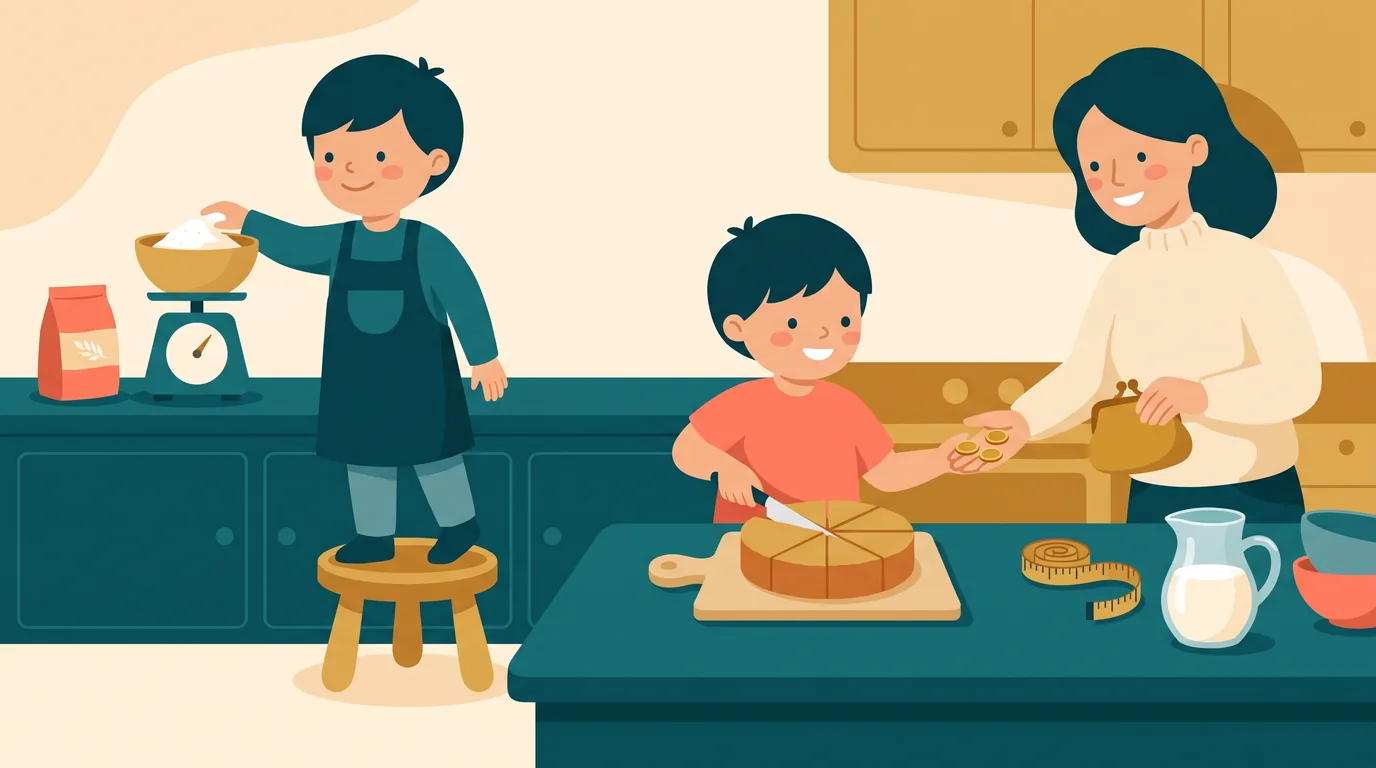
The rest happens away from the workbook: doubling a recipe, sharing a cake into eight, checking the change for bread. Real-life maths, and your child doesn't feel tested. For evenings when even ten minutes feels impossible, our guide to improving your child's concentration gives suggested timings by age.
Five homemade maths games, from CP to CM2
Fun maths isn't a reward after the work: it's practice in disguise, with no equipment or screens, and children join in willingly. Five games cover most of primary school:
- Bataille (CP-CE1): the highest card wins. Children compare numbers without realising.
- Two dice (CE1-CE2): roll, multiply the two numbers, fastest wins. The tables stick through play.
- The cashier (CE2-CM2): you're the customer, your child gives change from a real purse. Brilliant for decimals.
- The total is right (CM1-CM2): four random numbers, a target, get as close as you can.
- Recipe to adapt (CM1-CM2): 150g of flour for 6 servings, but you need 4. Fractions become a snack-time question.
How to help your child in maths when mistakes hold them back
Many children aren't stuck on the topic itself, but on the fear of making mistakes: in maths, errors are obvious and can't be argued.
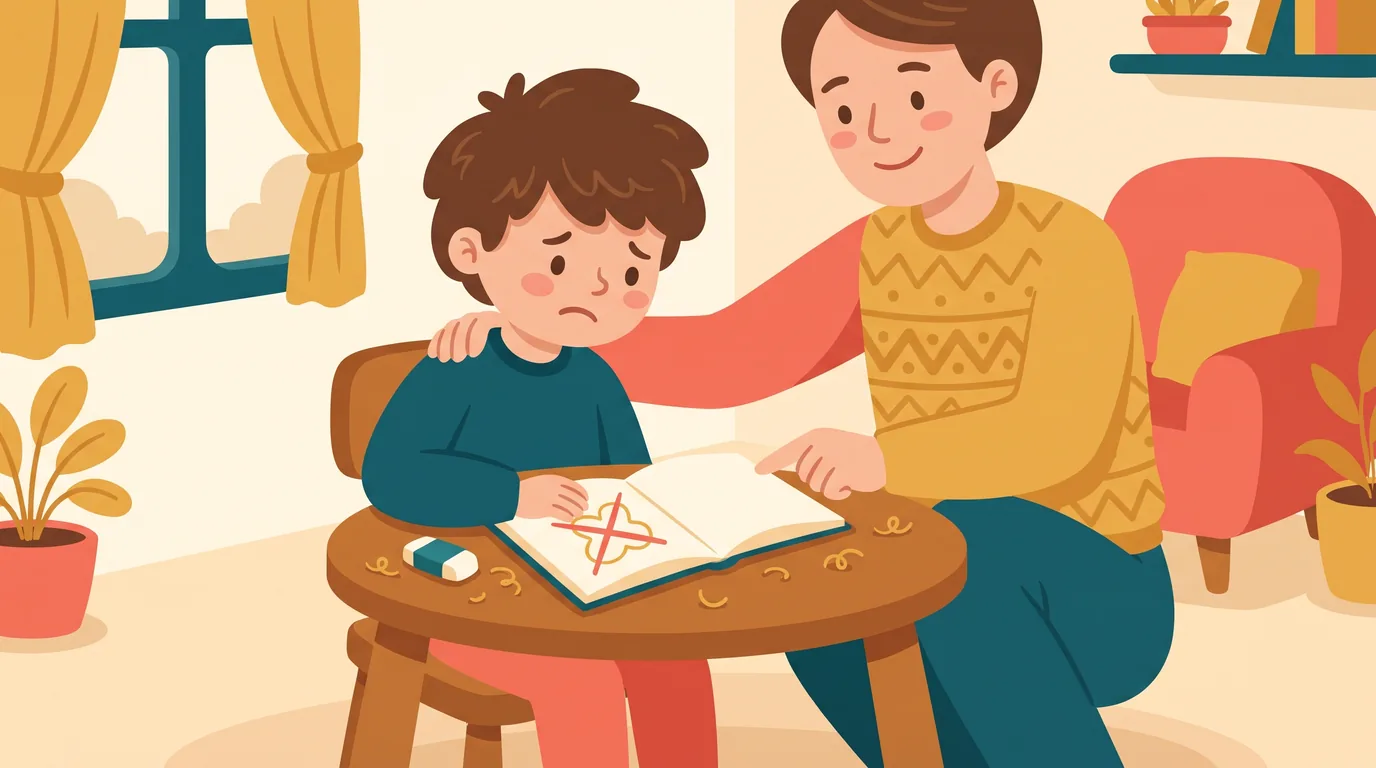
Two phrases can change the mood in the evening. The helpful one: “show me where it got tricky”, which treats mistakes as information, not as faults. The one to avoid: “but it's easy!”. If it were easy, it would be done already; your child ends up thinking they're the problem.
When refusal is set in and the workbook brings on a meltdown, it's no longer about maths. Our article on helping a child who refuses to revise tackles the issue from the right angle.
When to worry (and when not to)
A bad test, a topic that takes three weeks to click: nothing to panic about. What deserves a closer look is when things persist—
- your child still counts everything one by one on their fingers at the end of CE1;
- they keep mixing up how to write numbers (writing “30007” for 307);
- they can't say what a problem is asking, even when you read it together;
- tears come before the first exercise, every evening.
The order of steps matters here. First, talk to the teacher, who sees your child in class and knows if it's just a temporary gap. Next, the doctor can refer you for an assessment if needed—the speech therapist is the professional who checks for calculation difficulties.
In the vast majority of cases, it's just about regularity and confidence. Ten minutes a day, practical maths, a parent who listens more than explains. The printable maths exercises from Kidibook workbooks are designed for this pace: one short page a day, by level, ready to put on the table with no prep.
Want to put these tips into practice?
Every day, a new adventure workbook adapted to your child's school level — to print or do on screen. No commitment.
Your questions
Why does my child struggle with maths?
In most cases, an earlier topic isn't solid and blocks everything that follows: if the tables aren't automatic, written multiplication slows down; weak number work throws off decimals. The second, very common reason is fear of making mistakes. First, spot which stage is tricky (see the level-by-level table) rather than starting all over again.
How do I explain maths to a child who doesn't understand?
By stopping explaining. Have them read the question out loud, then say what they're being asked to find, then draw the situation. If nothing comes, use real objects: pasta, coins, a real slice of cake. Only go back to written numbers once the situation is clear.
Should I get a private maths tutor in primary school?
Rarely as a first step. Start by talking to the teacher: they see your child working and know if the gap is just a phase. A short, daily routine at home solves many problems. Private lessons are useful if the block persists despite this, or if homework has made the parent-child relationship too tense.
How can I help a child who thinks they're bad at maths regain confidence?
By helping them succeed at short, manageable tasks. A set of sums at their level, finished in three minutes, is better than a tricky exercise left incomplete. Praise their approach rather than just the result: “You reread the question before starting — that’s exactly what you should do.”
Read next
 Revision techniques
Does your child refuse to revise? 7 methods that really work
Refusal, tears, arguments? Discover 7 parent-approved ways to help your child revise without drama: short sessions, rit…
 Revision techniques
The syllabic method for learning to read: why it’s making a comeback
Syllabic method for learning to read: how it differs from the global method, and what the official recommendations say…
 Revision techniques
Boosting your child’s concentration: 10 practical strategies at home
How to improve your child’s concentration: realistic attention spans by level, 10 strategies you can use tonight, and the si…