🇬🇧 Tip for learning English: irregular verbs, vocabulary and false friends
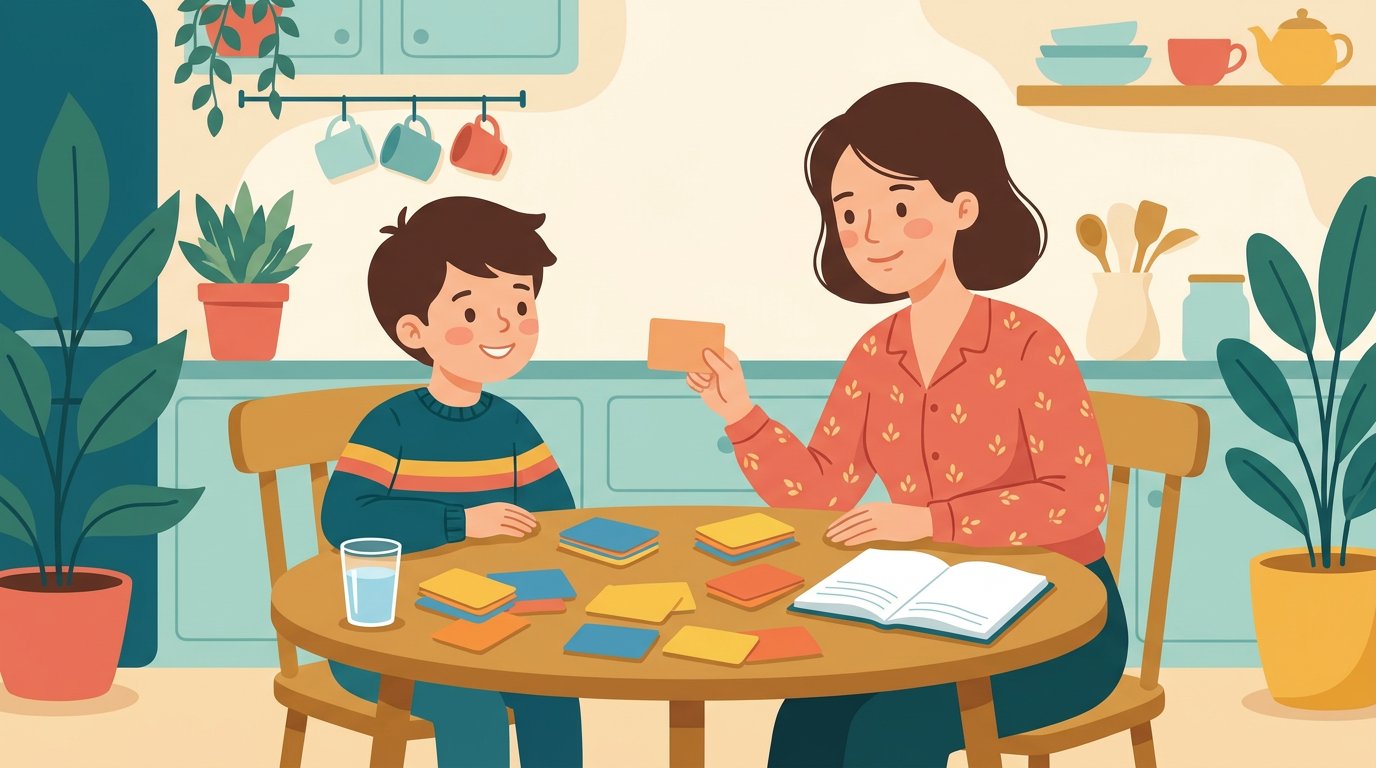
He’s been revising his irregular verbs for twenty minutes. You hear “bring, brought, brought” repeated like a mantra, then a long pause, then “wait, what was it again?”. Tomorrow morning, the test will be on the verbs in the middle of the list, and he’ll have forgotten half of them.
The problem isn’t the effort: it’s the method. Reading through a list in alphabetical order asks the brain to remember dozens of unrelated facts. A good tip for learning English does the opposite: it creates the missing link. A sound, a picture, a silly little phrase. That’s the whole idea behind an English mnemonic.
Here are the ones that really work for children, from CM1 up to the start of collège: to remember vocabulary, learn irregular verbs, spell tricky words and spot false friends. None require you to be bilingual. You can try the first one this evening.
Why a tip for learning English beats rereading
A list of isolated words is what memory dislikes most: no logic, no story. The brain remembers what it can connect to something it already knows. A mnemonic creates that hook.
For foreign languages, the best-known technique is the keyword method. It was described in the 1970s by American psychologists Richard Atkinson and Michael Raugh, for Russian vocabulary. The idea is simple: link the foreign word to a French word that sounds similar, then create a picture that joins the two meanings. It works just as well for English:
- carpet (tapis) → a carpe (carp) sleeping on the living room carpet;
- chair (chaise) → chair de poule (goosebumps) when you sit on a freezing chair;
- grapes (raisin) → a grappe (bunch) of grapes.
The sillier the image, the better it sticks. You’ll remember a carp on a carpet, but never line 47 of a list.
Second trick: test yourself instead of rereading. Turn the sheet over, try to recall everything, then check. This is the approach explained in our article on how to learn a lesson by heart, and it works just as well for English.
Learning English vocabulary from primary school
In CM1 and CM2, English is mostly about words: colours, numbers, days, things around the house. It’s the perfect time to build good habits, without pressure.
The days of the week have a story
Three English days are easy to remember when you know their origin:
- Sunday = the day of the Sun;
- Monday = the day of the Moon. Just like in French: lundi is also the day of the Moon;
- Saturday = the day of Saturn, the planet Saturn.
For Wednesday, the trickiest word to spell all week, read it as it’s written, in three parts: “Wed – nes – day”. Then say it normally, but your eye will remember the hidden d.
Question words and tricky numbers
- WH questions: who, what, where, when, why. Nearly all question words start with wh. The odd one out is how: it hides its w at the end.
- -teen or -ty? thirteen (13) and thirty (30) look very similar. Remember that -teen is long and the stress is at the end (thir-TEEN), while -ty is short and the stress is at the start (THIR-ty). All the numbers from 13 to 19 have “teen”: that’s why teenagers are called teenagers.
The labelled house
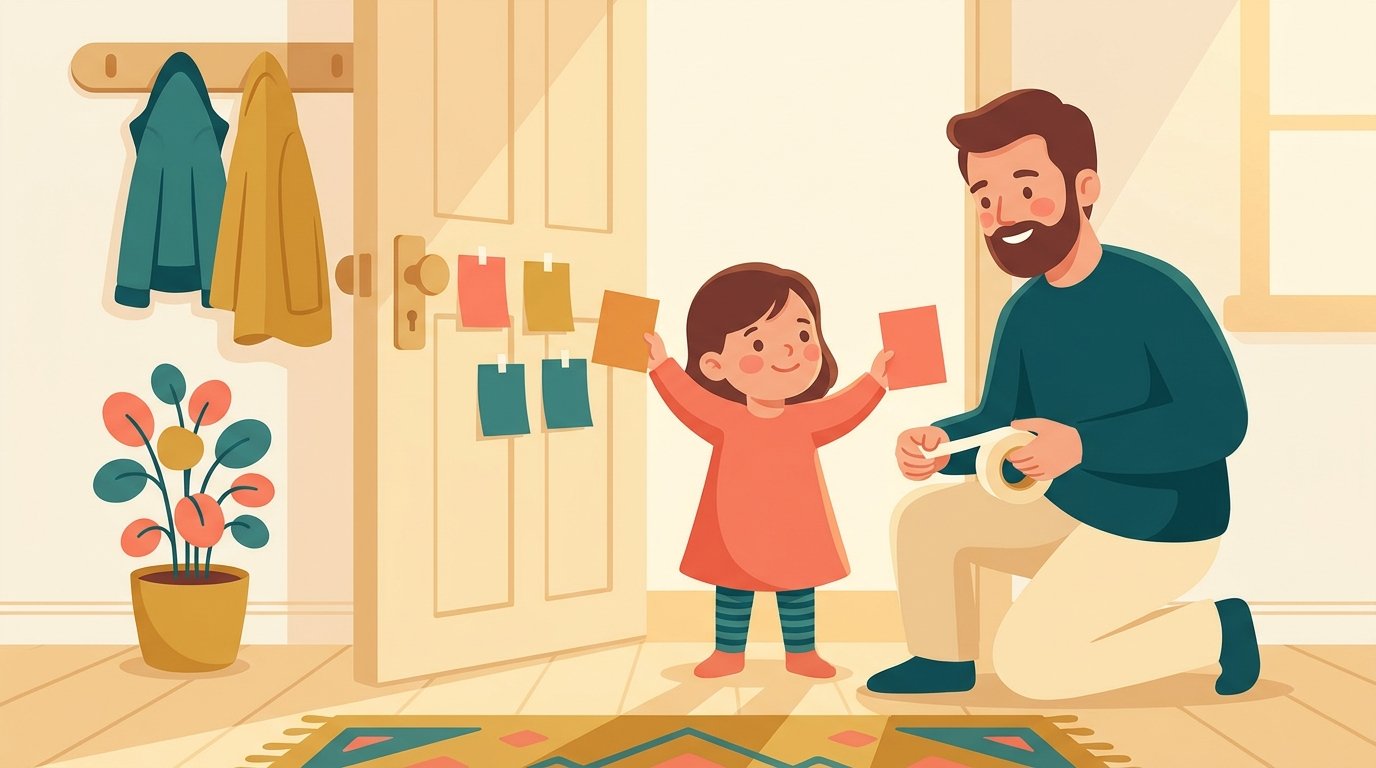
A super simple way to remember English vocabulary: stick labels on things around the house. door on the door, fridge on the fridge, window on the window. Your child sees the words ten times a day without “revising”. Change the labels each week, and ask them to stick them back in the right place themselves.
For more, The Big Book of Memory Tricks brings together this kind of short, illustrated tips for primary school, including English: see the book.
Learning English irregular verbs by sound families
The trick that changes everything: never learn verbs in alphabetical order, but group them by sound family. Irregular verbs aren’t random: many follow the same patterns, inherited from Old English. Once you spot the pattern, you learn five verbs for the price of one.
| Family | Pattern | Other verbs | The trick |
|---|---|---|---|
| I → A → U | sing / sang / sung | ring, drink, swim, begin, sink | Chant the series: “i, a, u”. One tune for six verbs. |
| The “-ought / -aught” group | bring / brought / brought | buy, think, fight, catch, teach | The past simple and past participle are the same and end with the same sound, similar to “ôte”. |
| -EW → -OWN | know / knew / known | grow, throw, blow, fly | Past simple in -ew, past participle in -own: fly, flew, flown. |
| The O in the middle + -EN | speak / spoke / spoken | break, wake, choose, freeze, steal | The vowel changes to “o”, then the participle ends in -en. |
| The lazy ones | cut / cut / cut | put, let, hit, cost, hurt, shut, set | Three identical forms: nothing to learn, just spot them. These are short verbs. |
Two tricky ones to point out to your child while sorting the list:
- read / read / read is spelled the same three times, but pronounced differently: “reed” for the base form, “red” for the past simple and participle. Easy in writing, tricky when speaking.
- be and go don’t belong to any family: be, was/were, been and go, went, gone. They’re loners. Learn them separately, once and for all.

Spelling: key phrases that save tricky words
The English words French children misspell are almost always the same ones. In English-speaking schools, they’re taught with silly phrases. And it works.
- because → Big Elephants Can Always Understand Small Elephants. The initials spell b-e-c-a-u-s-e.
- beautiful → Big Elephants Are Ugly for the start b-e-a-u, the trickiest part.
- rhythm → Rhythm Helps Your Two Hips Move. The word with no obvious vowel becomes a phrase.
- necessary → a shirt has one collar and two sleeves: one c, two s.
- friend → a friend stays with you to the end, and the end of the word is end.
- separate → there’s a rat in sep-a-rat-e. No more “seperate”.
- hear → you hear with your ear. And here is the place: “ici”.
“I before E except after C”: the rule… and its limit
It’s the most famous spelling rhyme in the English-speaking world: i before e, except after c. It explains believe, piece, field on one side, receive, ceiling on the other.
A fair warning, to avoid disappointment: the rule mostly works when you hear the “ee” sound. The longer version adds or when sounded as A, as in neighbour and weigh, which explains eight or weight. And there are still a few rebels to learn by heart, like weird, seize or either. For primary, the short version is more than enough.
False friends: a mini-story for each word
False friends cost marks in every test, because they don’t sound like mistakes. The trick is always the same: a little story-image, learned once, that locks in the meaning.
- actually = in fact (not “actuellement”). “Actuellement” is currently: think of an electric courant, flowing right now.
- library = bibliothèque. You’re libre to leave without paying; a librairie is a bookshop.
- eventually = finally, in the end. The event always happens eventually.
- sensible = reasonable, full of good sense. “Sensible” in French is sensitive.
- to attend = to be present at. You’re not waiting: you’re already in the room. “Attendre” is to wait.
- a journey = a trip, a voyage. The day is a day.
- to pass an exam = to succeed in an exam. To say “passer” an exam, use to take an exam.
Turn it into a wall: seven little cards, English word on the front, mini-story on the back, stuck inside a door you open every day. You’ll see them dozens of times a week without thinking about it. The same trick works for French invariable words.
The 5-verbs ritual: the trick to learning English without spending hours
A mnemonic doesn’t replace repetition: it makes it short. The rhythm that lasts all school year fits one rule: five verbs a week, from the same family, and a few minutes a day. Not an hour on Sunday night.
- Monday: choose. Five verbs from the same sound family, written by hand on five little cards: English on the front, French on the back.
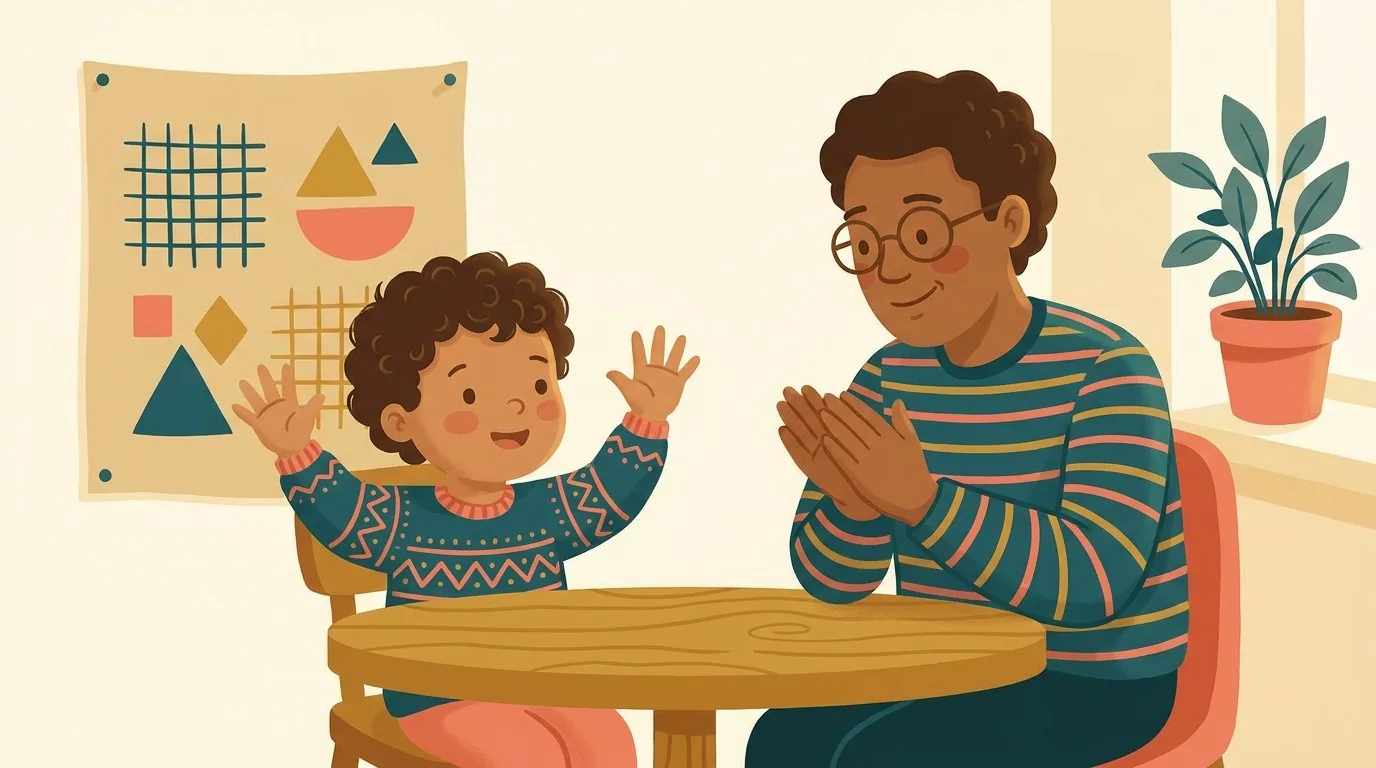
- Tuesday: say them aloud. Say all three forms out loud, clapping hands: sing, sang, sung. The rhythm does half the work.
- Wednesday: writing practice. The five memory verbs, cards turned over. Then they mark their own work.
- Thursday: using them. Make up a sentence for each verb, even a wobbly one: “I drank my milk.” Using a verb in a sentence sticks better than just reciting it.
- Friday: mix it up. The five from this week, plus a few old ones picked at random. This mix is what stops you forgetting previous weeks.
Week by week, the card box grows—without a single evening of cramming. Keep it: you’ll use it all through collège.
Three mistakes that waste time
Mnemonics work—as long as you don’t turn them against yourself.
- Wanting a trick for everything. A trick is for a specific hurdle, not a replacement for learning. Regular verbs ending in -ed don’t need any magic phrase.
- Making up the trick for them. An image invented by your child will always mean more than one you suggest. Explain the idea, then let them come up with something silly.
- Giving them all the night before. A trick discovered the night before gets forgotten with the rest. It needs to be in place before it’s needed.
Not sure where to start? Our selection of essential mnemonics covers French, maths and history with the same approach. And if your child is about to start collège, our article on getting ready for 6e will help you build good habits.
Want all these tricks in one place, ready to open in the evening? The Big Book of Memory Tricks brings together primary school mnemonics, including English, as handy illustrated cards with exercises. For collège, the Middle School volume takes over with the preterite, comparatives, and other topics that come up in tests.
Above all, remember: one trick per hurdle, two max per evening, and a little bit every day. English becomes a game again, and irregular verbs just a simple tune.
📘 All these tips are also in book form: The Big Book of Memory Tricks — Middle School — irregular verbs and the 8 other collège subjects.
Want to put these tips into practice?
Every day, a new adventure workbook adapted to your child's school level — to print or do on screen. No commitment.
Your questions
What’s the best trick for helping a child learn English?
For vocabulary, use the keyword method: link the English word to a similar-sounding French word, then imagine a funny scene (a carp on a carpet for “carpet”). For irregular verbs, group them by sound families instead of alphabetically. In both cases, test yourself instead of just rereading.
From what age can you use mnemonics in English?
From CM1-CM2 for vocabulary: days of the week, numbers, household objects. Irregular verb families become really useful in 6e and 5e, when the list appears in their workbook. The key is to keep sessions short and fun.
How can you learn English irregular verbs without spending hours on them?
Pick five verbs from the same family each week, for example sing, ring, drink, swim and begin. A few minutes a day is enough: say them aloud, write them from memory, use them in a sentence, then mix them with the old ones on Friday. Consistency matters far more than time spent.
How many irregular verbs should you know at the start of collège?
The lists handed out at collège are long, but only a small group keeps coming back: be, have, do, go, say, make, take, come, see, get, know, think, give. Start with these, then move on family by family. The rest will come over the years.
My child is mixing up two tricks—what should I do?
It’s often a sign they’ve had too many at once. Keep the one they like best—ideally one they made up themselves—and wait a week before adding another. Two solid tricks are better than six shaky ones.
Should you learn pronunciation at the same time as spelling?
Yes—and that’s what makes verb families so effective: they’re based on sound first. Have them say all three forms out loud before writing them. The verb read, which looks the same but sounds different, shows that ear and eye don’t learn the same way.
Next to read
 Memory tricks & memorisation
Mnemonics: essential tricks for remembering, from CP to collège
Essential mnemonics: tried and tested examples for spelling, conjugation, maths and science, plus the method…
 Memory tricks & memorisation
Learning multiplication tables: the plan that finally works
Learning multiplication tables without the drama: the right order, one trick per table, the 9 times table on your fingers and…
 Memory tricks & memorisation
Mnemonic for the planets: remember the order of the solar system in one sentence
Mnemonic for the planets: the sentence to remember the order, from Mercury to Neptune, the trap with the two Ms, and why…