🎒 Preparing to start 6e: the calm parents' guide for CM2

Your child is finishing CM2 (10-11 years old) and, in a few weeks, will push open the door of middle school for the first time. It's a real milestone—for them, but often for you too. The good news is that prepare for entry into 6th grade does not require turning the summer into a revision course. 6e is even designed as a smooth transition year. The essential part happens elsewhere: in autonomy, organization, and confidence. Here is what really changes, a realistic checklist for the last weeks, and the few concepts to consolidate without ruining the holidays.
Starting 6e: what really changes after CM2
What impresses the most when arriving at middle school is not the level: it is the change in how things work. In CM2, your child had one teacher for almost everything, one classroom, a reassuring rhythm. In 6e, everything multiplies. Reassure them (and yourself): tens of thousands of children make this leap every year and get used to it in two or three weeks.
| In CM2 | In 6e |
|---|---|
| One teacher for most subjects | A different teacher for each subject |
| One fixed classroom | Changing classrooms depending on the lessons |
| Same schedule every day | Different schedule depending on the day |
| Little or no written homework | Homework to note and organize alone |
| The communication notebook signed by parents | Correspondence book + often a school life software (like Pronote) |
One point deserves to be known to reduce stress: 6e is the last year of cycle 3, the “consolidation cycle” which starts from CM1 (4th grade). In other words, the programs are designed to link with primary school, not to revolutionize everything at once. Your child will find in 6e many things seen in CM1 and CM2, deepened step by step.
Preparing for 6th grade: the checklist for the last weeks
No need to do everything in July. Save the bulk for the end of August, when the brain and rhythm slowly get back on track. Here is a simple and pressure-free plan.
- Reset sleep the last week: go to bed 15 minutes earlier each day, wake up at a fixed time. A tired middle schooler quickly loses focus.
- Review telling time and using a planner: in 6th grade, knowing how to read a schedule and find your way through the week becomes vital.
- Automate multiplication tables : they will be used every day in math. Five minutes here and there is enough.
- Practice packing the school bag alone and organizing belongings by subject.
- Locate the middle school if possible: walk past it, look at the map, demystify the route and the cafeteria.
- Prepare the supplies calmly, without overspending: most primary school supplies can be reused.
If your child has had a 100% relaxing summer, no worries: a gentle restart over ten to fifteen days is enough. Our free printable CM2 summer workbook precisely revisits, in adventure mode, the key end-of-primary concepts — a good starting point to get back into the swing of things without it feeling like school.
Autonomy: habits to establish before 6th grade
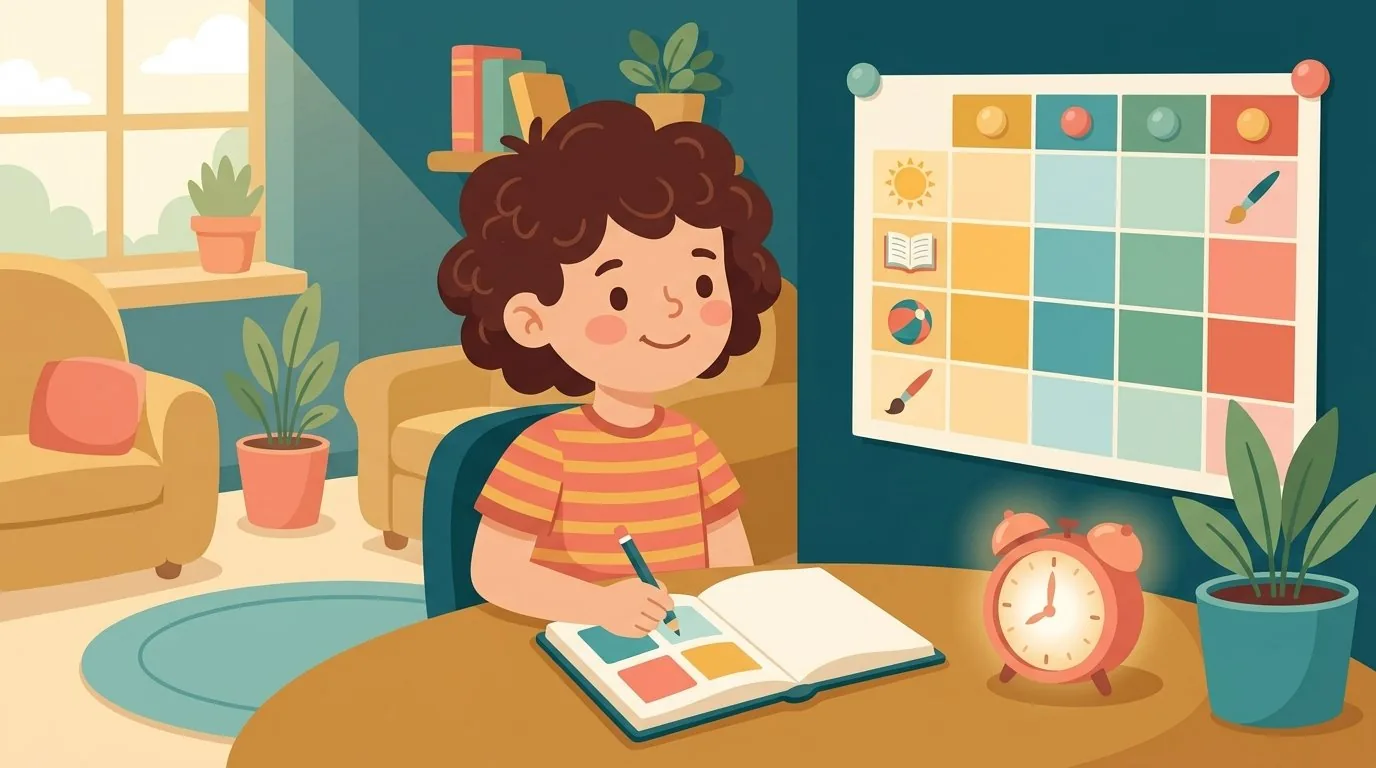
This is THE word for 6th grade: autonomy. In middle school, no one will remind your child to write down homework or take out the right notebook. These habits are learned, and summer is the ideal time to start.
Writing down and organizing homework
Teach them to write their homework in a planner on the correct date, then to spread it out over the week rather than doing everything the night before. This little exercise prevents Sunday night overload.
Managing time and materials
A middle schooler juggles several subjects in the same day. Organizing the bag by subject, having a complete pencil case, keeping notes in order: these may seem trivial but make all the difference in class.
Dare to ask
With several teachers, a child who doesn’t dare to speak up can go unnoticed. Remind them they have the right to raise their hand, ask to repeat, or see an adult (homeroom teacher, student life office, nurse). Knowing how to ask for help is a skill, not a weakness.
Reviewing for 6th grade without cramming: key concepts to consolidate
Should you review a selection of primary school concepts? No. It's better to focus on a few solid basics that will serve as foundations. Here are the points on which a future 6e (11-year-old, first year of middle school) should be comfortable — to review in small doses, never in a marathon session.
| Subject | To consolidate before 6th grade |
|---|---|
| French | Fluent reading, understanding instructions, simple agreements (subject-verb, within the noun group), conjugation of basic tenses |
| Math | Multiplication tables, the four written operations, an initial sense of proportionality |
| Method | Learn a lesson by heart, proofread yourself, write legibly and a bit faster |
| Organization | Read a timetable, keep a planner, prepare your bag |
Motivating news to announce to your child: 6e (first year of middle school) brings real new subjects, such as SVT (Life and Earth Sciences), technology orhistory-geography with specialized teachers. English started in primary school continues; the second foreign language (LV2) will only begin in 5e (second year of middle school) — no need to worry about it this summer. For everything that needs to be memorized (tables, dates, conjugations, formulas), the good old memory tricks work wonders: our article on essential mnemonic devices is full of them.

Prepare for entering 6e calmly: the right role of parents
Your greatest lever is not academic, it is emotional. A child who starts 6e with confidence learns better than a worried child, even if very well prepared academically. Practically: talk about middle school positively, listen to their concerns without dismissing them (“what if I get lost?”, “what if I have no friends?”), and remind them that everyone starts at the same time.
Support without doing it for them: help them organize the first weeks, then gradually step back to let them fly on their own. And keep in mind that a slight wobble in September is normal: the adjustment period exists for everyone. If real anxiety persists beyond a few weeks, a word to the homeroom teacher often unlocks the situation.
In summary, to do well prepare for entry into 6th grade : understand what changes, install autonomy step by step, consolidate some basics without cramming, and above all bet on confidence. Your child is much more ready than you think — and this new big step can become a wonderful momentum.
📘 All these tips are also available in book form: The Special Middle School Reminders — everything needed to start 6e with a method, not just supplies.
Want to put these tips into practice?
Every day, a new adventure workbook adapted to your child's school level — to print or do on screen. No commitment.

Your questions
Should we review all summer to prepare for entering 6e?
No. 6e is the last year of cycle 3, designed to link with CM1 and CM2 (ages 9-11): nothing urgent to review. Better to target a few basics (fluent reading, multiplication tables, agreements, method to learn a lesson) in small doses, and keep real holidays. Autonomy and confidence count at least as much as knowledge.
What changes the most between CM2 and 6e?
Mostly the way it works: a different teacher for each subject instead of just one, classrooms that change, a timetable that varies by day, and homework to note and organize by oneself. The level progresses gently. That’s why organization and autonomy are the real priorities of the summer before 6e.
How can I help my child become autonomous before middle school?
Train them in concrete actions: prepare their schoolbag the night before by reading the next day's timetable, write down homework in a planner and spread it over the week, tidy their things by subject. Do it first with them, then beside them, then let them do it alone. Also remind them they have the right to ask an adult at school for help.
My child is stressed about starting 6e, what to do?
Listen to their concrete worries (getting lost, the cafeteria, making friends) without minimizing them, talk about middle school positively and, if possible, visit the school together before the start. Remind them that all students start at the same time and that an adjustment period is normal. If anxiety persists for several weeks, talk to the homeroom teacher or school life staff.
To read next
 Preparing for back-to-school
Preparing for CP entry during the summer: the 7 real priorities
Preparing for entry into CP without cramming: the 7 real summer priorities, what is learned in class and a 10-minute ritual…
 Preparing for back-to-school
Revising before back to school in August: the program for the last 2 weeks
Revising before back to school in August without stress: a gentle 15-day plan to restart the rhythm and key concepts, cla…
 Preparing for back-to-school
Primary homework routine: the guide by level, from CP to CM2
Primary homework routine: what time, how long by level, the 5 steps that last all year and what to do…