🪐 Mnemonic for the planets: remember the order of the solar system in one phrase
"Where is Saturn again?" Your child has a lesson on the solar system to learn by Thursday, and the eight names happily mix up in their head. This is perfectly normal: no one remembers a list of eight abstract words in a precise order. You need a hook.
This hook is the mnemonic for the planets : a little phrase whose initials give back the exact order, from the closest to the Sun to the farthest. Five minutes are enough to learn it… and many adults still use it thirty years later. Here is the phrase, the table of the eight planets, the explanation of the Pluto mystery, and the method for your child to create their own.
The order of the eight planets, once and for all
In order, starting from the Sun: Mercury, Venus, Earth, Mars, Jupiter, Saturn, Uranus, Neptune. The first four are rockyplanets, with a surface where you could set foot. The last four are gas and ice giants : no solid surface, just layers of clouds as far as the eye can see.
This division into two families is already, in itself, a memory aid: four small, then four big. If your child hesitates between Jupiter and Mars, the question to ask is not "which comes first?" but "which is a giant?".
| Rank | Planet | Initial of the sentence | The key point to remember |
|---|---|---|---|
| 1 | Mercury | Me | the closest to the Sun — and the smallest |
| 2 | Venus | V | the hottest of all |
| 3 | Earth | T | ours: the only one with liquid water on the surface |
| 4 | Mars | M | the red planet |
| 5 | Jupiter | J | the largest in the solar system |
| 6 | Saturn | S | the one with spectacular rings |
| 7 | Uranus | U | the one that spins lying on its side |
| 8 | Neptune | N | the farthest — and the coldest |
This chart copies very well onto an A4 sheet to tape above the desk. A displayed lesson is a lesson reviewed twenty times effortlessly.
The mnemonic for the planets that works at all ages
The most common phrase in France is this one:
« Me VHere Tall Mwet, Je Sthen Unot Nwet."
Each word gives the initial of a planet, in order: Meercury, Venus, Tarth, Mars, Jupiter, Saturn, Uranus, Neptune. It is absurd, it is a bit silly: that's exactly why it sticks. The brain loves ridiculous images.
There are variants that circulate just as well, for example " Me Here All Cute, I Am a Nebula ". It doesn't matter which one you choose: the only rule is to keep only one at home. Two competing sentences, and the child mixes the two.
Beware of the classic trap: the sentence gives theorder, not the names. Check that your child can correctly go from “Me” to “Mercure” and from “U” to “Uranus”. Otherwise, they will recite a perfect rhyme without knowing what it is about.
Why Pluto is no longer in the sentence
If a grandparent recites theirs, it might end with a word starting with “P”. This is not a mistake: it is another era. For decades, people counted nine planets, including Pluto.
Everything changed on August 24, 2006 : gathered in a general assembly in Prague, theInternational Astronomical Union adopted an official definition of the word “planet”. To earn the title, a body must orbit the Sun, be large enough to have taken a nearly round shape, and have “cleared the neighborhood” around its orbit. Pluto meets the first two conditions, but not the third: it shares its neighborhood with many other icy bodies, some of comparable size. It was therefore reclassified as a dwarf planet.
Explained like this to a child in CM1 (9-10 years old), it is even an excellent science memory: knowledge is not fixed, it corrects itself. And it answers in advance the question they will inevitably ask.
Have your child invent their own mnemonic for the planets
A learned trick is well remembered. A trick made up is remembered much better because the child has done all the memorization work without realizing it while searching for their words. Here is how to proceed, in ten minutes at the breakfast table.
- Write the initials on a sheet: Me – V – T – Ma – J – S – U – N. Note well “Me” and “Ma” to never confuse Mercury and Mars.
- Look for words, randomly, without censoring. The funniest ones are the best.
- Choose the sentence that makes you laugh the most. Laughter is an excellent memory marker.
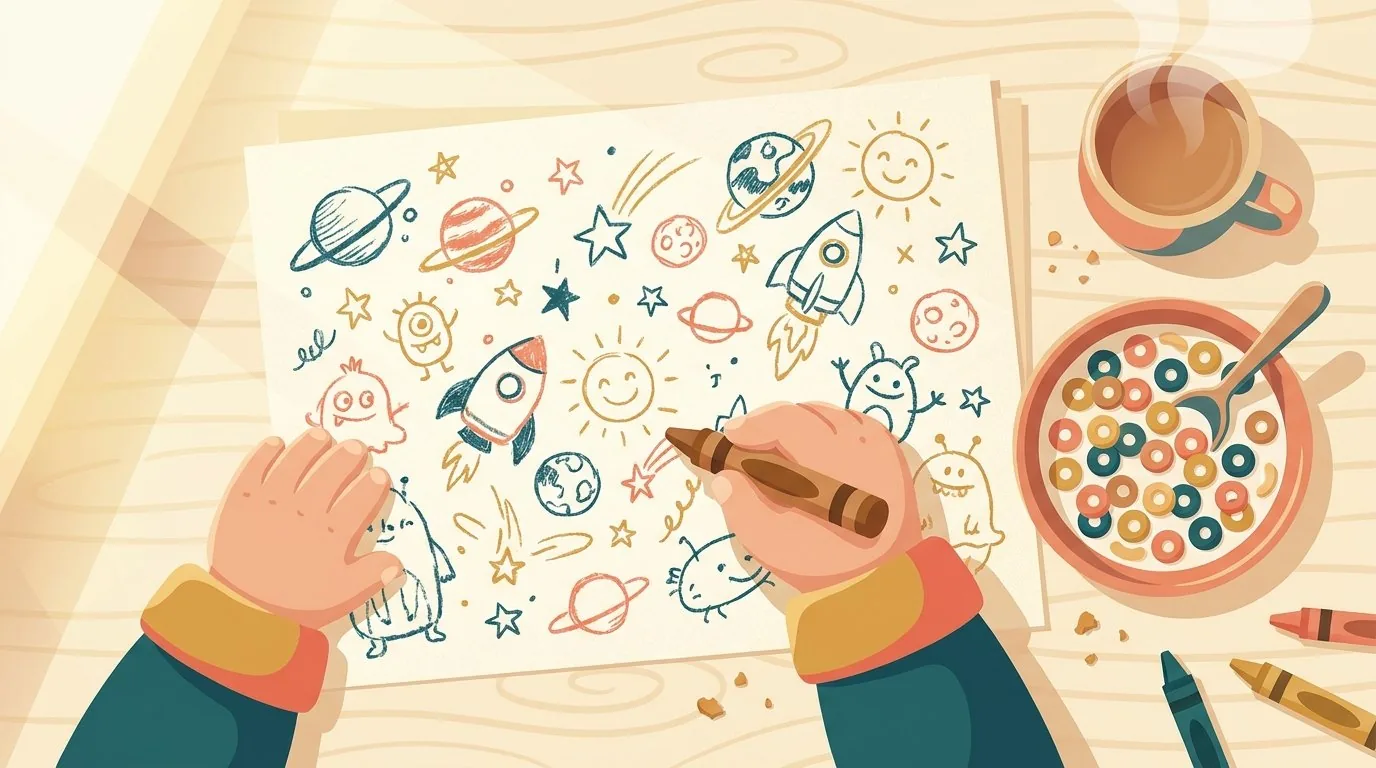
- Draw it. A silly, ugly, and funny drawing will seal the deal.
An example obtained this way in three minutes: “ Meednesday, VHere Three Manèges, Jhursday Sept Uniformes Neufs. » She is no better than ours; she is simply worth more for the child who found it.
The Sunday evening mini-quiz
A tip is only verified by testing it. To test yourself, precisely, is much more effective than rereading: five questions asked orally are worth half an hour of reread lesson. To ask at dessert, without a pen:
- Which planet comes just after Earth?
- How many planets are there in the solar system?
- Which is the biggest? And the closest to the Sun?
- Name the planets backwards, from Neptune to Mercury.
- Why is Pluto no longer a planet?
Answers: 1. Mars — 2. eight — 3. Jupiter; Mercury — 4. Neptune, Uranus, Saturn, Jupiter, Mars, Earth, Venus, Mercury — 5. because it has not "cleared the neighborhood" around its orbit.
Retake the quiz the next day, then a week later: it is this little spacing that moves the sentence from weekly memory to permanent memory. The same reflex works for multiplication tables — see our plan to learn multiplication tables — and for everything learned by heart. And if you are looking for something to intelligently occupy the end of the day, our free adventure workbook mixes exactly this kind of challenge with games.
📘 All these tips are also available in book form: Le Grand Livre des Pense-Bêtes — the planets, the rainbow, the rivers… and 130 other tips.
Want to put these tips into practice?
Every day, a new adventure workbook adapted to your child's school level — to print or do on screen. No commitment.
Your questions
What is the most well-known mnemonic for the planets?
"Me Voici Tout Mouillé, Je Suis Une Nouille" (Here I am all wet, I am a noodle). Each word gives the initial of a planet in order: Mercury, Venus, Earth, Mars, Jupiter, Saturn, Uranus, Neptune. A common variant is "Me Voici Toute Mignonne, Je Suis Une Nébuleuse" (Here I am very cute, I am a nebula).
What is the order of the planets in the solar system?
Starting from the Sun: Mercury, Venus, Earth, Mars, Jupiter, Saturn, Uranus, Neptune. The first four are rocky, the next four are gas and ice giants.
Why is Pluto no longer a planet?
On August 24, 2006, the International Astronomical Union officially defined what a planet is: it must notably have cleared the neighborhood of its orbit. Pluto shares its orbit with many other icy bodies; it was therefore reclassified as a "dwarf planet".
At what age is the solar system taught at school?
Locating Earth in the solar system is part of the science curriculum of cycle 3, that is, from CM1 to 6th grade. However, nothing prevents learning the sentence much earlier: many space-enthusiast children in CE1 memorize it in one evening.
To read next
 Memory aids & memorization
15 mnemonic techniques every student should know (from CP to Bac)
A good mnemonic technique gets a lesson into the head in a few seconds. Discover 15 proven tips, from …
 Memory aids & memorization
How to learn multiplication tables: the plan that finally works
In what order, with which tips and how much time per day? The concrete plan to learn multiplication tables…
 Memory aids & memorization
How to learn a poem quickly: the method in 4 evenings
How to learn a poem quickly: the method in 4 evenings of 10 minutes, the cloze text, tips by level …