✏️ Primary school supplies list: the waste-free guide from CP to CM2
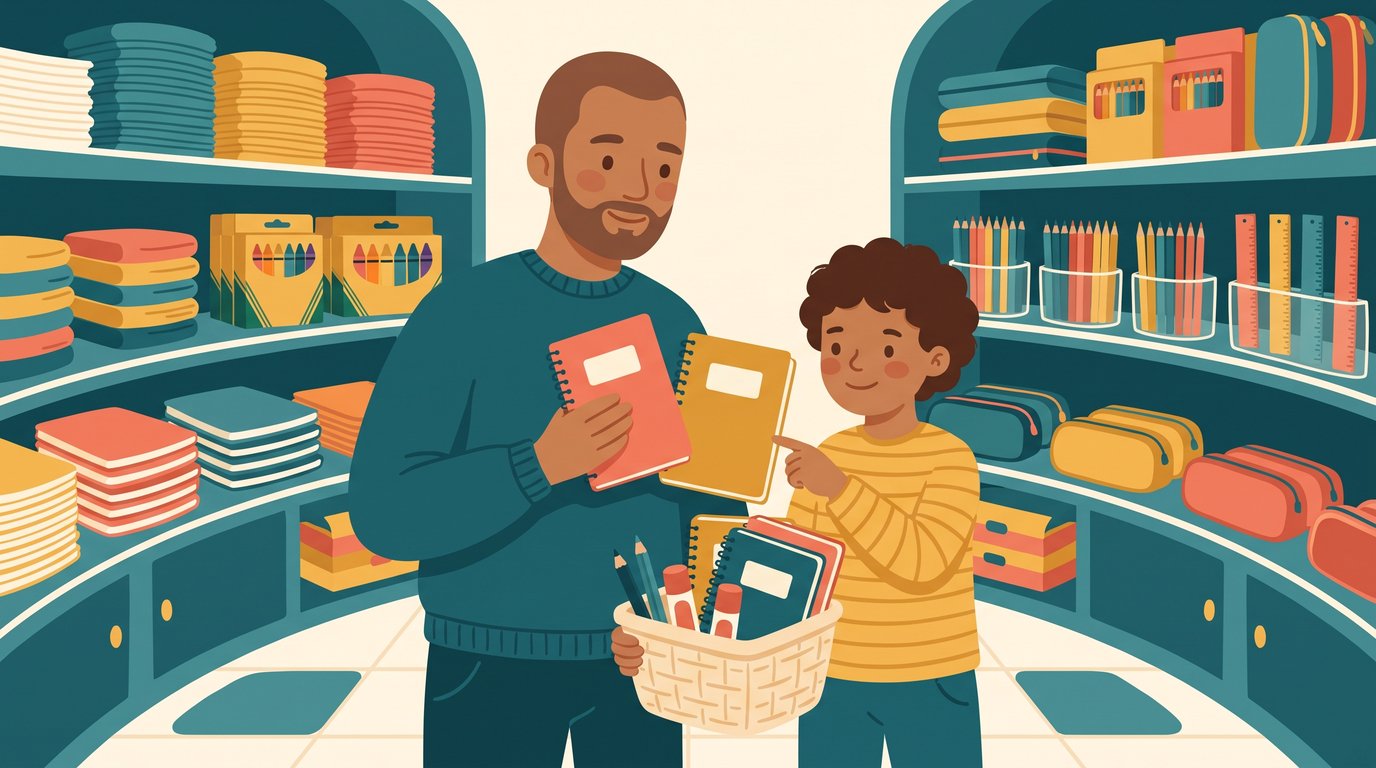
Every year at the end of August, the same scene: a school note in one hand, a shopping trolley in the other, and stationery aisles overflowing with colourful things no one really knows how to use. The primary school supplies list has a knack for making you spend twice as much, only to end up buying more glue by November. Here’s the clever version: what actually changes from CP to CM2, what you can reuse from last year, what you need to buy in pairs, and the common traps in the stationery aisle.
Primary school supplies list: why there’s no national list
Let’s start with the biggest money-saver: there’s no single national list for primary school. The Ministry of Education does publish recommendations to lighten schoolbags and bills, but the only list that matters for your child is the one their teacher gives you—usually at the start of July, sometimes only on the first day back.
Two classes at the same level, even in the same school, won’t have the same list: one asks for a display book, the other a ring binder. That’s normal, and it’s why buying ‘just in case’ gets expensive.
The best approach comes in three steps:
- Before you get the list: only buy universal consumables—glue, pencils, erasers, colouring pencils, felt tips. You can’t go wrong.
- When you receive the list: buy the exact formats (exercise books, line spacing, covers, binders) and nothing else.
- Mid-September: top up anything missing, once the class is settled and the back-to-school rush is over.
The back-to-school supplies list, level by level (from CP to CM2)
From one year to the next, the basics in the pencil case hardly change: pencil, eraser, glue, round-tipped scissors, pencil sharpener with container, colouring pencils, felt tips. What changes is the handwriting, the size of exercise books, and a few new tools as the years go by:
| Level | What’s added to the pencil case | Exercise books and line spacing | The detail that matters |
|---|---|---|---|
| CP | Wipe-clean whiteboard and pens, pencil that’s easy to grip | Small size, wide lines (Seyès 3 mm or double lines depending on the class) | Label everything with their name: at six, nothing finds its way back on its own |
| CE1 | Often the first blue ballpoint pen | Classic Seyès, usually 17×22 format | Glue runs out twice as fast as you expect |
| CE2 | 20 cm rigid ruler, sometimes a fountain pen and eraser pen | Large 21×29.7 format appears | First diary or homework notebook to manage alone |
| CM1 | Simple compass, highlighters, set square | Large format, display book or flexible binder | Check the number of rings and thickness of the binder required |
| CM2 | Compass, junior dictionary, sometimes a basic calculator | Binder, dividers, plastic wallets | What you buy this year will often be used again in 6ᵉ |
Two useful notes. In maternelle, the list is almost always just a bag, a box of tissues, a change of clothes and a pair of slippers: no pencil case needed, supplies stay in the classroom. And if you search online for ‘liste fournitures CE1’, ‘liste fournitures CE2’, ‘liste fournitures CM1’ or ‘liste fournitures CM2’, you’ll find very long lists: these are combined from several schools, not what your teacher expects.
What you can reuse from last year (and what really needs replacing)
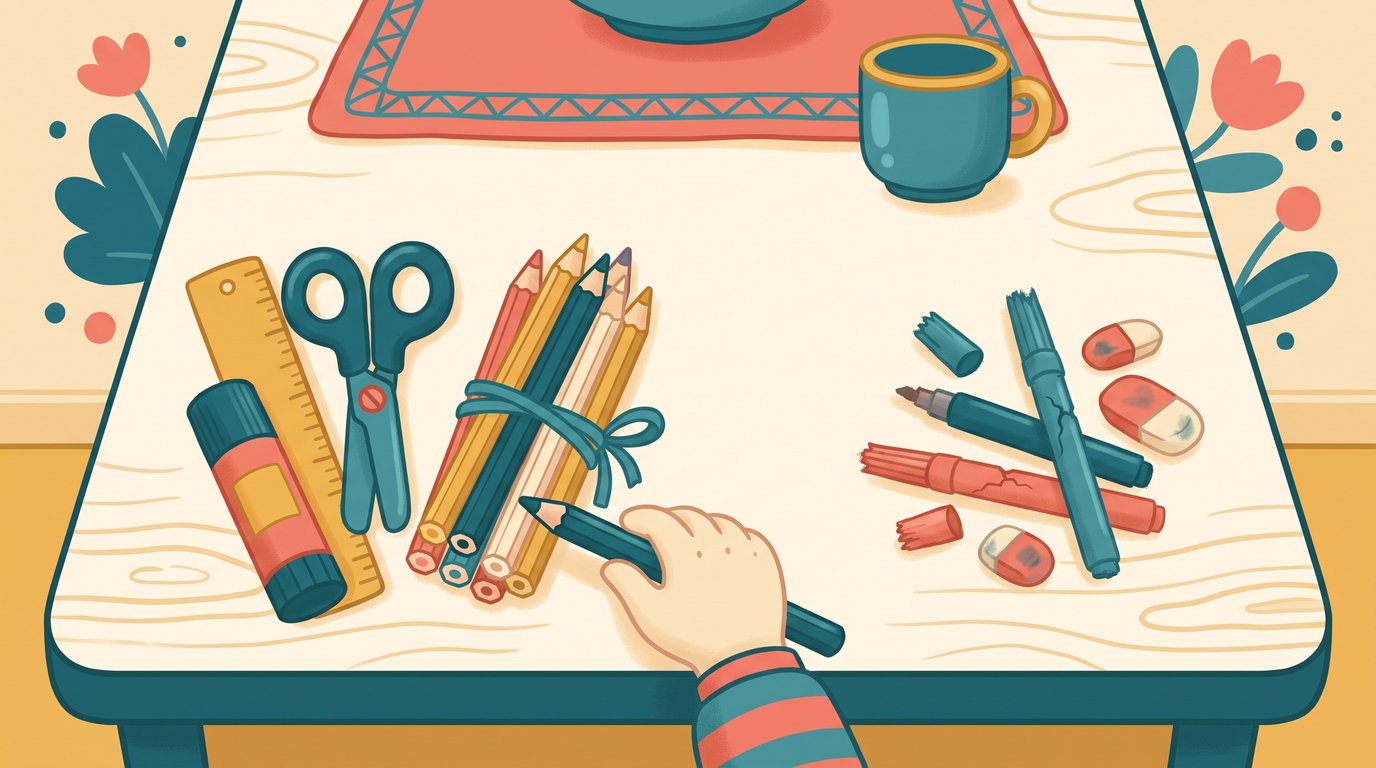
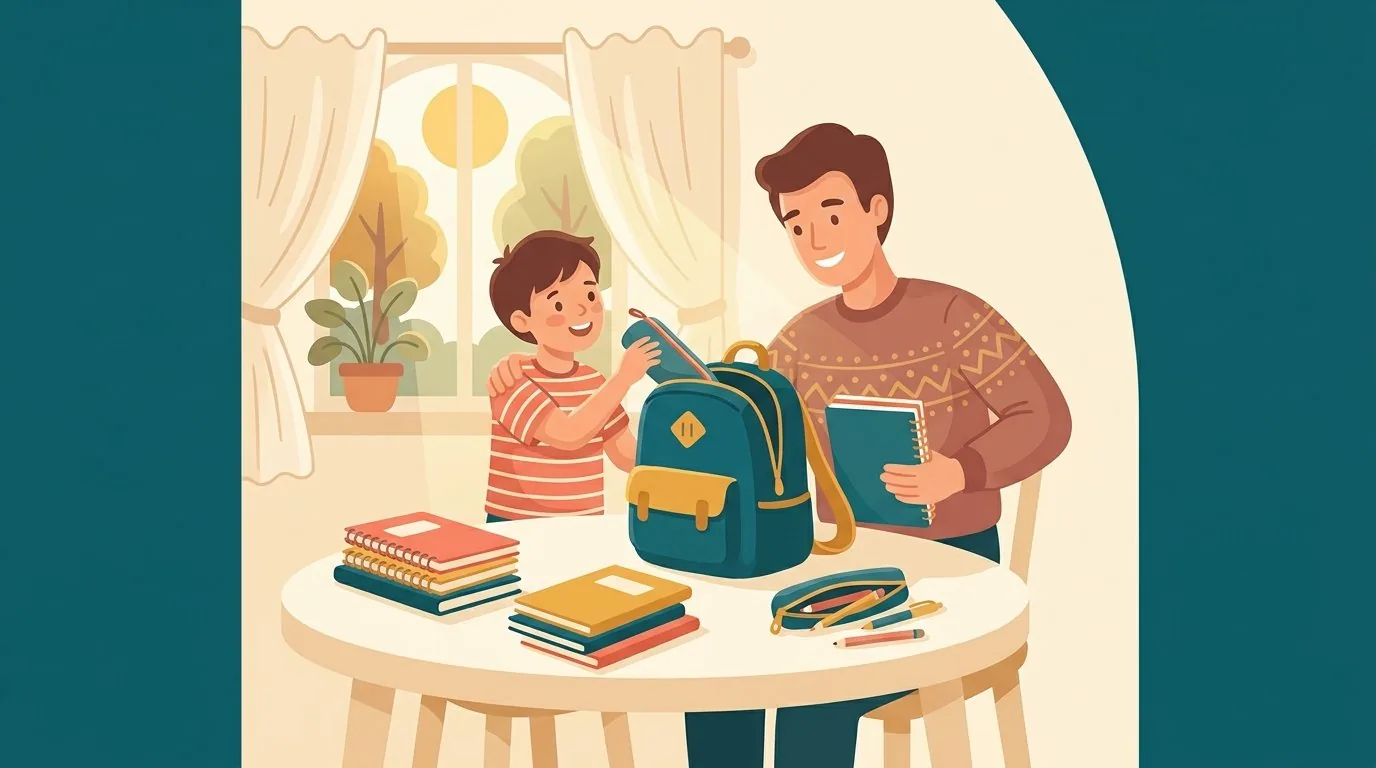
This is the quickest way to save at back-to-school time. Tip out the June schoolbag onto the table and make three piles with your child:
- Good to go again: scissors, ruler, set square, compass, pencil sharpener, pencil case, schoolbag, colouring pencils, whiteboard. These last for years. A quick wipe is all they need.
- Worth testing: felt tips (just draw a line on paper to check), opened glue sticks, pens, rubbers that are dirty but still whole.
- Definitely going: dried-out felt tips, hardened glue, finished exercise books. A half-used exercise book, on the other hand, makes a great rough notebook for home.
The school bag is the most interesting case: we tend to replace it automatically, but it actually lasts three to four years. The real question isn’t its age, but your child’s back: wide, padded straps, a reinforced back, and a weight that doesn’t tip them forward when worn. Try it loaded up before term starts—much more telling than any label.
What to buy double in August
Some supplies don’t get lost—they just disappear. Doubling up in August saves you three last-minute Sunday evening trips to the shop in November.
- Glue sticks: the undisputed champion. Buy plenty, and keep one at home for homework.
- Pencils and rubbers: they travel from one pencil case to another and never seem to come back.
- Blue pens from CE1 onwards, and ink cartridges if the teacher asks for a fountain pen.
- Whiteboard pens in CP: they dry out in just a few weeks—it’s inevitable.
On the other hand, never buy double exercise books, covers, binders or dividers: these are exactly the items whose format changes from one class to the next, and they’ll just sit on the shelf for five years.
Primary school supplies list: 5 pitfalls in the stationery aisle
Back-to-school aisles play on two things: parental guilt and children’s excitement. The five classic traps:
- Licenced products. The same exercise book with a character on the cover often costs twice as much. The best compromise: let your child pick a licenced pencil case or school bag (it’s visible and their choice), but stick to budget exercise books—the teacher will cover them anyway.
- Ready-filled pencil cases. They seem reassuring, but usually contain fifteen mediocre felt tips and none of the specific items the school asks for. It’s better to put together your own.
- The shop’s ‘back-to-school pack’. It’s designed for the shop, not your child’s class. Compare it line by line with the teacher’s list before giving in.
- ‘Grown-up’ equipment. A sharp compass in CE1, a scientific calculator in CM1: bought too early, broken or lost before it’s even needed.
- Paper stockpiles. Double sheets, folders, loose-leaf paper: you buy enough for the year, but only use a third. Just get one pack in August; if the teacher wants more, they’ll say so in class.
For your budget, two practical tips: spread your shopping over two or three weeks instead of one giant trolley, and check if you’re eligible for the back-to-school allowance (ARS), paid under certain conditions by the CAF or MSA for children aged 6 to 18 in school. Many families are entitled to it without realising.
Back-to-school shopping with your child—without the drama
Taking your child along is a good idea: if they choose, they feel more involved in starting school. But set the ground rules before you go in, not in the middle of the aisle. Three phrases are enough: “we’re following the teacher’s list”, “you choose the pencil case”, “there’s one free choice, you decide what it is”. This joker option defuses almost all negotiations: your child saves it for what really matters to them.
And if back-to-school brings more than just excitement—tummy aches, evening worries, disrupted sleep—supplies are only part of the story. Two articles go further: resetting sleep before school starts and helping a child who’s anxious about going back. A well-prepared pencil case helps, but a child who sleeps well and knows what Monday will look like is even more reassured.
Want to put these tips into practice?
Every day, a new adventure workbook adapted to your child's school level — to print or do on screen. No commitment.
Your questions
Which supplies are really compulsory in primary school?
Strictly speaking, none: in state schools, education is free and the school provides shared materials. The list from the teacher is a request to equip your child, not a bill. In practice, a child without a pencil case will struggle all day, so we follow the list. But if money is tight, talk to the teacher or head: most schools have a reserve, and no one will judge you.
Can you keep supplies from last year?
Yes, and it’s the best way to save at back-to-school time. Scissors, ruler, set square, compass, sharpener, pencil case, school bag and colouring pencils all last several years. Test felt tips with a line on paper, keep opened glue sticks for home, and only replace exercise books and covers, as their formats change from class to class.
Should you buy supplies before getting the school’s list?
Only universal consumables: glue, pencils, rubbers, colouring pencils, felt tips. They’ll always be useful. Anything with a specific format—exercise books, lined paper, covers, binders, number of rings—wait for the teacher’s list, or you’ll end up buying twice. And keep your receipts for the first week.
How can you spend less on school supplies?
Four simple steps: sort through last year’s supplies before buying anything, spread purchases over two or three weeks instead of one big shop, limit licenced items to one visible thing (the pencil case or school bag), and check your eligibility for the back-to-school allowance, paid under certain conditions by the CAF or MSA for children aged 6 to 18—the criteria and amounts are updated each year on caf.fr.
Read next
 Getting ready for back-to-school
Getting ready for CP over the summer: the 7 real priorities
Getting ready for CP: 7 real summer priorities, what’s covered in class, and a 10-minute daily routine…
 Back-to-school prep
Preparing for 6e: a calm guide for parents of CM2 children
Starting 6e without stress: what changes after CM2, your summer checklist, building independence and more…
 Back-to-school prep
August revision: a two-week plan before school starts
August revision, stress-free: a gentle 15-day plan to get back into the swing of things and review key concepts, clearly explained…