🎒 Child anxious about going back to school: 9 simple ways to reassure them

In the evening, they say their tummy hurts. They wake up at six and slam doors over a lost pencil — and there’s still a week to go before school starts. If you have a child who’s anxious about going back to school, you’re not alone: September brings all the unknowns children worry about most. The good news is, this back-to-school stress is normal and almost always temporary. Here’s how to spot the signs, what to say, and how to get ready for September together.
Child anxious about going back to school: signs of stress to look out for
The most common signs of stress in children
Before the age of eight, a child anxious about going back to school rarely says so directly: they complain of tummy aches or headaches, sleep badly, cry over nothing or suddenly go quiet. These signs are normal if they happen on their own; they need attention if they pile up and last more than a week. The trap is to treat the symptom without seeing what’s behind it.
| What you notice | What’s often behind it | First thing to do |
|---|---|---|
| Tummy ache or headache, in the evening and morning | Anxiety often shows up in the body first | Name it without making a fuss: “your tummy has the jitters” |
| Trouble falling asleep, waking in the night | Their mind is replaying the first day over and over | Start the bedtime routine earlier, turn off screens an hour before |
| “I don’t want to go”, asking the same questions again and again | A need for something concrete | Answer with facts: where, what time, who’s picking them up |
| Old habits coming back (thumb-sucking, bedwetting) | A temporary regression, common with big changes | Don’t make it a big deal: it will pass on its own |
| A child who’s “too good”, suddenly very quiet | Stress turned inwards, so it lasts longer | Open up by sharing your own memories of starting school |
One or two of these signs the night before: that’s just nerves, it’ll soon pass. Several signs together that affect sleep or appetite: that’s when it’s time to talk about it.
Fear of going back to school: where anxiety comes from, and why it changes as they grow
It’s almost never the school itself, it’s the lack of information. To feel safe, a child needs to picture their day: the route, the playground, the adult who greets them, when they’ll be picked up. If any link is missing, their imagination fills in the gaps — and rarely with happy thoughts.
In maternelle and CP: fear of being separated
“What if you don’t come to pick me up?” At this age, the worry is about the bond, not the school. Repetition is reassuring: the same phrase, the same route, the same routine. Starting CP deserves special preparation, explained in detail in getting ready for starting CP.
From CE2 to CM2: social worries and fear of failure
Later, the fear becomes social: fitting in, being teased, worrying they won’t manage. This kind of worry is eased by talking, and by preparing answers in advance — just like for moving up to sixième.
How to reassure a child anxious about going back to school: 9 practical tips
To reassure a child who’s anxious about going back to school, focus on practical things and repetition rather than general encouragement. None of these nine tips is dramatic; used together in the week before, they really change the mood on the big day.
- Put it into words before they do: “I think going back to school is on your mind.” When a child feels understood, they feel less alone.
- Share your own memories of starting school, nerves and all: nothing reassures like a parent who was scared and got through it.
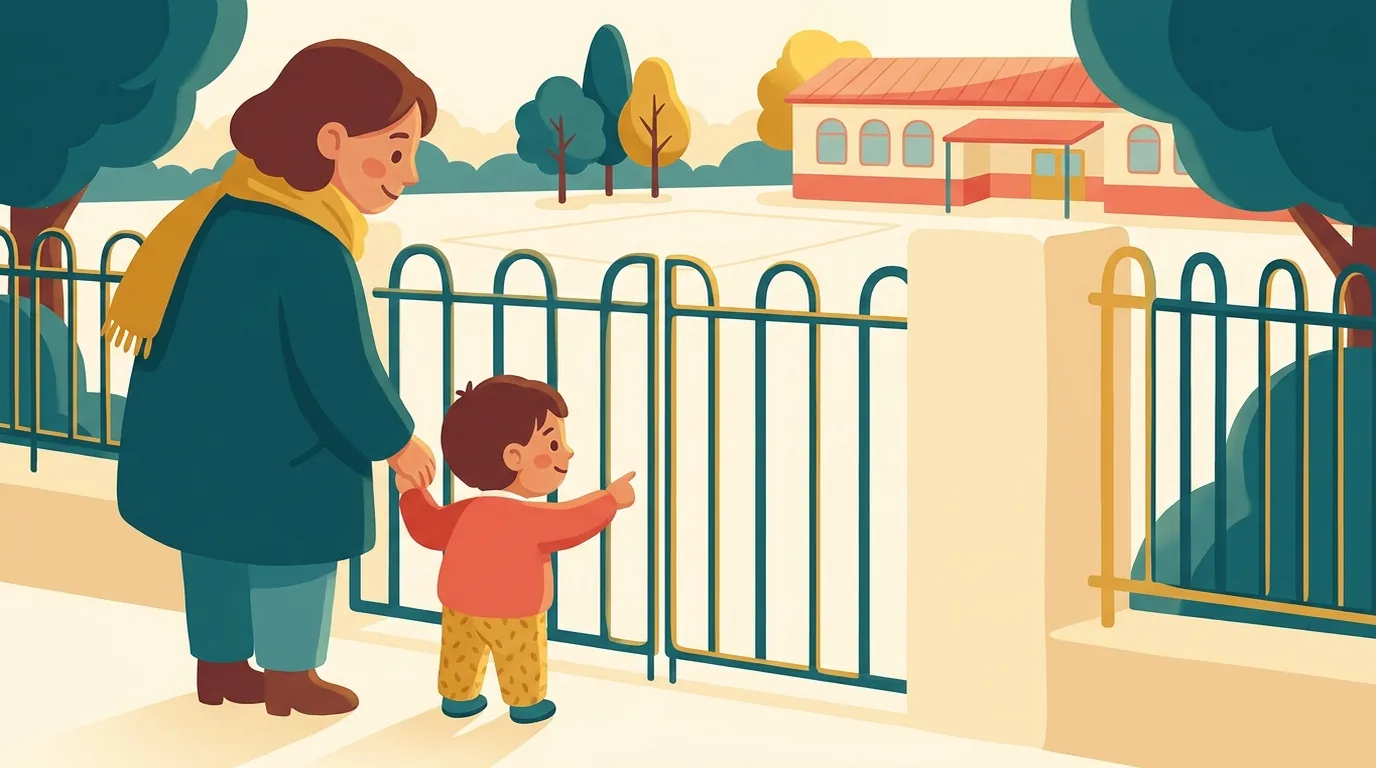
- Visit the school before the big day: the route, the gate, the playground. What’s familiar is less scary.
- Pack the school bag together the night before: handling their things helps them get used to the day ahead.
- Give them some control over the details: their pencil case, their snack, their outfit. We cope better with things we’ve chosen ourselves.
- Get sleep back on track a week before: fifteen minutes earlier each day, wake up at the same time. A tired child finds it harder to cope.
- Act out the scene again: “You arrive, you don’t know anyone—what do you do?” Having a ready phrase to start a conversation with a classmate is worth a thousand pep talks.
- Slip in a comfort object: a little note in the pencil case, a lucky eraser. A piece of home tucked into the school bag.
- Make morning goodbyes calm: keep them short, predictable, cheerful, and always the same. It’s the most effective gesture—and the hardest.
On this last point, stay strong: a long goodbye only adds ten more minutes of anxiety. A ten-second ritual—a kiss, a phrase, and off you go without looking back—reassures far more. And if your child cries at drop-off, ask the teacher what happens next: tears usually stop just a few minutes after the door closes.
First week rituals: keep things light, not busy
The first day isn’t the end of the back-to-school period, and the best ritual is one that lightens the load. The first week is tiring: noise, new rules, new faces, getting back into focus. No new activities, no invitations, no late nights. And swap the usual “Did it go well?”—which gets a “yes”—for a more open question: “Who did you sit next to?”
When it comes to work, wait until the second week to get back into a proper homework routine. To restart gently, one page a day is enough: our free printable activity book is perfect for this, and we explain this gentle restart in revising before school starts in August.
School anxiety: when to seek help
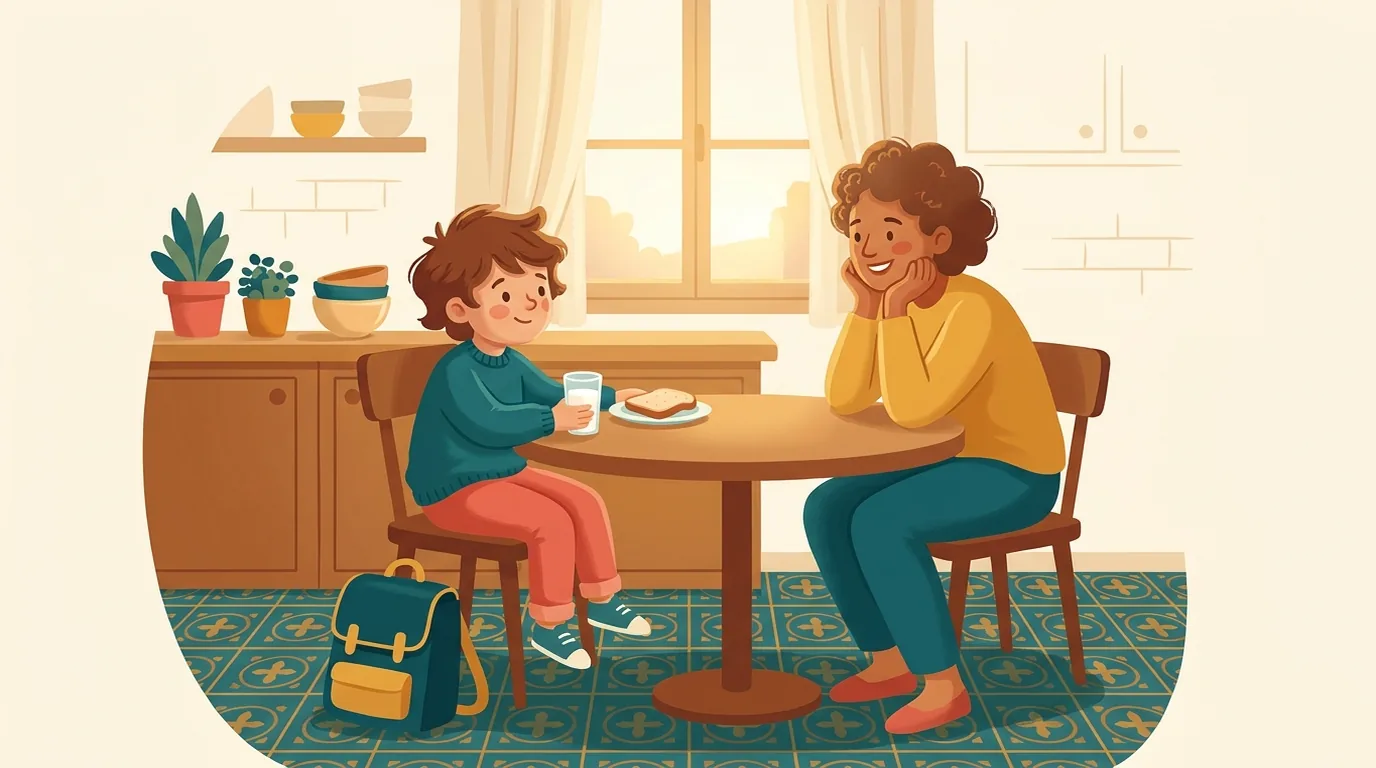
Nerves usually settle within one or two weeks. Seek help if your child’s school anxiety lasts more than three weeks, comes with daily physical symptoms, or leads to refusing school: speak to the teacher first, then the school psychologist or your GP. Specifically, be alert if:
- the anxiety lasts more than three to four weeks, with no improvement;
- physical symptoms become daily and affect sleep or appetite;
- your child no longer wants to go to school, or you regularly keep them at home;
- there are panic attacks, or a “I’m never going back.”
Teachers see what you don’t: playtime and lunch. School refusal due to anxiety—often called school phobia—is real; it can be treated, and the sooner you act, the better. Asking for help is never overreacting.
And take a look at yourself: children read our faces far better than our words, and a parent who keeps repeating “Will you be okay? Are you sure you’ll be okay?” actually sends the opposite message to what they mean.
Key points to remember
A child stressed about going back to school isn’t fragile—they just need more information about what to expect. Give them concrete details, short rituals—and keep the first week easy-going.
Want to put these tips into practice?
Every day, a new adventure workbook adapted to your child's school level — to print or do on screen. No commitment.
Your questions
How can I reassure a child who’s anxious about going back to school?
Give them concrete details instead of general encouragement: visit the school and walk the route before the big day, pack the school bag together the night before, tell them exactly who’s dropping them off and picking them up. Add a very short, always-the-same goodbye ritual in the morning. It’s these details and repetitions that reassure, much more than a “don’t worry.”
What are the signs that back-to-school stress is serious?
It’s the ongoing, combined signals: daily tummy aches or headaches, sleep problems, regressing to younger habits, crying every morning or repeatedly refusing to go to school. One sign alone is normal nerves. If three signs persist for more than a week, talk to the teacher, and then to your doctor if nothing improves.
What should I say to an anxious child before school starts?
Start by acknowledging their feelings: “It’s normal to feel nervous when you don’t know what to expect yet.” Then ask an open question: “What’s worrying you most?” Share your own memories of starting school—including your fears—and finish with some practical details about their day. Avoid saying “There’s nothing to be afraid of”: children then feel their worry isn’t valid and keep it to themselves.
My child doesn’t want to go to school—what should I do?
First, find out exactly what’s causing the problem—the lunch hall, playtime, a classmate, a subject—as a general refusal often hides a very specific issue. Keep the routine: the more you give in to days at home, the harder it is to return. Talk to the teacher quickly, then to the school psychologist if it keeps happening.
When should I seek help for my child’s school anxiety?
If anxiety lasts more than three to four weeks after school starts with no improvement, if tummy aches or headaches become daily, if sleep or appetite get worse for a long time, or if your child refuses to go to class. Speak to the teacher, then your GP or paediatrician: school refusal due to anxiety is treated best when caught early.
Read next
 Getting ready for back to school
Preparing for CP over the summer: the 7 real priorities
How to get ready for CP without cramming: the 7 real priorities for summer, what’s covered in class, and a 10-minute ritual…
 Getting ready for back to school
Preparing for 6e: a calm guide for parents of CM2
Preparing for 6e without stress: what changes after CM2, the summer checklist, independence skills, and the new routines…
 Getting Ready for Back to School
August Back-to-School Revision: The Last 2 Weeks’ Plan
A gentle 15-day plan to ease back into routines and key skills before school starts in August—no stress, just a smooth restart…