🎒 Resetting your child's sleep routine before school starts: the 10-day method

Bedtime is 10:30 pm, wake-up is 9:30 am, and school starts in ten days. Let’s get straight to what’s on your mind: getting your child’s sleep back on track before school takes about a week to ten days, moving bedtime earlier by fifteen minutes each day. Here’s a day-by-day plan, target bedtimes by school level, and a quick version if you’ve only got three days left.
How long does it take to reset a sleep routine before school?
The rule is simple: allow one day for every fifteen minutes you need to shift. If your child falls asleep at 10:30 pm and the goal is 8:30 pm, that’s a two-hour difference—so eight days, or ten to allow for the odd late night.
Why so gradual? You can’t just decide to fall asleep earlier. A child’s body clock is set by light and routine: it shifts late quickly, but resets slowly. Announcing “tonight you’re going to bed at 8:30 pm” after six weeks of late nights just means an hour spent staring at the ceiling.
Sunlight until 10 pm, late dinners, no alarm clocks: it only takes two weeks for a child’s sleep to shift. Summer sleep isn’t worse, it’s just moved—like jet lag, but at home and without the plane.
Signs your child isn’t getting enough sleep
They’re rarely dramatic, and almost never just yawning:
- mood swings, meltdowns over a lost pencil;
- struggling to wake up, or falling back asleep as soon as you turn away;
- getting more hyper in the evening: for children, tiredness often means more energy before sleep finally comes.
What time should children go to bed before school starts?
For a 7 am wake-up, children in CP-CE2 (ages 6-8) should go to bed between 8:00 and 8:45 pm, CM1-CM2 (ages 9-11) between 8:30 and 9:15 pm, and those in maternelle (ages 3-5) between 7:30 and 8:15 pm. There’s no official bedtime: start from the school wake-up and count back the hours of sleep they need.
| Level | Recommended daily sleep | Target bedtime for a 7 am wake-up | What to watch out for |
|---|---|---|---|
| Maternelle, PS to GS (ages 3-5) | 10 to 13 hours, including naps | 19 h 30 – 20 h 15 | No more naps in grande section: the first weeks can be tough |
| CP to CE2 (ages 6-8) | 9 à 12 h | 20 h – 20 h 45 | Long school days, energy dip around 5 pm |
| CM1-CM2 (ages 9-11) | 9 à 12 h | 20 h 30 – 21 h 15 | Screens and homework eat into the evening |
| Collège (age 12 and up) | 8 à 10 h | 21 h 30 – 22 h 15 | Falling asleep naturally gets later in adolescence |
These ranges are deliberately broad: two children the same age may need different amounts of sleep. The best sign is your own: if they wake up more or less on their own, they’re getting enough.
The 10-day method to reset your child’s sleep routine before school
The idea is simple: move both wake-up and bedtime fifteen minutes earlier each day, including weekends.
- Day 1 (10 days before): note the real bedtime and your target, then explain the plan—ten small steps, not one giant leap.
- Each morning, wake up fifteen minutes earlier than the day before: this is the real key, as getting up earlier brings bedtime forward (never the other way round).
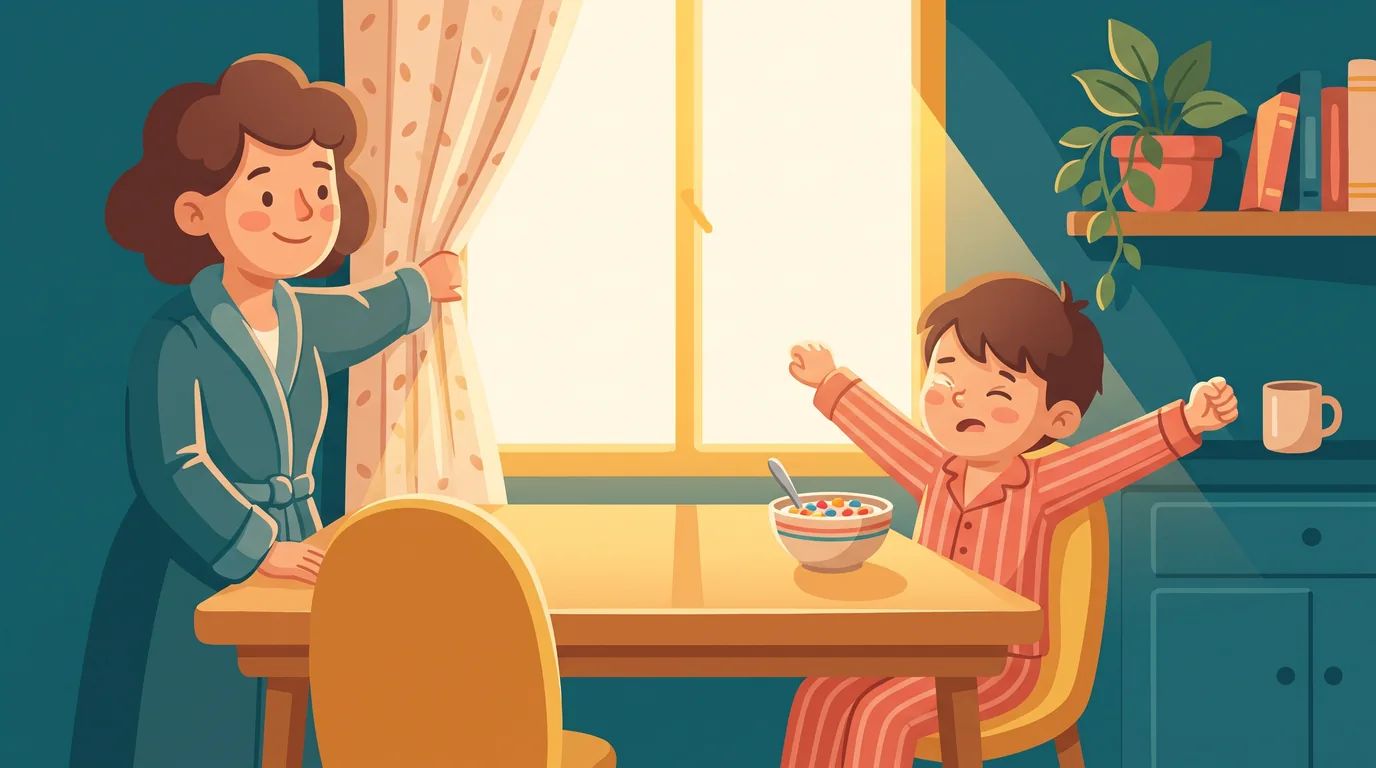
- Open the curtains as soon as you wake up, have breakfast in daylight, get outside if you can: mornings are what reset the body clock.
- Each evening, move the bedtime routine forward by fifteen minutes—dinner too, or it won’t add up.
- No screens for an hour before bed, and charge devices outside the bedroom—this rule only works if adults stick to it too.
- Active days, calm evenings: get outside in the morning, slow things down after 6 pm.
- By day 7 (three days before school), you’ve reached your target bedtime: keep it steady, including Saturday.
How to move bedtime earlier without a battle
Should you wake your child up during the holidays? Yes, for these ten days: it’s the only reliable way. In the evening, don’t negotiate the time, but offer a choice: “Bedtime is 8:30 pm; would you like one long story or two short ones?” They get some say in their evening, you keep the schedule. And if they’re tossing and turning the first night, that’s normal.
Your child's evening routine: thirty minutes, always in the same order
Children fall asleep more easily when their bodies know what's coming next. The activities themselves matter less than the order — which never changes — and each step helps them wind down.
- A shower or warm (not hot) bath: the body needs to cool down to fall asleep;
- Pyjamas, teeth, toilet — the practical bits, done quickly;
- Ten minutes of quiet time sitting down: reading, drawing, or a page from a workbook;
- Story or cuddle, with the lights already dimmed;
- Lights off, door left slightly open.
For those ten minutes of calm, our free printable activity book offers short, screen-free, low-pressure pages. One page is enough; two is already a proper session.
This evening routine doesn't stop when school starts: it becomes the backdrop for homework. A child who knows their evening order copes much better with the primary homework routine.
Screens, heat, lie-ins: the three end-of-August pitfalls
Screens: more stimulating than just bright
People blame blue light, but that's not the main issue: videos and games keep the brain alert just when it needs to unwind. Switch off an hour before bedtime — and offer something else, because an empty gap will fill itself.
A bedroom that's too warm
The main sleep-wrecker in August: air out the room early in the morning and evening, keep shutters closed during the day, and use a light sheet instead of a duvet.
Weekend lie-ins
Two Saturdays waking at 10 am can undo ten days of effort. Allow up to an hour's difference, no more: the least popular rule here, but the most helpful.
Should you stop naps before school starts?
For maternelle only: no. Naps are still needed in petite and moyenne section, and schools provide them. In grande section, naps usually stop — it's better to shorten them gradually than cut them out suddenly. In all cases: keep naps short and before 3 pm.

Three days left: how to quickly reset a child's sleep routine
No time to be gradual? Focus only on wake-up time, and accept two imperfect nights.
- From tomorrow, wake up at school time, even after a short night.
- Light and fresh air first thing: the strongest signal you can give.
- Short nap if needed: twenty minutes, before 3 pm.
- No screens in the evening, early dinner, calm routine.
- No bedtime battles: a child who cries at 9 pm falls asleep later than one who reads.
If your child can't sleep because they're worried about going back to school — tummy aches, endless questions — it's not the routine that needs fixing: you'll need different strategies for a child stressed about the new term.
Key points to remember for back-to-school
Fifteen minutes a day, using wake-up time as your anchor, morning light as your ally, and an unchanging evening routine: that's all it takes to reset sleep before school starts. Begin tonight — three days gained are better than none.
Want to put these tips into practice?
Every day, a new adventure workbook adapted to your child's school level — to print or do on screen. No commitment.
Your questions
How long does it take to reset a child's sleep routine?
Seven to ten days in most cases. The rule: allow one day for every fifteen minutes' difference between current and target bedtime. You can go faster in a pinch, but expect two or three tough nights. Consistency is key: fifteen minutes every day, including weekends, works better than a sudden change on Sunday night.
What time should a primary school child go to bed at the start of term?
Work backwards from wake-up time. For a 7 am start, children in CP to CE2 (age 6-9) usually go to bed between 8:00 and 8:45 pm, those in CM1-CM2 (age 9-11) between 8:30 and 9:15 pm. These are broad guidelines — adjust for your child: if they wake up on their own and in a good mood, the timing is right.
Should you wake your child up in the morning during the holidays?
Not all summer — that would be a shame. But in the last ten days, yes: getting up is the main lever for resetting a child's sleep, much more effective than just moving bedtime earlier. Wake them fifteen minutes earlier each morning, open the curtains, and get outside within the hour.
My child can't fall asleep earlier — what should I do?
That's normal for the first two or three nights: the body clock takes a few days to adjust. Stick to the new schedule without turning it into a battle, switch off screens an hour before bed, and let them read or draw in low light rather than wait for sleep in the dark. Above all, keep the earlier wake-up: that's what will help them fall asleep sooner.
Should you stop naps before school starts?
In PS and MS, no: naps are still a real need, and schools keep them in place. In GS, if your child no longer falls asleep at lunchtime, try shortening the nap gradually rather than stopping it suddenly. In primary school, naps are no longer needed: only short naps before 3pm are kept.
Read next
 Getting ready for back to school
Getting ready for CP: the 7 real priorities for summer
How to prepare for CP without cramming: the 7 real summer priorities, what’s actually taught in class, and a 10-minute ritual…
 Getting ready for back to school
Preparing for 6e: the calm parent’s guide from CM2
How to prepare for 6e without stress: what changes after CM2, the summer checklist, steps towards independence and the new…
 Getting ready for back to school
Revising before school starts in August: the 2-week plan
Gentle revision before school starts in August: a 15-day plan to get back into routine and review key topics, clearly…