🥧 Fractions in CM1: how to help your child understand them
Fractions in CM1 often appear at home as a tricky exercise: “Colour three quarters of the shape”, “Place 5/4 on the number line”. Your child hesitates, and you might too, because it’s been a while since you learned this and it’s not always easy to explain in simple words.
Good news: in CM1, a fraction is simply about dividing into equal parts. If your child has ever cut a cake, they already have the basic idea. This guide gives you the right vocabulary, hands-on activities you can do tonight with a pie or a strip of paper, the method for the number line, and the most common mistakes to watch out for.
The right words: numerator, denominator and how to read fractions
A fraction is written with two numbers separated by a line. Each has a name and, most importantly, a specific role:
- the denominator (the bottom number) tells you how many equal parts the whole is divided into;
- the numerator (the top number) tells you how many of those parts you take.
In 3/4, the whole is divided into 4 equal parts and you take 3 of them. To remember which is which, a simple phrase often helps: “the denominator is at the bottom, it names the parts: quarters, fifths, eighths”.
Reading fractions follows a simple rule, with three exceptions to learn by heart:
| Fraction | How to say it | What it means |
|---|---|---|
| 1/2 | one half | the whole divided into 2 equal parts, you take 1 |
| 2/3 | two thirds | 3 equal parts, you take 2 |
| 3/4 | three quarters | 4 equal parts, you take 3 |
| 2/5 | two fifths | 5 equal parts, you take 2 |
| 5/6 | five sixths | 6 equal parts, you take 5 |
| 3/8 | three eighths | 8 equal parts, you take 3 |
| 7/12 | seven twelfths | 12 equal parts, you take 7 |
For denominators above 4, just add “-ths” to the number: fifths, sixths, sevenths, and so on. The three exceptions are half, third and quarter. Try the reverse exercise too: you say “four sevenths”, your child writes 4/7. Reading and writing both ways is the first skill to master.
Fractions and sharing: pies and paper strips
Before writing any fractions, your child needs to see and touch them. Two very simple activities are all you need.
The pie (or pizza, or cake)
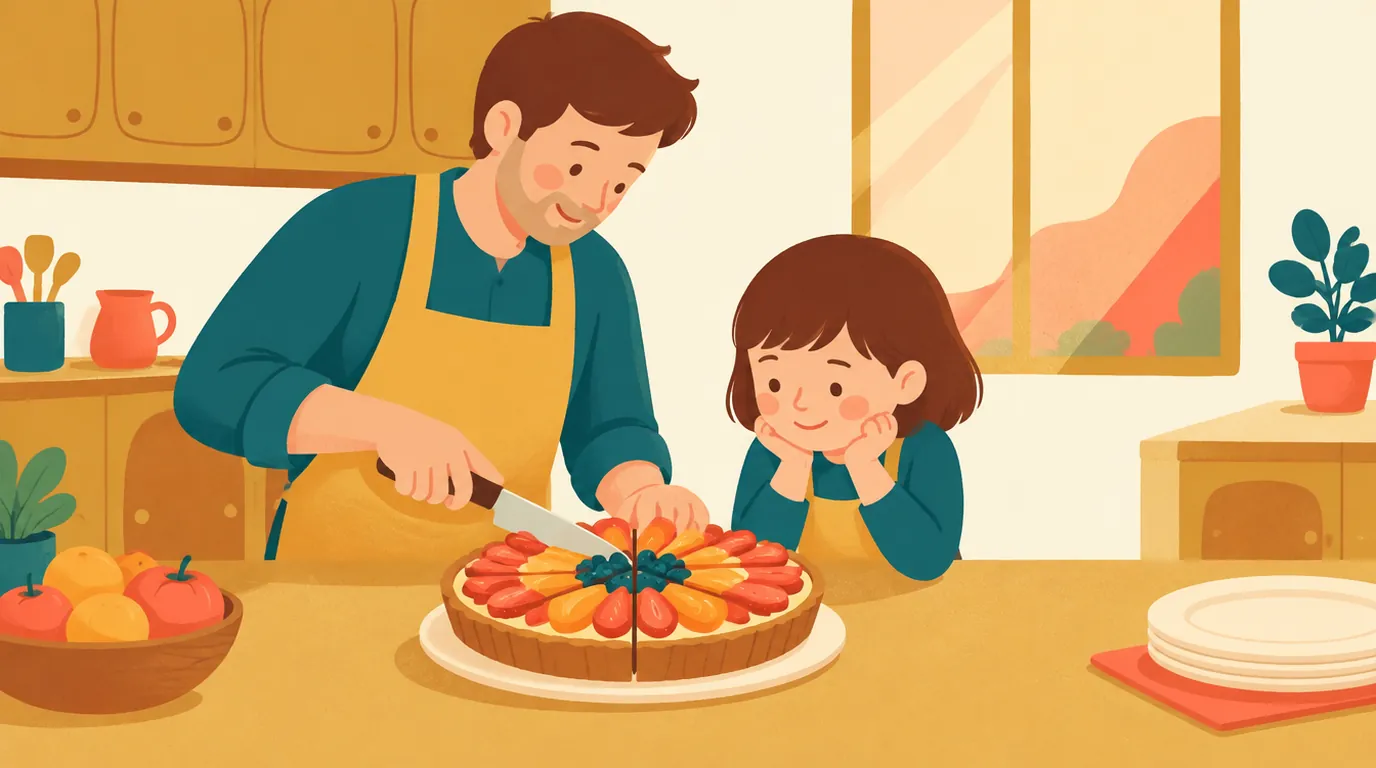
At dessert time, let your child use the knife under your supervision. Cut in 2, then 4, then 8. At each step, ask the same questions: “How many pieces? What is each piece called?” And point out what many children find surprising: the more pieces you cut, the smaller each piece gets. One eighth of a pie is smaller than a quarter.
Emphasise the word equal. If the pieces aren’t the same size, you can’t call them quarters. Deliberately cut a pie into 4 very uneven pieces and ask: “Is each piece a quarter?” The “no” that follows is worth any lesson.
Paper strips
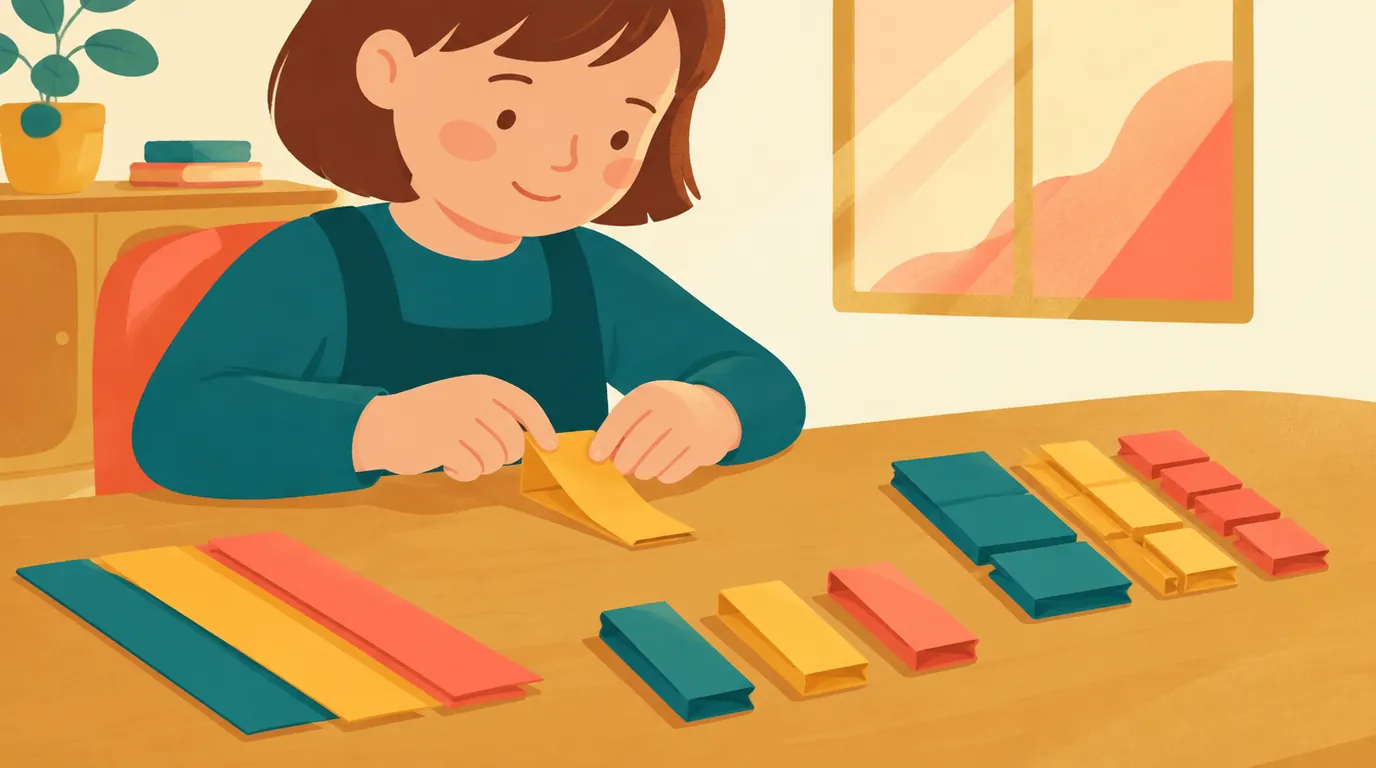
Cut several strips of the same length from coloured paper. Each strip represents one whole. Fold the first in half: two halves. Fold the second in half, then in half again: four quarters. Fold the third in three, like a leaflet: three thirds. Your child then colours 3/4 of one strip, 2/3 of another, and compares them by laying them side by side.
Strips have a big advantage over pies: they lead directly to the number line, since an unfolded strip is already a length divided into equal parts.
Placing a fraction on a number line
This is often the exercise that causes problems. The method is always three steps, in the same order:
- Find the whole: where are 0 and 1?
- Count the intervals between 0 and 1 (the spaces, not the lines). If there are 4 intervals, each small space is worth 1/4.
- Start from 0 and move forward by as many intervals as the numerator shows. For 3/4, you move 3 intervals.
To make your own number line at home, take a sheet of squared paper and choose a unit of 12 squares. This is a handy number, as it can be divided by 2, 3, 4 and 6. Check with your child: 1/2 lands on the 6th square, 1/3 on the 4th, 2/3 on the 8th, 1/4 on the 3rd, 3/4 on the 9th. And 2/4? On the 6th square, exactly the same place as 1/2. Keep this in mind for later—it will come in useful.
A common mistake is to count the lines instead of the spaces: between 0 and 1, there are 5 lines if you include 0 and 1, but only 4 intervals when the unit is divided into quarters. Ask your child to put their finger in each space while counting out loud.
Smaller than 1, equal to 1, or greater than 1?
In CM1, children learn to compare a fraction to 1. The reasoning is based on the parts, not a memorised rule:
- if the numerator is smaller than the denominator (3/4), you have taken fewer parts than make up a whole: the fraction is less than 1;
- if they are equal (4/4, 6/6), you have taken all the parts: the fraction is equal to 1;
- if the numerator is greater (5/4), you have taken more parts than make up a whole: the fraction is greater than 1.
With paper strips, it’s clear: to show 5/4, you need a whole strip (4/4) plus a quarter of a second strip. So 5/4 = 1 + 1/4. In the same way, 7/4 = 1 + 3/4, 5/3 = 1 + 2/3 and 9/4 = 2 + 1/4. Writing fractions as “whole number + fraction” is very helpful for placing fractions greater than 1 on the number line.
Equivalent fractions: 1/2 = 2/4
Take two identical strips. Fold one in half and colour one half. Fold the other into four and colour two quarters. Place them one under the other: the coloured areas are exactly the same length. Your child has just discovered that 1/2 = 2/4. Try with 8 parts: 1/2 = 4/8. And you can also write 1/2 = 3/6 = 5/10.
After a few examples, encourage your child to find the rule themselves: when you multiply both the numerator and denominator by the same number, you get an equivalent fraction. You cut each part in two (so you have twice as many, each half the size), and take twice as many. Try more examples together with the strips: 1/3 = 2/6, 2/3 = 4/6, 3/4 = 6/8.
Watch out for this trap: adding the same number to the top and bottom doesn’t work. 1/2 and 2/3 are not equal (if you add 1 to both numbers): on the strip, 2/3 is clearly more than half. This is a common mistake, and it’s easier to correct by comparing the strips side by side than by repeating the rule.
This same idea will later help with tenths and hundredths: 1/2 = 5/10, for example. We have a whole article on decimal fractions, tenths and hundredths; it’s best to tackle it once your child is confident with the simple fractions in this article.
Common mistakes and activities to try at home
Three mistakes to watch for
- Thinking 1/4 is bigger than 1/3 “because 4 is bigger than 3”. Go back to the pie: if you cut it into 4, each piece is smaller than if you cut it into 3. So 1/4 is smaller than 1/3.
- Forgetting that the parts must be equal. A shape cut into 4 pieces of different sizes does not represent quarters.
- Mixing up numerator and denominator. The phrase “the bottom tells you how many equal parts you split into; the top tells you how many you take” clears this up.
Five 10-minute activities
- The chocolate bar. With a bar of 24 squares: half is 12 squares; a third is 8; a quarter is 6; a sixth is 4. Let your child check each answer by breaking the bar.
- The recipe. Half a litre of milk is 500 mL; a quarter of a litre is 250 mL. The measuring jug becomes a great fractions tool.
- The strip game. You call out a fraction, your child colours the matching strip, then says if it’s less than, equal to, or greater than 1.
- Finding a fraction of a quantity. “A quarter of 20 marbles?” 5. “Three quarters?” 15. This is excellent mental maths practice for CM1, as it involves dividing and multiplying in your head.
- The chapter mind map. Once the ideas are clear, ask your child to draw a mind map with “Fractions” in the centre and four branches: vocabulary, sharing, number line, equivalent fractions.
The key thing to remember: in CM1, fractions are best understood with your hands before they make sense as numbers. A pie, three paper strips and a few minutes a day are enough for 3/4 to become a familiar quantity, not just two mysterious numbers separated by a line.
Want to put these tips into practice?
Every day, a new adventure workbook adapted to your child's school level — to print or do on screen. No commitment.
Your questions
My child mixes up numerator and denominator—how can I help?
Link each word to a question. The denominator, at the bottom, answers “into how many equal parts is it divided?”; the numerator, at the top, answers “how many parts are taken?”. Have your child read each fraction using this phrase for a few days—the habit forms quickly.
Why is 1/3 bigger than 1/4 when 3 is smaller than 4?
Because the denominator shows how many parts the whole is split into. A pie cut into 3 gives bigger pieces than one cut into 4. For fractions with 1 as the numerator, the bigger the denominator, the smaller the fraction.
Do children need to add fractions in CM1?
In CM1, the main thing is to understand, read, write, place and compare simple fractions. You might come across sums of fractions with the same denominator, like 1/4 + 2/4 = 3/4, which are easy to grasp with a strip divided into quarters. More complex calculations come later.
What materials can I use to practise fractions at home?
Nothing special: strips of paper of the same length, squared paper, a pie or a chocolate bar. These help your child see equal parts, which matters far more than reciting a rule.
Read next
 Study methods
The phonics method for learning to read: why it’s making a comeback
Phonics versus whole-word reading: what’s different, and what do the official guidelines say?
 Study methods
The Pomodoro technique for children: revising in 10-minute bursts
Pomodoro for kids: how long should each session last, which timer to use, and a sample homework routine
 Study methods
Mind maps: a great way to help your child learn
Mind mapping for parents: how to make one with your child, a real lesson example, and practical tips