🏅 Should you reward your child for their marks? What to know before you reach for your wallet

The report card arrives, the comments are positive, and the question comes: “What do I get?” Should you reward your child for their marks? Many parents hesitate between giving a treat and worrying about “buying” their child’s effort. The good news: there’s a middle ground. The idea isn’t to ban all rewards, but to choose what you reward, how, and at what age.
Should you reward your child for their marks? The short answer
Yes to celebrating, no to paying. Marking a good school moment strengthens your bond and their pride. Promising money or gifts in advance for a mark is different: your child then learns for the reward, not for understanding.
Remember these three points:
- Reward effort (re-reading, trying again, asking for help), not just the result.
- Surprise is better than a deal like “if you get 18, you’ll get…”
- Choose shared time over money or things.
What psychology says about motivation (without dogma)
Researchers distinguish two types of motivation. Intrinsic motivation: doing something because it’s interesting or you feel you’re improving. Extrinsic motivation: doing it to get something outside the activity (a reward, avoiding punishment).
Several classic studies have described what’s called the “overjustification effect”. In 1971, psychologist Edward Deci found that students paid to solve puzzles were less likely to return to them on their own once the payment stopped. In 1973, Mark Lepper and colleagues saw something similar in young children who enjoyed drawing: those who were promised a certificate for their drawings later drew less on their own than those who expected nothing.
In schools, economist Roland Fryer tested large-scale financial rewards in American schools (results published in 2011). Paying students for marks didn’t improve their results on average. One explanation: many students were motivated, but didn’t know how to improve.
The lesson for parents is simple: a reward can’t replace good methods or real motivation. These studies don’t say that a compliment or a small celebration ruins everything. They mainly show the risk of promised, conditional rewards.

Rewarding marks in primary: it all depends on age
In primary, a “mark” often isn’t a number. The school report usually says for each subject whether objectives are not met, partly met, met or exceeded; some schools use colours, letters or marks. A child in CP doesn’t see their report the same way as in CM2. Here’s how to adapt.
| Age / class | What the child understands | What works | What to avoid |
|---|---|---|---|
| CP – CE1 (6-7 years old) | They mainly sense if adults are pleased or disappointed. | Praise straight away, and be specific: “You checked every line!” | Mark-based deals: too abstract at this age. |
| CE2 – CM1 (8-9 years old) | They compare with friends and link their effort to results. | A small goal chosen together (e.g. “learn my 7 times table”), celebrated when it’s reached. | Comparing with siblings or classmates. |
| CM2 (10-11 years old) | They look ahead to collège and may try to negotiate. | Privileges linked to independence (organising their Wednesday, choosing an outing). | Paying per mark: it leads to endless bargaining. |
Rewarding effort, not just results
A mark depends on many things: how hard the test was, how tired they felt, a misunderstood instruction. Effort, though, is in your child’s hands. That’s what’s worth noticing.
Some phrases that work better than “Well done, you’re so clever”:
- “You redid your exercise without me asking.”
- “You practised three nights in a row for your dictation, and it shows.”
- “You were stuck, and you dared to ask the teacher.”
These compliments describe actions they can repeat. They also help when the mark is disappointing: the effort is still visible, even if the result isn’t there yet. If your child feels discouraged, our article on helping your child regain confidence at school offers phrases to support them.
Rewards that don’t cost money but really make children happy
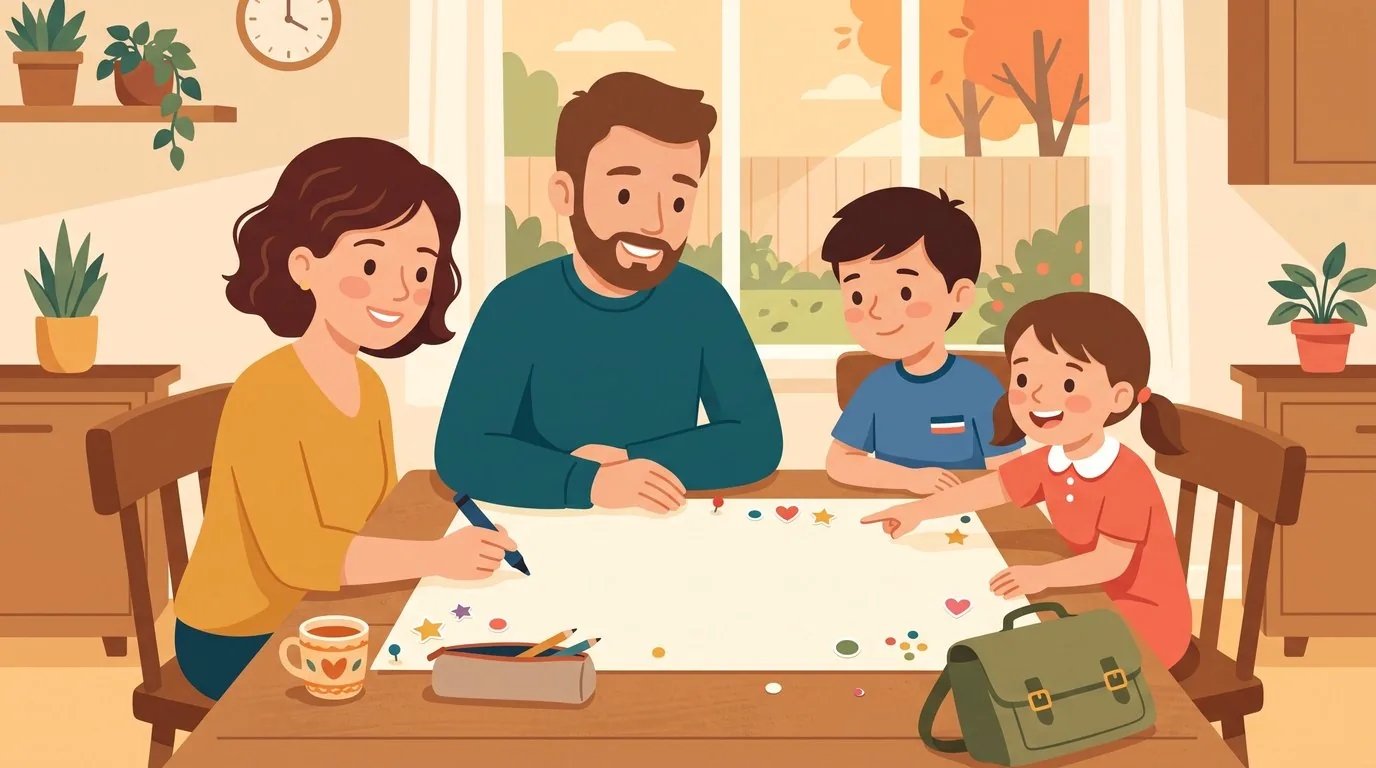
If you want to mark the occasion, pick a shared reward that’s not promised in advance. It’s a celebration, not a “payment”.
- Letting your child choose dinner or baking a cake together.
- A family board game night, or a round of Le Grand Saut, Kidibook’s free game, where your child plays with the workbook mascots.
- A one-on-one outing: library, park, or cinema.
- A privilege: staying up fifteen minutes later on Friday, or choosing the family film.
- Send a photo of the report card to the grandparents, who call to congratulate.
What all these have in common: time and attention. That’s what most children are really looking for when they ask, “What will you give me?”
Pocket money for good marks, punishing bad ones: the pitfalls
Money for marks turns school into paid work. The risk: negotiating every test, or losing motivation when there’s nothing left to win. Pocket money can exist, but should be separate from school results.
Punishing a bad mark creates the opposite problem. Children mostly learn to fear their report card, and sometimes to hide it. It’s better to calmly look for what’s blocking them: a tricky concept, a learning method, tiredness. For evenings when your child refuses to revise, our guide helping a child who refuses to revise offers practical tips.
Our view: celebrate often, never pay
Should you reward your child for good marks? Instead of a simple yes or no, remember this: praise effort, celebrate progress with a surprise, and keep money out of school. The strongest motivation is built through small, regular successes, when your child feels they’re moving forward.
That’s the spirit of Kidibook workbooks: short sessions, tailored to their class, where every finished page is a small, visible victory. To start this routine, discover Kidibook’s adventure workbooks.
Want to put these tips into practice?
Every day, a new adventure workbook adapted to your child's school level — to print or do on screen. No commitment.
Your questions
Should you reward a good report card?
You can celebrate it, yes: a specific compliment, a meal chosen by your child, or a special outing together. Try not to promise a gift or money in advance for a mark, as this shifts the focus to the reward.
Is it a good idea to give money for good marks?
It’s rarely recommended. Money turns school into a contract and can lead to negotiations over every test. Studies in American schools haven’t shown any average improvement in results when pupils are paid for their marks.
Should you punish bad marks?
Punishment mainly teaches children to fear their report card. It’s better to talk calmly, spot the concept or method that’s tricky, then set a small, realistic goal. If difficulties persist, talk to the teacher.
How can you value effort rather than results?
Describe something concrete your child did: rereading, trying again, practising over several evenings, asking for help. This kind of praise shows them what they can repeat, even if the mark isn’t there yet.
Next to read
 Parent guide
The ‘summer slide’: why your child forgets, and what to do
Learning loss over the school holidays isn’t inevitable: here’s how to avoid it in just 10 minutes a day…
 Parent guide
“My child is bored during the holidays”: what to do (without feeling guilty)
My child is bored during the holidays: why boredom is actually healthy, a box of anti-boredom ideas, and a simple family ritual…
 Parent guide
Back-to-school budget: saving money without making your child feel deprived
Back-to-school budget: sorting supplies, second-hand schoolbags, CAF support — practical tips for spending less without stress…