📖 Reading comprehension CE1: helping your child understand what they read
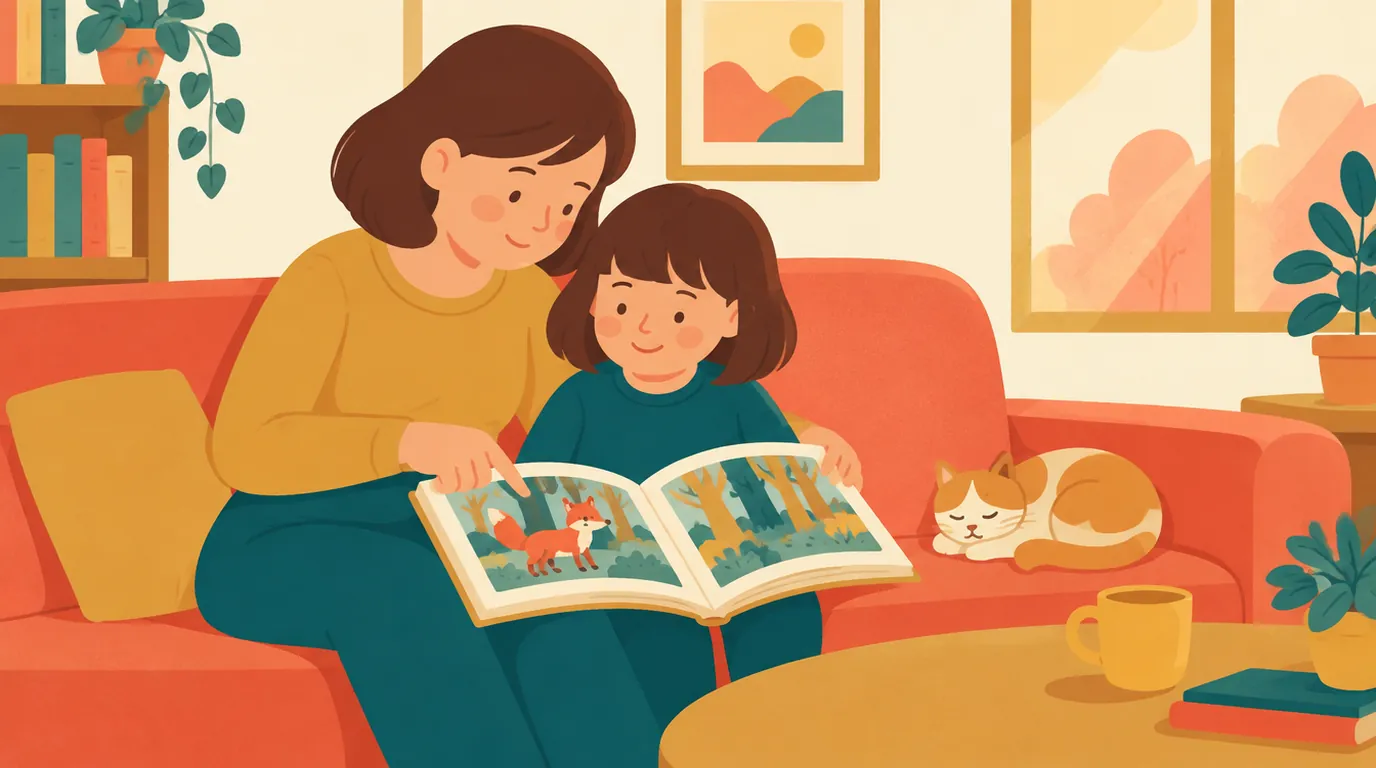
Reading comprehension in CE1 can be a puzzling stage: your child reads a whole page fluently, but when you ask what just happened, they can't say. They can read, yes—but they haven't yet got into the habit of making a little film in their head as they go.
Don't worry: comprehension is something you can teach, and your living room sofa is the perfect place to practise. No need for endless worksheets: a storybook, a few well-timed questions and ten minutes of chat are all it takes. Here’s how you can start, as soon as this evening.
Why your child might read without understanding
In CP, almost all your child’s energy went into decoding: matching letters to sounds, blending syllables, recognising small words. In CE1, this decoding gradually becomes automatic. It’s this very automation that frees up attention for meaning. As long as every word takes effort, there’s little room left to follow the story.
That’s why fluency and understanding go hand in hand. A child who reads in a choppy way reaches the end of a sentence having forgotten the beginning. This fluency has a name—reading fluency—and we explain how to practise it in our article on reading fluency at home. If some tricky sounds (like “ein”, “ouil”, “gn”) are still causing problems, spend a few minutes each day revisiting the basics of the syllabic method: comprehension can’t build on shaky decoding.
Even when decoding is solid, three common obstacles pop up in CE1:
- Reading just to finish: your child rushes through the lines as a chore, without thinking about what they mean.
- Losing track of characters: they’re not sure who “he”, “she”, “him” or “the little boy” refers to.
- Missing the clues: the answer isn’t written out clearly—they need to guess, and they don’t know how yet.
Questions before, during and after reading
Comprehension starts before the first line and is reinforced after the last. Spreading your questions across these three moments changes everything: your child reads with a purpose, instead of just getting through the text.
Before: making predictions
Look together at the cover, the title, the first picture. “Who do you think this fox is? Where is the story set? What might happen to them?” There are no wrong answers—the aim is to get your child thinking and curious to find out. It’s also a good time to explain one or two tricky words you’ve spotted while flicking through.
During: pausing at the right moments
Pause once or twice—no more—at key points: just after a twist, or when a new character appears. “What just changed?”, “Did you guess right?”, “Who’s speaking here?” If you stop at every paragraph, the story loses momentum and your child loses the thread.
After: retelling and sharing opinions
Once the book is closed, ask your child to retell the story. Then ask for their opinion: “Would you have done the same?”, “Which part scared you?” There’s no single right answer, and that’s what makes these questions valuable: they encourage your child to revisit the story in their mind and justify their view.
Retelling: the best test of understanding
If your child can tell a story in their own words, they’ve understood it. If they just recite whole sentences from the book, they may only have memorised it. Retelling is your best gauge—much more reliable than closed questions with yes/no answers.
To help them structure their retelling, offer a simple five-part guide: who? (the characters), where? (the setting), what’s the problem? (what starts the story), what happens? (the events), and how does it end? At first, your child can count the steps on their fingers. Gradually, it’ll become second nature.
Two variations are especially popular in CE1:
- Tell someone who doesn’t know the story: a younger sibling, a grandparent on the phone, a favourite toy. They’ll have to be clear.
- Summing up in three sentences: one for the beginning, one for the problem, one for the ending. It’s a great way to pick out the essentials from the details.
Inferences: learning to read between the lines
An inference is something the text doesn’t say directly, but you can work out from clues. This is often where CE1 readers get stuck—they look for the answer written exactly in the text. Take this short passage:
Tom rentre de l'école. Il enlève ses bottes pleines de boue et secoue son parapluie dans l'entrée. Dans la cuisine, ça sent le gâteau au chocolat. Sa petite sœur a déjà du chocolat autour de la bouche.
Nowhere does it say it’s raining, or that the little sister has tasted the cake. But an attentive reader knows. Here are the main types of questions you can ask, from simplest to most challenging:
| Type of question | Example from Tom’s story | What your child needs to do |
|---|---|---|
| Literal | What does Tom take off when he gets home? | Find the information written in the text (his boots). |
| Reference | In “He takes off his boots”, who is “he”? | Link the pronoun to the character (Tom). |
| Inference | What's the weather like outside? | Put two clues together: mud and an umbrella mean it's raining. |
| Inference | Who has already tasted the cake? | If there's chocolate around her mouth, it must be the little sister. |
| Opinion | Will Tom be happy? | Give your opinion based on the text. |
The magic question after every answer stays the same: “How do you know?” This encourages your child to point to the clue, so they go back to the text instead of guessing.
Five ten-minute activities for home
Consistency matters more than length: a few minutes almost every day is better than one long session on Sunday. Here are some activities that don't feel like homework.
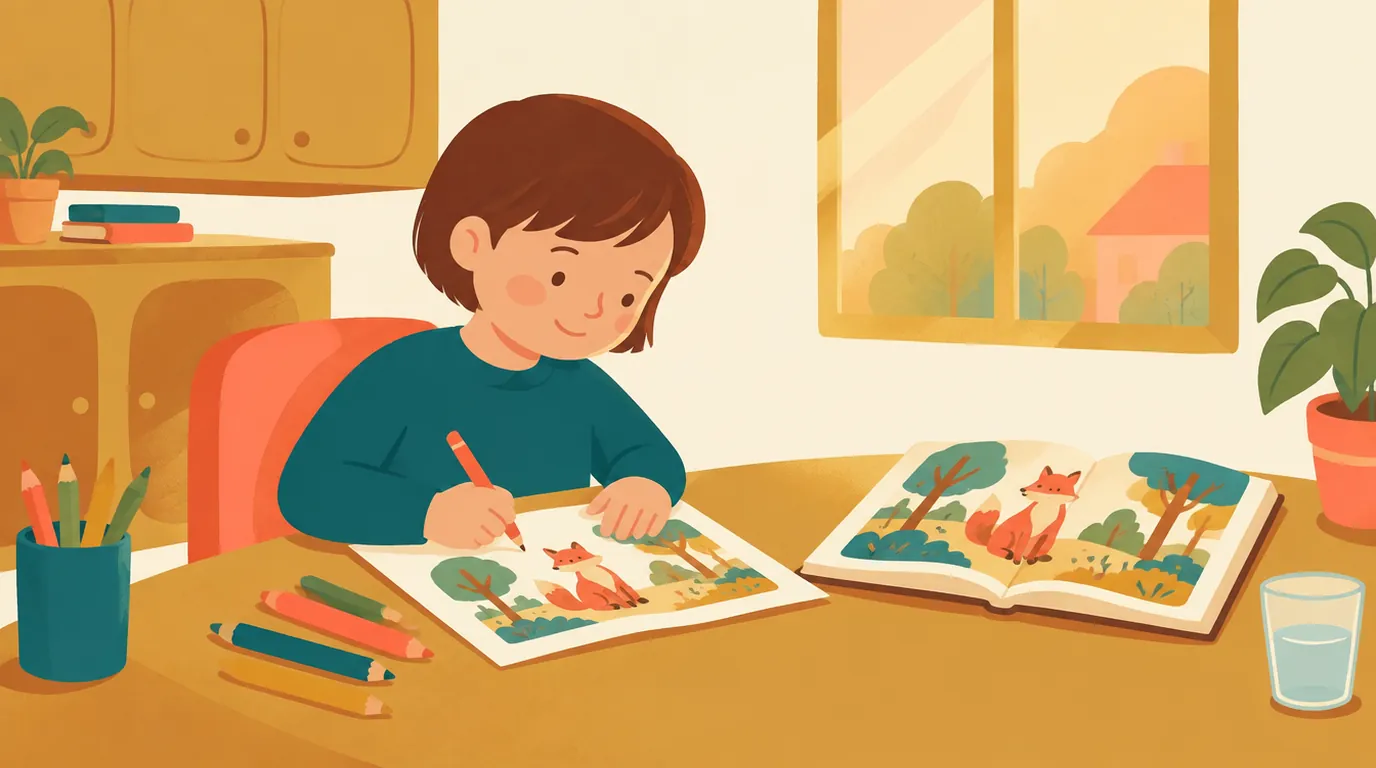
- Draw the scene. After reading a page, your child draws what they 'saw'. If the fox, the forest and the snow described in the text appear in the picture, they've built a good mental image.
- Put the story in order. Write four key sentences from the story on strips of paper, mix them up, and let your child put them back in the right order.
- True or false. Say statements about the text, some true, some false. Each time, your child must justify their answer by pointing to the passage.
- Read by acting out the roles. You're the wolf, your child is the little pig. To read a dialogue with the right voice, you have to understand how each character feels.
- Imagine what happens next. Stop before the last page: “How do you think it will end?” A logical ending shows your child has followed the story.
Try using different approaches: some children understand a story better when they hear it, others when they read it quietly to themselves. Watch what works best for your child, as we explain in our article on visual and auditory memory. And for ready-to-use resources, our printable CE1 exercises offer short texts with step-by-step questions.
Mistakes to avoid so your child doesn't lose interest in reading
- Turning bedtime stories into a quiz. Keep some reading time just for pleasure, with no questions at all. A love of reading also grows from these moments.
- Choosing texts that are too hard. If your child struggles with several words per line, they won't have energy left for meaning. To build confidence, going back to CP-level reading sheets is not a setback—it's how you consolidate skills.
- Correcting every word as they read. Let your child finish the sentence. If they correct themselves, that's a sign they're paying attention to meaning.
- Only asking closed questions. “Is the fox red?” can be answered without reading. Try “why” and “how do you know” instead.
If, after several weeks of regular practice, your child still seems lost—even with very short texts they can read—talk to their teacher. They can tell you what they observe in class and, if needed, suggest further steps. In most cases, though, a little patience, good books and well-chosen questions work wonders over the year.
Want to put these tips into practice?
Every day, a new adventure workbook adapted to your child's school level — to print or do on screen. No commitment.
Your questions
My child reads aloud well but doesn't understand— is this normal in CE1?
It's common at the start of the year: as long as decoding takes effort, there's little attention left for meaning. Build fluency with repeated readings of short texts, and ask questions before, during and after reading. If nothing changes after several weeks, talk to the teacher.
How much time should we spend on comprehension each day?
Ten to fifteen minutes is plenty in CE1. Short daily sessions are better than one long session at the weekend. Also keep some reading time just for pleasure, with no questions.
Should my child reread the text to answer questions?
Yes, and it's a skill to encourage: going back to find the clue in the text is exactly what good readers do. Ask your child to point to the sentence that supports their answer. This helps them avoid guessing.
What if my child refuses to retell the story?
Try a different approach instead of insisting: your child can draw the scene, tell it to their favourite toy, or act out a part. You can also retell the story yourself, adding a deliberate mistake for your child to spot and correct.
Read next
 Revision methods
The syllabic method for learning to read: why it’s making a comeback
Phonics Method for Learning to Read: how it differs from the whole-word approach, what official guidelines say, and…
 Revision techniques
The Pomodoro Method for Children: Study in 10-Minute Bursts
The Pomodoro Technique for Kids: best block length by level, which timer to use, and a sample homework session…
 Revision techniques
Mind Maps: How to Help Your Child Learn
Mind mapping explained for parents: how to create one with your child, a real lesson example, and practical tips.