📖 Reading comprehension CE2: helping your child understand what they read

By CE2 (age 8-9), your child can read. They can decode words without stumbling, and sometimes read alone in bed. Yet, when faced with a comprehension quiz, they get stuck. “I don’t know, it’s not written!” Don’t worry: this is a normal stage for this year. CE2 is when children move from knowing how to read to understanding what they read on their own. Here’s how you can support them without turning every evening into a test.
Reading comprehension in CE2: what changes from CE1
In CE1, the teacher often reads with the class and asks questions out loud. In CE2, texts get longer and your child reads more independently, in silence, before answering in writing. The official expectations for the end of CE2 published by Eduscol focus on understanding texts read alone, and on reading aloud more fluently (the guideline is about 90 words per minute on an age-appropriate text).
In practice, your child needs to learn to:
- follow the thread of a text with several paragraphs, or even a short chapter book;
- find a specific piece of information in the text without rereading everything;
- understand what isn’t stated directly (why a character is crying, where the scene takes place);
- answer in a full sentence and explain their answer.
If reading aloud is still choppy, start there: a child who uses all their energy to decode words has none left for understanding. Our article on reading fluency offers a ten-minute routine to help build confidence.
The three types of questions in a CE2 comprehension text
Many children get stuck because they think all the answers are “in the text”. But a CE2 quiz mixes three types of questions. Recognising them already helps your child know how to look for answers.
| Type of question | Example | Where’s the answer? | How to help |
|---|---|---|---|
| Find | “What’s the dog’s name?” | Written exactly in the text | Spot the keyword in the question (“dog”) and scan for it, using a pencil |
| Deduce | “Why is Léa scared?” | Not written: you need to link several clues | Ask, “What in the text makes you think that?” |
| Give your opinion | “Would you have done the same?” | In their head, backed up by the text | Accept any answer, as long as they say “because…” |
“Deduce” questions are the trickiest: these are called inferences. You can practise them out loud, even with bedtime stories. If your child still finds this hard, the games in our article reading comprehension in CE1 are still perfect for the start of CE2.
Reading silently without drifting off
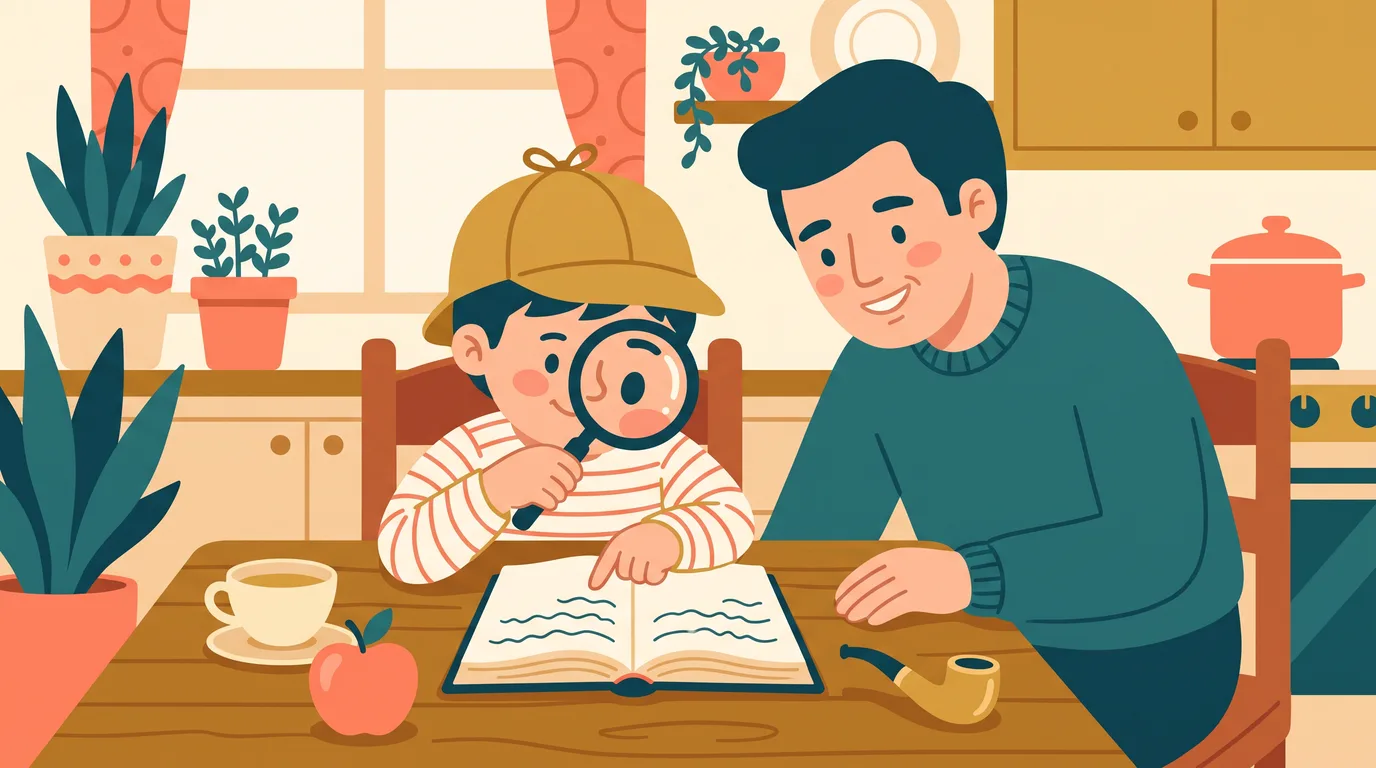
Silent reading is new for many children. Without a voice or an adult listening, their mind wanders: their eyes reach the bottom of the page, but nothing has sunk in. This isn’t laziness or a lack of intelligence; it’s a skill that takes practice.
- Break it up: read one paragraph at a time, then pause to sum up what just happened in a sentence.
- Make a movie: ask your child to “see” the scene in their mind. Where are the characters? What’s the weather like? If they can’t picture it, it’s time to reread.
- Read the question first: for a quiz, reading the questions before the text gives a purpose to the reading.
- Keep a pencil handy: lightly underline character names and places to help follow a long text.
Unknown words: guess before looking them up
In CE2, texts include more unusual words. A child who stops at the first unknown word loses track. On the other hand, skipping every tricky word means they’ll soon lose the thread. The right approach is somewhere in between:
- Read the sentence to the end.
- Work out the meaning from the rest of the sentence: « Le loup se tapit derrière un buisson, prêt à bondir » — you can guess he’s hiding.
- See if the word looks like a word you already know (like « reprendre », « prendre »).
- Only if the meaning is still unclear and it’s stopping you from understanding: use the dictionary.

Choose books that spark interest
We understand best what we want to read. Try different formats so reading isn’t just ‘school text’:
- first chapter books with short chapters and a few illustrations: perfect for learning to follow a story over several evenings;
- non-fiction books on a favourite topic (dinosaurs, space, animals): these help your child practise finding specific information;
- comics: these encourage your child to connect images and text, making them infer meaning;
- everyday texts: a recipe, game instructions, a cinema schedule. Reading to do something is reading to understand.
And keep reading stories aloud, even if your child can read alone. Listening to a slightly more challenging text than they’d choose themselves builds vocabulary and a love of stories.
A 15-minute reading comprehension routine for CE2 (age 8-9)
No need to spend the whole evening. Three or four times a week, this simple routine is enough:
- 2 minutes: look at the title and picture together, and your child guesses what might happen.
- 6 minutes: your child reads a passage silently, or aloud every other time.
- 4 minutes: your child retells it in their own words, without looking at the text. You ask one ‘find’ question and one ‘infer’ question.
- 3 minutes: your child gives their opinion and checks if their prediction was right.
If you’re ever short of ideas, the Kidibook subscription offers ready-to-print worksheets with texts at the right level and matching questions. And to try out the format for free, you can download the free Kidibook workbook in one click.
In summary
In CE2 (age 8-9), your child is learning to understand longer texts on their own. Help them sort the questions (find, infer, give an opinion), read silently in short sections, guess unknown words from context, and justify their answers. Regular fifteen-minute sessions are better than one long session on Sunday. And if grammar or conjugation rules are holding them back in written answers, our Big Book of Memory Tricks brings together all the essentials in easy-to-remember cards.
Want to put these tips into practice?
Every day, a new adventure workbook adapted to your child's school level — to print or do on screen. No commitment.
Your questions
My child can read well but doesn’t understand what they read in CE2. What should I do?
This is common: your child may still be using a lot of energy to decode words, or they read without picturing the story in their mind. Have them read short sections and retell each one in their own words. If it’s still difficult after regular practice, talk to their teacher.
How long should a child in CE2 read each day?
There’s no official time for reading at home. A regular fifteen minutes, several times a week, in addition to schoolwork, is a good rhythm. Consistency matters more than duration.
How can I help my child answer comprehension questions in writing?
Teach your child to use words from the question in their answer: « Comment s’appelle le chien ? » becomes « Le chien s’appelle Filou. » Then have them point to the sentence in the text that proves their answer.
Should I still read stories to a child in CE2 who can read alone?
Yes. Listening to texts that are a bit richer than those your child reads alone develops vocabulary and understanding. It’s also a great time to ask ‘why’ and ‘what will happen next’ questions out loud.
Read next
 Parent guide
The "summer slide": why your child forgets, and what to do
Loss of skills during school holidays is not inevitable: here’s how to avoid it in 10 minutes a day, without ruining the…
 Revision methods
Decimal numbers CM1: understanding the decimal point, with exercises
Help your child in CM1 master decimal numbers: reading, comparing, ordering, and placing decimals, plus 6 corrected exer…
 Parent guide
Educational gift ideas: a present they'll still use in March
Educational gift ideas for children: 4 tips to avoid toys that end up forgotten, a selection by type and age, and inspir…
 Revision methods
Mental maths in CE2: 10 minutes a day that make all the difference
Mental maths in CE2: discover the curriculum, 7 easy strategies, a 10-minute routine and 5 fun games to help your child …
 Parent guide
Poor school report: how to respond without crushing motivation
Poor school report? Read teachers’ comments, discuss calmly, find the cause and support your child with a plan for small…
 Revision methods
Long Division Explained Simply for Your Child
Long division made easy for you: step-by-step with brackets, a full example, classic mistakes (like forgetting zero) and…