🧮 Mental maths in CE2: 10 minutes a day that make all the difference

In CE2 (age 8-9), mental maths takes on a new dimension. Your child is no longer just expected to know that 7 + 3 makes 10: now they need to add 29 to a number in a second, find half of 120, or work out 4 × 37 without writing it down. It sounds like a lot, but really, it all comes down to a handful of facts learned by heart and a few clever strategies.
The good news: CE2 mental maths is easy to practise at home, out loud, in just 10 minutes a day. Here’s what your child will learn this year, the strategies you can show them, and a simple daily routine to help them progress without stress.
What your child learns in mental maths in CE2
The maths curriculum introduced in September 2025 sets out exactly what a CE2 pupil should be able to do in their head. Numbers now go up to 10,000, and the end-of-year expectations are clear:
- addition tables both ways: fill in 4 + … = 12 just as quickly as 5 + 3 = …;
- multiplication tables both ways: 9 × 6, but also 7 × … = 42 or 70 = 7 × …;
- common doubles and halves: doubles of numbers from 1 to 20, 25, 50, 75, 150…; halves of even numbers up to 40, and of 120, 150, 1,000…;
- some ‘clever’ results: 4 × 25 = 100, or different ways to make 60 (2 × 30, 3 × 20, 4 × 15, 5 × 12, 6 × 10);
- multiplying by 10 or 100 and understanding why: units become tens, tens become hundreds.
The curriculum even gives a benchmark: by the end of CE2, a pupil completes about fifteen addition equations, or twelve multiplication ones, in a minute. It’s not a competition—just a sign that these facts have become automatic.
Mental maths strategies in CE2 to show your child
A strategy is a way to turn a tricky calculation into easier ones. The CE2 curriculum lists several. Show your child one a week, out loud, and ask them to explain ‘how they did it’: putting it into words helps them remember.
| Strategy | How it works | Example |
|---|---|---|
| Adding 9, 19, 29… | Add the next ten, then subtract 1 | 46 + 29 = 46 + 30 − 1 = 75 |
| Adding 8, 18, 38… | Add the next ten, then subtract 2 | 25 + 38 = 25 + 40 − 2 = 63 |
| Subtracting 9, 19, 29… | Take away the next ten, then add 1 | 84 − 29 = 84 − 30 + 1 = 55 |
| Multiply by 4 | Double, then double again | 4 × 37: 74, then 148 |
| Multiply by 8 | Double three times in a row | 8 × 27: 54, 108, then 216 |
| Multiply by tens | Multiply, then multiply by 10 | 9 × 40 = 36 × 10 = 360 |
| Split into two parts | Separate tens and units | 23 × 7 = 140 + 21 = 161 |
For multi-step calculations like 8 × 27, your child is allowed to jot down intermediate results on a whiteboard or scrap of paper. The curriculum allows for this: these little notes help their memory. It’s not cheating—it’s well-organised mental maths.

Tables, doubles and halves: the foundation to know by heart
All the strategies in the table rely on facts learned by heart. In CE2, multiplication tables are no longer new: they were introduced in CE1, and this year is about consolidating them, both ways.
Practically, ‘both ways’ means your child should be able to answer “6 times 7?” but also “How many times does 7 go into 42?” This second question is great preparation for division. If the tables are still shaky, our guide to learning multiplication tables suggests a learning order that avoids having to start from scratch.
Doubles and halves are useful everywhere: multiplying by 4 or 8, sharing, giving change. Practise them as quick-fire questions (“I say 35, you say?” – “70!”).
The 10-minute daily routine at home
Mental maths improves with regular practice, not with longer sessions. Here’s a typical week, easy to fit in between snack time and bath:
- Monday: 10 times tables questions, mixing both ways (6 × 8? and 48, that’s 6 times what?);
- Tuesday: doubles and halves in a ping-pong style, taking turns to ask each other questions;
- Wednesday: strategy of the week — 5 calculations explained out loud;
- Thursday: making up to the next ten or hundred (from 74 to 80? from 230 to 300?);
- Friday: a quick timed challenge, against themselves only, never against a sibling.
Stick to a simple rule: always finish on a success. If your child gets stuck, ask an easy question before ending. They should leave the table thinking, “I can do this.”
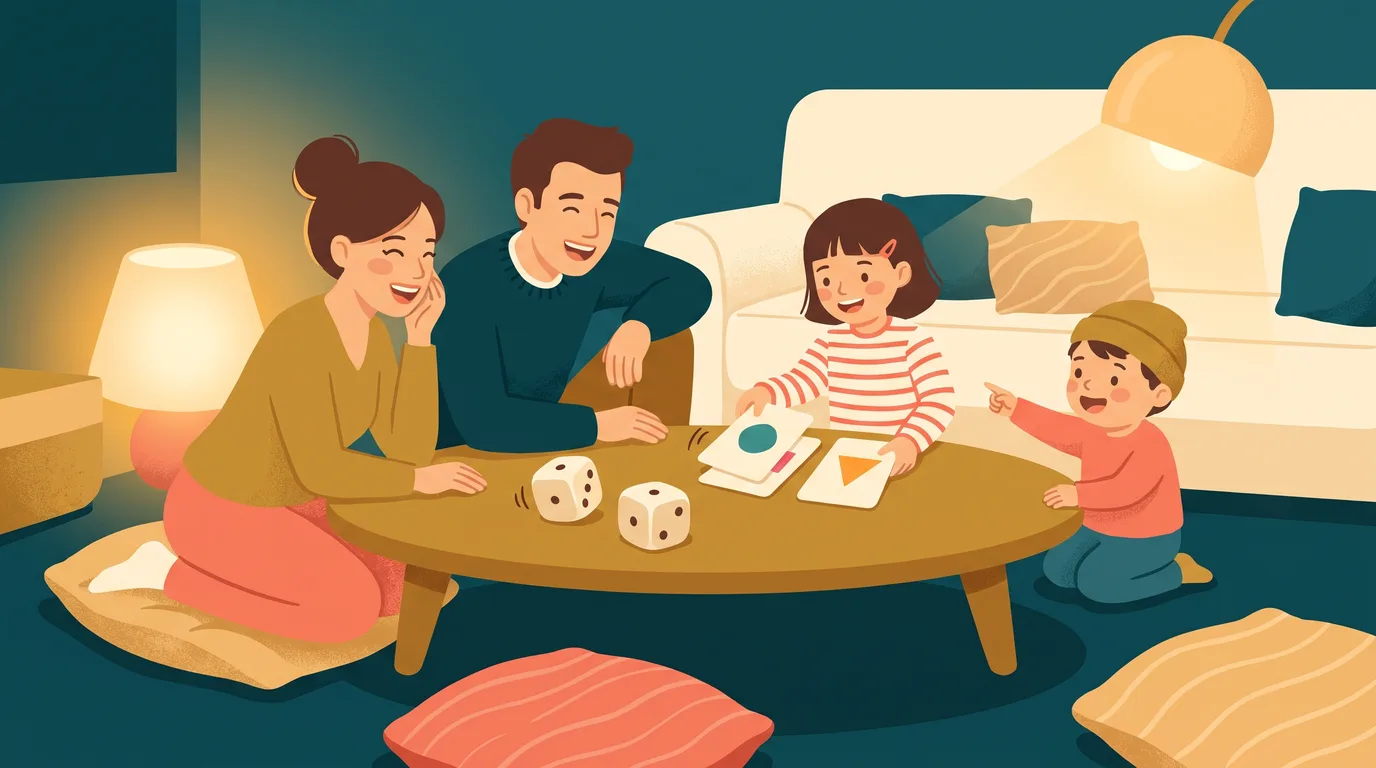
5 mental maths games for CE2 the whole family can play
Games take the pressure off and encourage repetition. Here are five ideas with little or no equipment:
- Doubles relay: start at 3, each person says double the previous number (3, 6, 12, 24, 48, 96…). If someone makes a mistake, start again at 3.
- Product battle: with a deck of cards (remove the face cards), each player turns over two cards and multiplies them. The highest product wins the round.
- Almost there: roll three dice and try to get as close to 50 as possible using addition and multiplication.
- Number plate game: in the car, add the first two digits of a number plate, then find what you need to reach 100.
- The shopkeeper: objects costing 25p, 50p or £1. How much for 4 items at 25p each? A real-life maths skill from the curriculum!
To go further, Kidibook’s 31-Day Adventure sends you a free activity book every morning, matched to your child’s CE2 class — a ready-made way to build the routine.
When your child gets stuck: three common situations
They still count on their fingers. This often means addition facts aren’t automatic yet. Go back to making 10 and doubles, without telling them off. The CE1 mental maths summary is a good place to spot what’s missing.
They panic when timed. Drop the timer for a few weeks: speed comes naturally once they’re confident with the answers.
They know their tables but struggle with multi-step sums. This is usually a working memory issue. Allow them to jot down intermediate results on a whiteboard, then gradually phase it out.
In short: little and often
Mental maths in CE2 is about knowing key facts by heart (tables, doubles, halves) and a handful of strategies to combine them. Ten minutes a day, spoken and through play, is enough to build strong habits over the year. Next year, the CM1 mental maths strategies will build directly on what your child has learned.
Want to put these tips into practice?
Every day, a new adventure workbook adapted to your child's school level — to print or do on screen. No commitment.
Your questions
How much time should my child spend on mental maths each day in CE2?
Ten minutes is enough, as long as it’s regular. A short daily session, spoken aloud, is better than a long one at the weekend.
Which times tables should children know in CE2?
The 2025 curriculum expects children to know the times tables both ways, for numbers 0 to 10: they should know that 9 × 6 = 54, but also fill in 7 × … = 42. The tables are introduced in CE1 and reinforced throughout CE2.
My child still counts on their fingers in CE2 — should I worry?
No, but it’s a sign that some facts aren’t memorised yet. Go back to making 10, doubles and addition tables, with short games. If it continues, talk to the teacher.
How can I make mental maths fun for an 8-year-old?
Turn it into a game: card battles with multiplication, doubles relay, number plates in the car or a little shopkeeper game. Your child will do lots of sums without feeling like it’s work.
Next up
 Revision methods
The syllabic method for learning to read: why it’s making a comeback
Phonics Method for Learning to Read: how it differs from the whole-word approach, what official guidelines say, and…
 Revision methods
The Pomodoro Method for Children: Study in 10-Minute Bursts
The Pomodoro Technique for Kids: best block length by level, which timer to use, and a sample homework session…
 Revision techniques
Mind Maps: How to Help Your Child Learn
Mind mapping explained for parents: how to create one with your child, a real lesson example, and practical tips.