🎲 Educational board games for ages 6-10: our skill-based picks
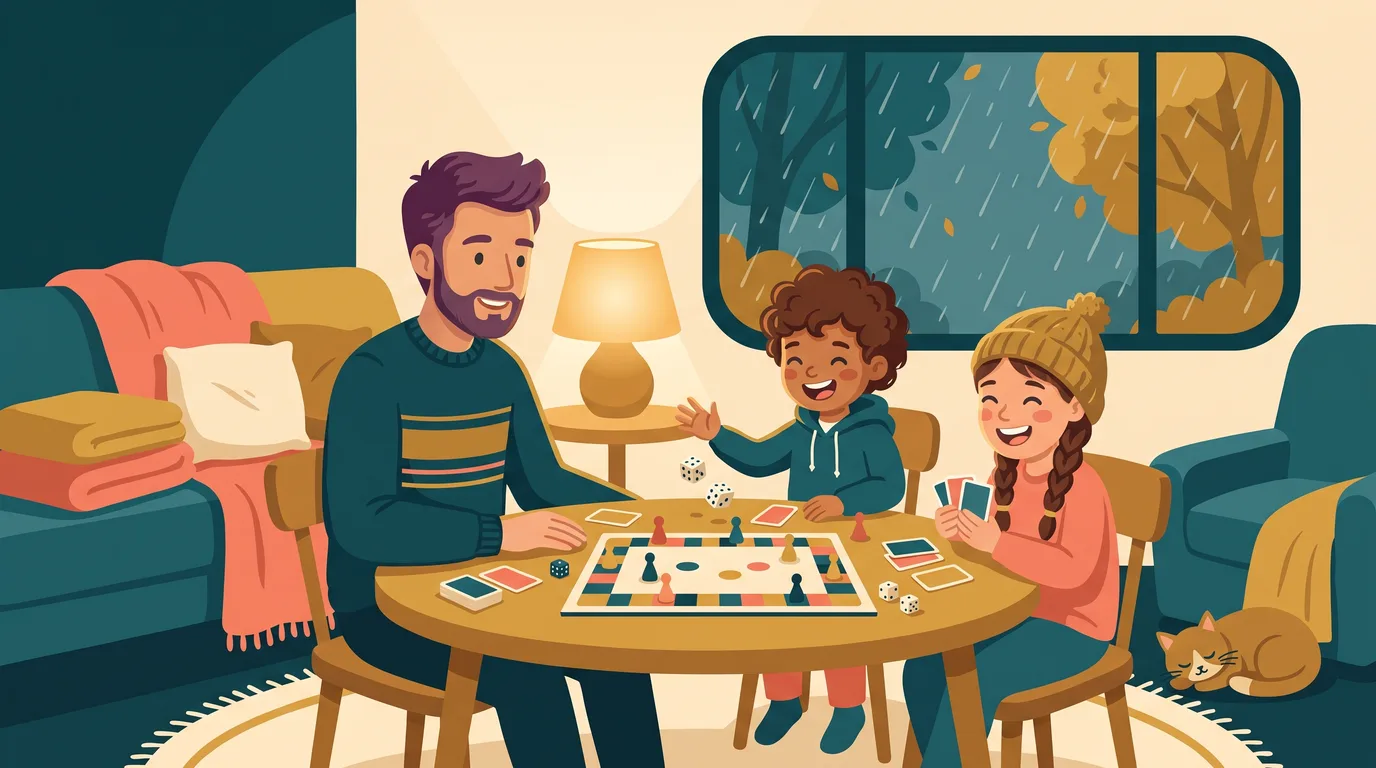
It's raining, the games console is off-limits, and you're searching for a board game for your 6-10 year old that doesn't feel like a disguised lesson. Good news: the best games for learning rarely have an 'educational' label. They're classic games you play to win... and along the way, your child practises maths, words or logic without even realising.
Instead of sorting by marketing age ranges, here's a selection organised by skill. You can choose what your child needs to practise, not just what the box says. This list is a solid starting point—feel free to add your own favourites.
Why choose an educational board game by skill, not by age
When a box says 'from age 7', it mainly refers to rule complexity. It doesn't tell you what the game actually helps practise. For example, a child in CE2 who reads well but struggles with addition doesn't need the same game as a classmate who finds reading tricky.
The best approach: start with the area your child finds tricky at school or during homework, then pick a game that lets them practise that skill over and over in each round. It's the fun repetition that helps things stick, not a one-off Sunday game.
Mental maths: board games that get kids counting without complaints
Mental maths gets stronger with speed and repetition. Games where you add up points each round are perfect.
- Skyjo: everyone tries to get the lowest score with cards from -2 to 12. Lots of adding, subtracting and negative numbers each round.
- Yam's (or Yahtzee): five dice, combinations to aim for, and a score sheet that gets you adding and multiplying.
- Halli Galli: hit the bell as soon as there are exactly five matching fruits on the table. Quick counting—ideal for CP-CE1.
- Rummikub: make runs and sets with numbers from 1 to 13. Great for number logic and quick calculations.
- Addition Battle: each player turns over two cards and adds them up. Highest total wins. There's a multiplication version for CM1-CM2.
For more ideas on practising times tables, see our article on games for learning multiplication tables.
Vocabulary and spelling: playing with words
Reading instructions, finding words, spelling them correctly—all these can be practised around the table too.
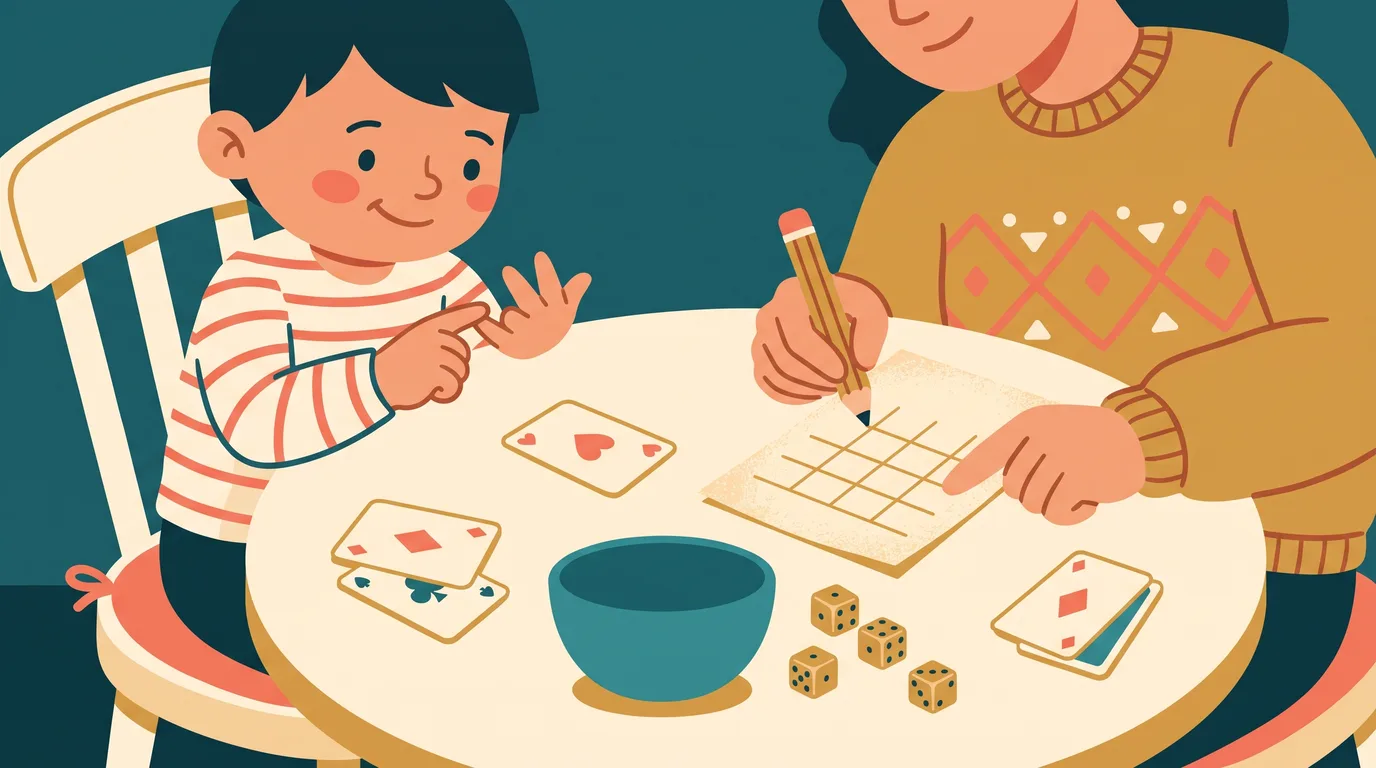
- Boggle: find as many words as you can in a grid of letters before time runs out. Brilliant for spelling, as long as your child is a confident reader.
- Scrabble (or the junior version): build words, count points. Two skills in one.
- Categories: pick a letter, then find words for categories (name, animal, country, fruit, etc.). Free to play—all you need is paper and a pencil.
- Taboo or Time's Up family version: get others to guess a word without saying it. Each card is a chance to build vocabulary and practise rephrasing.
Logic and strategy: learning to think before acting
Solving a maths problem starts with reasoning. Logic games help children anticipate, rule out options and learn from mistakes.
- Mastermind: guess a colour code using clues. Pure deduction.
- Connect 4: a classic for learning to predict your opponent's moves from age 6.
- Solo logic games (progressive puzzle challenges, like SmartGames): your child can go at their own pace, level by level.
- Chess or draughts: take longer to learn, but fantastic for building concentration.
Memory and focus: games that boost concentration
Remembering a lesson takes focus and a trained memory. The good news: lots of popular games help build these skills too.
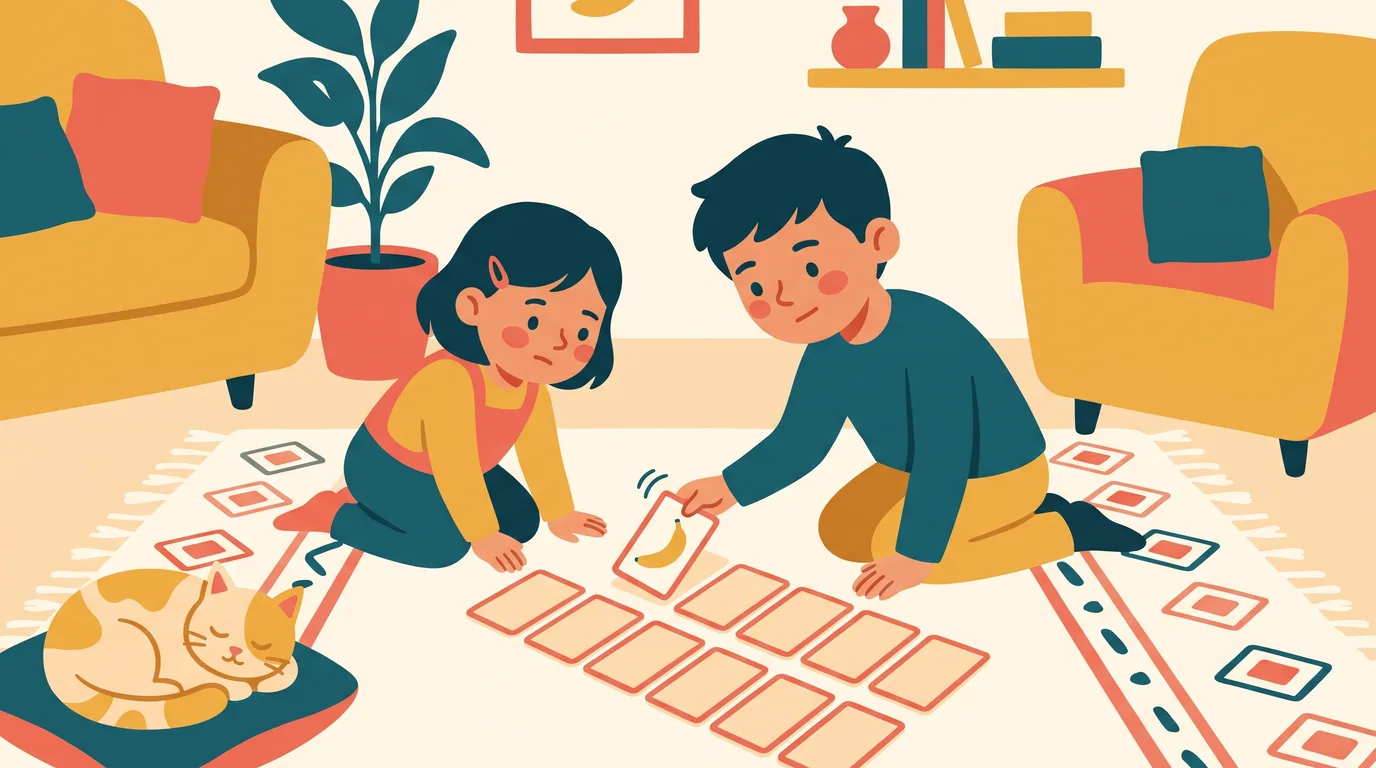
- Memory: find the matching pairs. Simple—and adults don't always win!
- Dobble: between any two cards, there's always one symbol in common. Great for observation and speed.
- Lynx: quickly spot an image on a big board. Excellent for visual scanning.
- Timeline: put events in chronological order—the date is on the back of each card. A great way into history for CM1-CM2.
Summary table: which game for which skill?
| Skill to practise | Shop-bought games | No-purchase version | Recommended level |
|---|---|---|---|
| Mental arithmetic | Skyjo, Yam's, Rummikub | Addition battle with a deck of cards | CP → CM2 |
| Quick counting | Halli Galli | Roll two dice: who can give the total first? | Kindergarten → CE1 |
| Vocabulary, spelling | Boggle, Junior Scrabble | Categories game | CE1 → CM2 |
| Logic, deduction | Mastermind, Connect 4 | Higher or lower with a secret number | CP → CM2 |
| Memory, attention | Memory, Dobble, Le Lynx | Kim's game (remembering objects on a tray) | Kindergarten → CM2 |
| History timeline skills | Timeline | Make your own timeline with homemade cards | CM1 → CM2 |
Levels are just a guide: check the age on the box for the rules, and trust your child for the rest.
Turn any board game into a revision game
No need to buy another game. With a few tweaks, you can revise using what you already have:
- Snakes and Ladders or Ludo: before moving, the player answers a question (a times table, a spelling word, a date). Wrong answer? Stay on the same square.
- Uno: play a card, then add it to the previous card and say the total.
- Homemade Memory: on blank cards, write a maths problem on one, the answer on another. Find pairs like “6 × 7” and “42”.
- Guess the word: try to guess a word from the week’s list by asking questions (“Does it have two syllables? Does it start with a vowel?”).
For more ideas when the whole family is stuck indoors, take a look at our indoor games for rainy days. If you’d like a ready-to-play, free game designed for revision, try the Kidibook game.
Keep the fun going: when memory wins the game
Board games show just how easily children remember what they enjoy. That’s the whole idea behind memory tricks: a catchy phrase, a picture, a pun, and the rule sticks. Our Kidibook Big Book of Memory Tricks collects these tips by level, so memory keeps winning even after the game.
In summary
A great educational board game for ages 6-10 is one you’ll want to play again and again. Choose based on the skill you want to boost, adapt the rules of your favourites, and remember what matters: playing together, for 15 minutes, often. It’s this regularity that makes the difference, far more than the price of the box.
Want to put these tips into practice?
Every day, a new adventure workbook adapted to your child's school level — to print or do on screen. No commitment.
Your questions
Which educational board game should I choose for a 6-year-old?
At age 6, go for short games with simple rules: Memory, Halli Galli for quick counting, Connect 4 for planning ahead, or Snakes and Ladders with a question on each square. The age on the box is still the best guide for how tricky the rules will be.
Do board games really help children do better at school?
Board games can't replace lessons, but they let your child practise useful classroom skills in a fun way: mental maths, vocabulary, focus, and reasoning. The real benefit comes from playing regularly: a few short games each week are much better than one long session now and then.
How can I encourage a child who hates losing to play?
Try cooperative games where everyone wins or loses together, pick short games so your child can have a quick rematch, and set an example by losing cheerfully yourself. Praise clever moves rather than just the win.
Can you make your own educational game?
Absolutely — and it’s often very effective. You can make a memory game with sums, a word game, or question cards for a board game in just a few minutes with some card. Getting your child involved in making the game is already a great way to revise.
Read next
 Learning through play
15 games to keep children busy in the car (that make them think)
15 car games to keep kids busy, almost no equipment needed: classics and clever games that help revise key skills
 Learning through play
Games to Learn Times Tables: 8 Ideas for Home
Games to learn times tables: battle, memory, dice, hopscotch… 8 screen-free ideas to play as a family, with printable cards.
 Learning through play
20 indoor games for rainy days (including 8 sneaky revision games)
Indoor games for children on a rainy day: 20 ideas that cost nothing, from calm activities to energetic games, plus 8 clever ways to sneak in some revision.