🌧️ 20 indoor games for rainy days (including 8 sneaky learning games)

It's raining, it's 2 pm, and you hear those words: “I'm bored.” Don't worry. With a bit of space in the living room and what you already have at home, you can keep the kids busy all afternoon. Here are 20 indoor games for children, grouped into three categories: quiet games, active games, and 8 clever games that sneak in some revision.
No need to buy anything. Siblings are welcome: most of these games work just as well with two or five players.
Indoor games on a rainy day: get the house ready in 5 minutes
Before you start the first game, set up the space. Five minutes is all it takes, and it helps avoid arguments later.
- A quiet corner: a blanket, some cushions, a lamp. This is the spot for reading, drawing, or just relaxing.
- An active area: move the coffee table, put away anything breakable. This is where the jumping happens.
- A game box: paper, pencils, painter’s tape, a pack of cards, some dice, a few empty plastic bottles.
The idea is simple: alternate. An active game, then a quiet one, then a clever one. A child who’s moved around will focus better afterwards.
6 quiet indoor games for rainy days
Perfect after lunch or at the end of the day, when energy is running low.
- The blanket fort. Two chairs, a sheet, some pegs. Once it’s built, read a story inside by torchlight. This one can keep them busy for a whole hour.
- Shadow theatre. A lamp, a pale wall, your hands. Rabbit, bird, wolf… then make up a little story with the characters.
- Story round. Each person adds a sentence to the previous part of the story. Bonus rule: the sentence must start with “Suddenly…” or “Luckily…”.
- Salt dough. Two cups of flour, one cup of fine salt, one cup of warm water: knead, shape, let dry. You can paint your creations on another rainy day.
- Blind drawing. One player describes an object without naming it, the other draws it. Compare at the end—guaranteed giggles.
- The puzzle or board game that’s been forgotten at the back of the cupboard. A rainy day is the perfect time to get it out and finally finish that game.
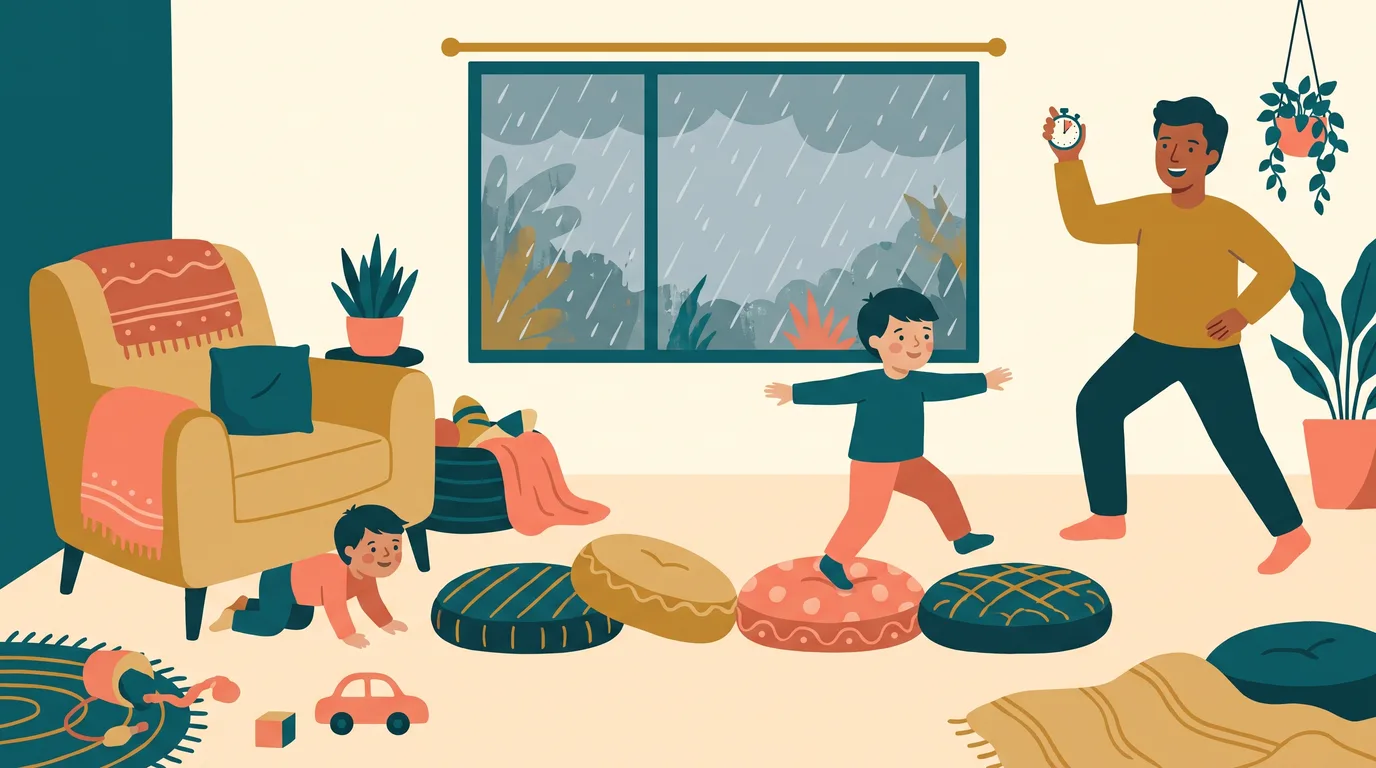
6 active games that won’t break anything
A child who hasn’t run around all day needs to move. These indoor games are designed for the living room, not a gym.
- The obstacle course. Step over cushions, crawl under chairs, walk along a line of tape for balance. Time each round and try to beat your record.
- Keep the balloon off the floor. A balloon, and count how many times you can hit it before it touches the ground. Simple, and surprisingly tiring.
- Red Light, Green Light in the hallway. The classic playground game works brilliantly in a corridor.
- Musical statues. Dance while the music plays, freeze when it stops. Whoever moves becomes the DJ.
- Home bowling. Six plastic bottles, a little water in each to weigh them down, a soft ball. Keep score on a sheet of paper.
- Hot or cold. Hide an object, one person searches, and you give clues: “colder… warmer!” Little ones love hiding things for the grown-ups.
8 clever games that sneak in revision
This is parents’ favourite part. These indoor games help with times tables, spelling or maths—no workbook or red pen needed. Your child plays. You know they’re revising.
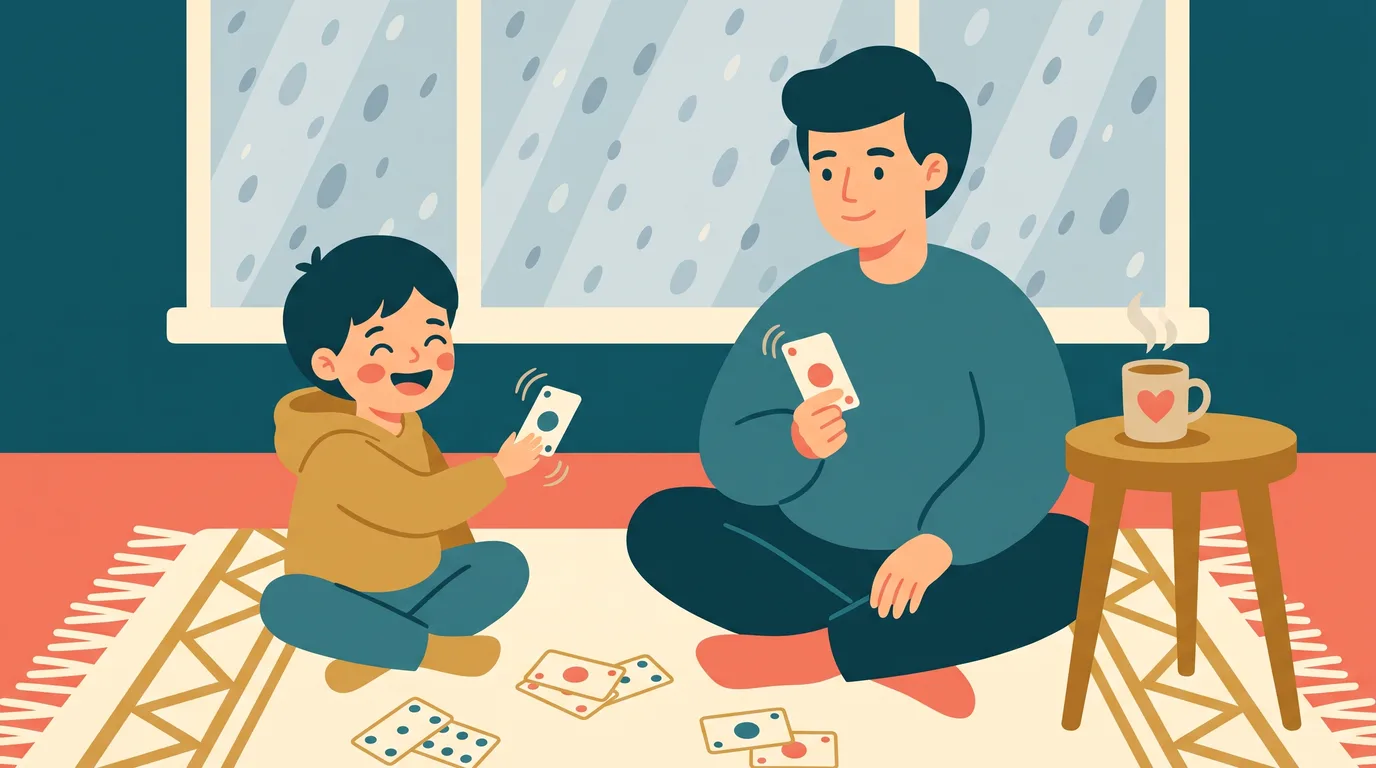
- Times tables battle. A deck of cards without the face cards. Each player turns over a card at the same time: the first to call out the product of the two cards wins the round. For more ideas, see our article on the game for learning times tables.
- Dictation challenge. Swap roles: your child dictates four or five sentences, you write them down… and deliberately make three mistakes. Your child has to spot them. They love correcting you, and they’ll read much more carefully than with their own work.
- Spelling treasure hunt. Hide five notes around the house. Each one has a clue to find the next, with a word to spell correctly before moving on. It’s a great way to review tricky words: toujours, beaucoup, maintenant…
- Shopkeeper with real coins. Price tags on household items, a purse, and your child is in charge of the till. Giving change is excellent mental maths.
- Categories. Pick a random letter, then find a name, animal, country, fruit… starting with that letter. Vocabulary, spelling and general knowledge all in one game.
- Who am I? An animal or job stuck to your forehead, and your child asks yes/no questions to guess. They learn to ask questions and use logic to narrow things down.
- The longest word. Draw eight random letters (written on slips of paper) and everyone tries to make the longest word possible. Like Scrabble, but without the board.
- Double the recipe. Make a cake, but for twice as many people: your child has to double each quantity. Weighing, measuring, counting… and tasting at the end.
| Clever game | Suggested age | Materials | Skills practised |
|---|---|---|---|
| Times Tables Battle | CE1 to CM2 | A pack of cards | Multiplication tables, speed |
| Dictation Challenge | CE1 to CM2 | Paper, pencil | Spelling, proofreading |
| Spelling Treasure Hunt | CP to CM2 | Five pieces of paper | Reading, tricky words |
| Shopkeeper Game | Kindergarten to CM1 | Coins, labels | Mental maths, money |
| Categories Game | CE1 to CM2 | Paper, pencil | Vocabulary, spelling |
| Who Am I? | Kindergarten to CM2 | Sticky notes | Questions, logic |
| Longest Word | CE2 to CM2 | Letters on paper | Vocabulary, spelling |
| Double Recipe | CE1 to CM2 | A simple recipe | Measuring, doubling, problem-solving |
Ages are just a guide: adjust the difficulty (start with the 2 and 5 times tables, or short words for younger children) rather than relying on the label.
A typical rainy afternoon, from 2:00 pm to 6:00 pm
Need a plan? Here’s a sample schedule you can adapt for your family.
- 2:00 pm: build a den, then read a story inside.
- 3:00 pm: timed obstacle course.
- 3:30 pm: snack time… and double recipe if you’re feeling brave.
- 4:15 pm: a clever game of your choice (categories or times tables battle).
- 5:00 pm: salt dough or drawing, for some quiet time.
- 5:30 pm: a short, chosen screen time if you wish.
If your child enjoys workbooks, slip in an activity page during the day: the free Kidibook workbook prints in minutes and offers fun activities for each level.
And what about screen time?
A rainy day doesn't have to mean no screens at all. What matters is choosing the right screen activity, at a set time, with a clear end. A short game is better than a cartoon that keeps playing automatically.
That's why we created The Big Jump, a free mini-game featuring the Kidibook mascots: just a few rounds to try and beat your high score, with no ads pushing you to keep playing. It's a handy treat for the end of the afternoon, not an all-day solution.
If the rain lasts all week, the 31-Day Adventure gives you a free adventure activity book every morning, set in your child's class universe. It's a great way to start the day with a challenge before getting the cushions out again.
Want to put these tips into practice?
Every day, a new adventure workbook adapted to your child's school level — to print or do on screen. No commitment.
Your questions
What indoor game for a child alone on a rainy day?
A reading den, salt dough, drawing, a puzzle or a timed obstacle course: trying to beat their own record works really well for solo play.
How do you keep children of different ages busy together?
Pick games where everyone has a role that suits them: the older one runs the shop, the younger one does the shopping; in word games, the youngest can play with just one category.
How can you help your child revise without them realising?
Make it a game: times tables battles, a spelling test where your child marks your mistakes, doubling a recipe, or a treasure hunt with words to write. Keep it short, fun, and pressure-free.
Should you ban screens on rainy days?
Not necessarily. It's better to have a planned, limited screen time, agreed in advance and balanced with other activities, than to try and ban screens all weekend — which can be hard to stick to.
Read next
 Learning through play
15 games to keep children busy in the car (that make them think)
15 car games to keep kids busy, almost no equipment needed: classics and clever games that help revise key skills
 Learning through play
Games to Learn Times Tables: 8 Ideas for Home
Games to learn times tables: battle, memory, dice, hopscotch… 8 screen-free ideas to play as a family, with printable cards.
 Parent guide
The "summer slide": why your child forgets, and what to do
Learning loss over the school holidays isn’t inevitable: here’s how to prevent it in just 10 minutes a day…