🎭 7 joke and riddle games to enjoy as a family without screens
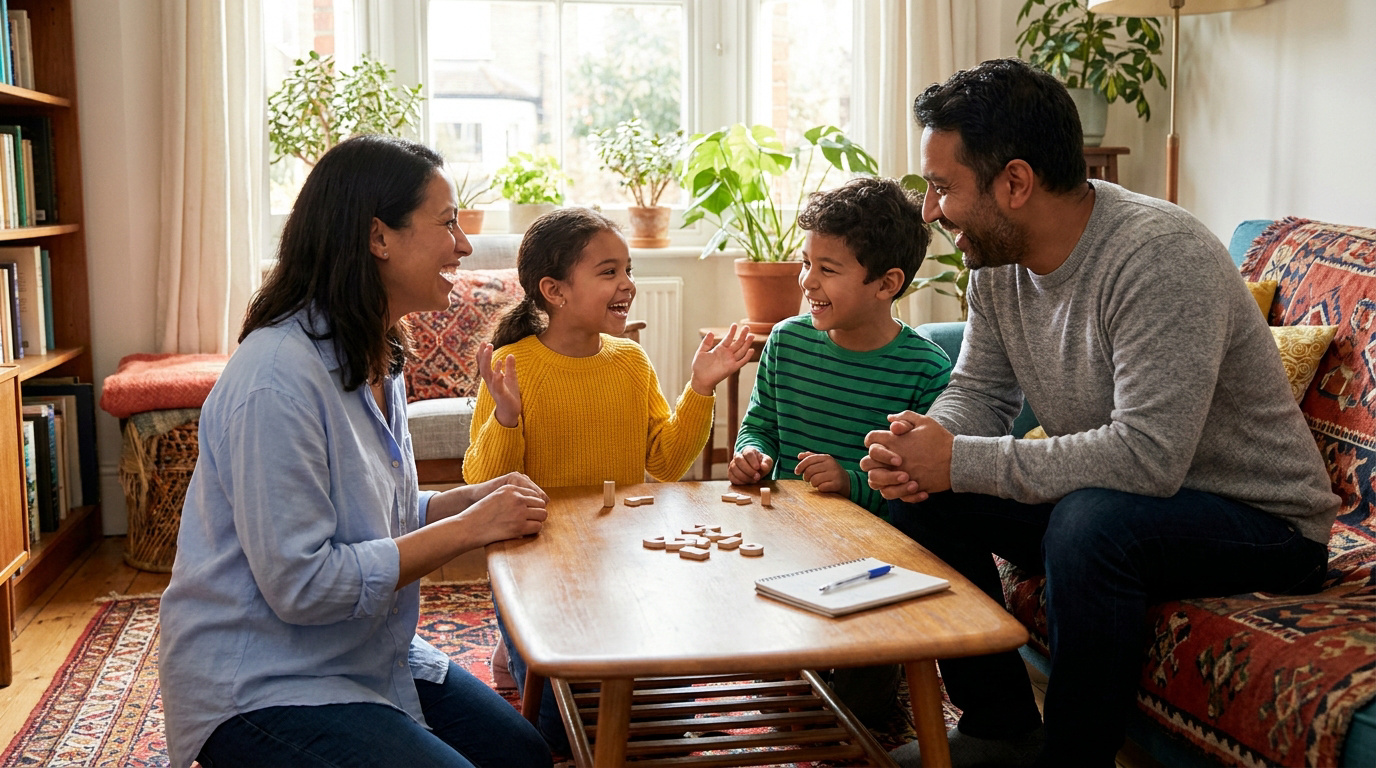
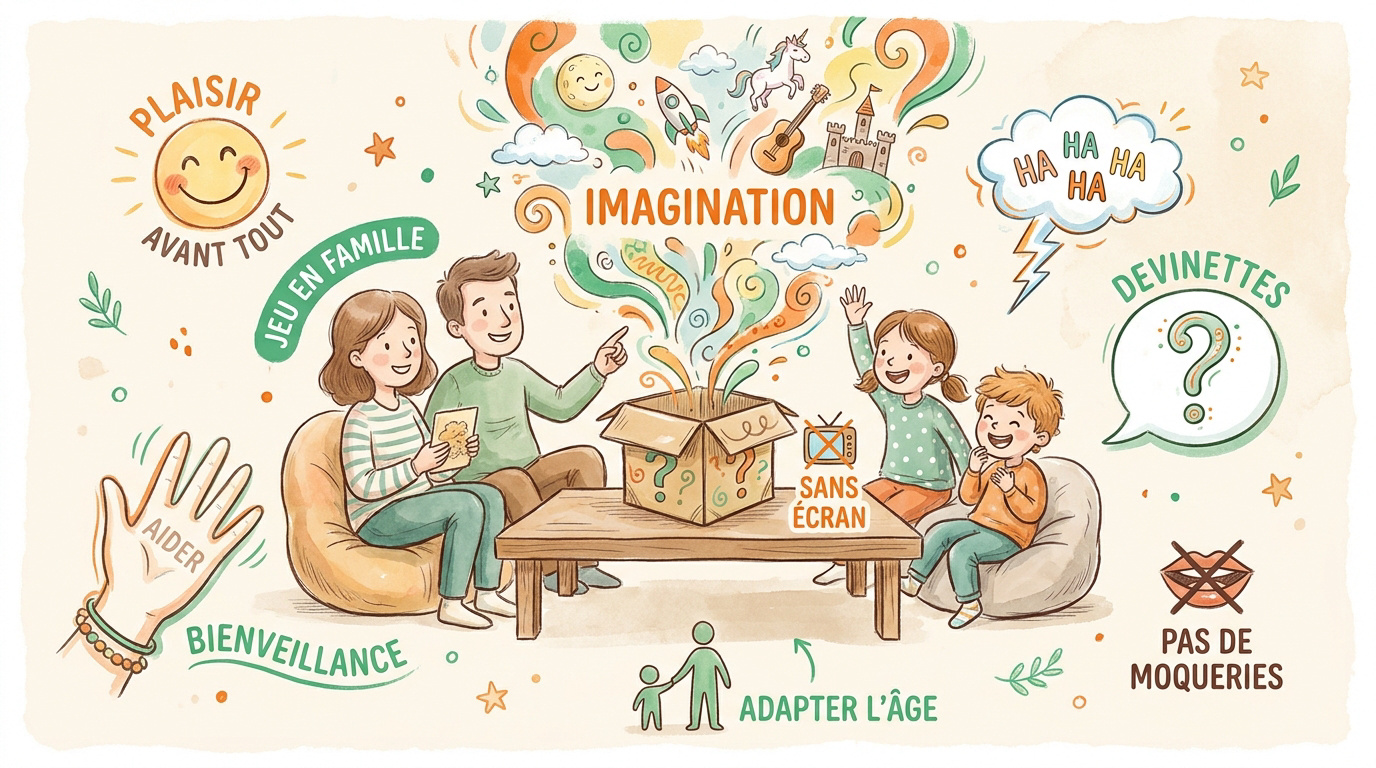
An empty box, a few slips of paper, and a fun question: that's all you need to start some family riddle games. Here are seven activities to try with children aged 6 to 11, whether in the living room or during a quick break. No need to prepare everything or finish the whole list—just pick the one you fancy today.
The examples below are ready to use for playing straight away. They aren’t taken from Kidibook books. The suggested times are just guidelines—feel free to adapt them for your family.
Before you start: a few tips for laughing together
Participation is always optional. Anyone can skip their turn, ask for a clue, or simply listen. A wrong answer isn’t a mistake—it can even spark a fun discussion about other possible solutions. The aim is to laugh together, never at someone’s expense.
Choose familiar words and match the difficulty to each person’s confidence, not just their age. An adult can read all the questions. If siblings are different ages, give the youngest the first clue and let the others join in afterwards.
Start with three questions. If everyone wants more, carry on. If not, save the rest for another day—there’s no need to finish or treat it like a test.
| Game | What you need | Suggested time |
|---|---|---|
| Riddle box | Box, paper, pencil | 5 to 10 minutes |
| Mystery question | None | 3 to 5 minutes |
| Act out an answer | A clear space | 5 to 10 minutes |
| Invent a riddle | An object and a notebook | 10 minutes |
| Read aloud together | A written riddle or a book | 5 minutes |
| Cooperative challenge | A few questions | 10 minutes |
| Mini show | Two or three jokes | 5 to 10 minutes |
1. The riddle box: a family game to pick and play
Use a small cardboard box that your child can decorate. Write a riddle on each slip of paper, with the answer on the back, then fold them up. Take turns to pick a paper and read the question, or ask an adult to read it for you.
Try this: “I contain thousands of words, but I never speak. What am I?” Answer: a dictionary. If your child suggests another book, ask them why—then add the clue, “my words are in alphabetical order.”
Variation: Use different coloured papers for animals, objects, and jobs. The child picks a theme before drawing a riddle. Keep the questions you’ve already used separate, so you have fresh ones for next time.
2. The mystery question, with step-by-step clues
Think of an object without naming it. Give a broad clue, wait for guesses, then get more specific. This game works well at the table after a meal: everyone takes their time to answer, no stopwatch needed.
Try this: “I fit in one hand. You’ll find me in a pencil case. I leave a mark on paper. You can sharpen me.” Answer: a pencil. The first clues allow for several answers; the last one helps narrow it down.
Variation for older children: they ask questions that the leader can only answer with yes or no. Agree on a theme at the start so the search isn’t too broad.
3. Act out the answer: riddles with gestures
One player is secretly given an answer, then acts it out without speaking. The others try to guess the word. Pick actions that are easy to mime, like brushing your teeth, opening an umbrella, or making bread dough.
Give it a try: whisper “brushing your teeth” to the mime. They can show an imaginary toothbrush, the brushing motion, then rinsing. When someone guesses correctly, offer them a turn to mime if they’d like.
Variation: play in pairs to act out a scene. A child who doesn’t want to get up can stay seated, give the answer, or choose the next action. Just make sure there’s enough space for the actions.
4. Workshop: invent your own riddle
Pick an object in the room. Look at its shape, what it’s made of, and how it’s used. Write down three clues without naming it, then finish with “What am I?”. An adult can write while the child dictates.
Try this: “I have four legs, but I never walk anywhere. I have a back, but I never lie down. You can sit on me.” Answer: a chair. Test your riddle on another player: if they hesitate between several objects, add another clue.
Keep your creations in a family notebook. Jot down unexpected answers too — you can use them to make new questions.
5. Two-voice reading to share a joke
Choose a short riddle or a two-line joke. The adult reads the question, then the child reads the answer if they want. Swap roles next time. If a word is tricky, just say it so the story can continue.
Try this: the adult asks, “Why was the maths book sad?” and the child answers, “Because it had too many problems!” Take a moment to explain the double meaning of “problems” (maths exercises and worries) if needed, but keep it light.
Variation: each person picks a character voice for their line. You’ll also find more ideas in our article on encouraging your child to enjoy reading, always respecting their pace and interests.
6. The cooperative challenge: solve it together
Pair up as adult and child, or play as one team. A leader asks a riddle. The others share ideas before agreeing on an answer. The aim can be to solve three riddles, using as many clues as needed.
Try this: “My first is something you drive. My second is an animal that lives at home with you. My whole covers the floor.” Answer: car + pet = carpet. Say both words out loud if the connection isn’t obvious.
Variation: one person reads, another suggests ideas, and a third checks the answer. Change roles each round. For more ideas, our article on games for car journeys has plenty — just remember, the driver stays focused on the road.
7. Mini joke show in the living room
Mark out a small stage with a rug. Each volunteer picks two or three jokes, old or new, and performs them for everyone. They can keep their notes, have someone join them, or ask a parent to read for them.
Try pausing briefly before the punchline. For example, tell the sad maths book joke in a very serious voice. The audience can clap after each turn: there’s no ranking or winner.
Variation: perform the show as a duo, with one asking questions and the other giving answers. Stop whenever the group feels like it, even if not all the jokes have been told.
Printed activity books, one for each age
Prefer something on paper for quiet moments between two games? Our large activity books are available in English, one for each age, each with its own hero:
- Plouf and the Magic Seashell — CP (age 6-7);
- Astro’s Workbook, Space Mission — CE2 (age 8-9);
- Gauvain and the Eight Keys — CM2 (age 10-11).
Each paperback costs €24.99 at the time of writing, with free delivery in France and €5 elsewhere. Check the product page for current details.
To get started right away, all you need is one question. Pick the box, the mime, or the two-voice reading, and let the family decide if they want another round.
Want to put these tips into practice?
Every day, a new adventure workbook adapted to your child's school level — to print or do on screen. No commitment.
Your questions
Can we play if my child can’t read yet?
Yes. An adult reads the questions, while the child finds the answer, acts it out, or makes up clues out loud. They don’t need to read on their own.
How do you play with children of different ages?
Give clues in stages and pair up adults with children. Let the youngest answer first, then others can add more. Adjust the words to suit everyone’s knowledge.
How can I easily make up a riddle?
Pick a familiar object, write three clues about how it looks or what it’s used for, then ask “What am I?”. Test your question and add another clue if there’s more than one possible answer.
Do I need to buy a book to try these games?
No. The examples in this article, some paper and your imagination are enough. A printed book is just an optional extra, whenever you feel like it.
Read next
 Learning through play
15 car games to keep kids busy (and thinking!)
15 car games to keep children entertained, with almost no equipment: classic favourites and clever games that get them practising their skills…
 Memory tricks & memorisation
15 memory techniques every pupil should know (from CP to Bac)
A good memory trick helps a lesson stick in seconds. Discover 15 tried-and-tested tips, from…
 Parent guide
The ‘summer slide’: why children forget, and what you can do
Learning loss over the school holidays isn’t inevitable: here’s how to prevent it in just 10 minutes a day…