🎭 How to learn a poem quickly: the method in 4 evenings

The poem is to be recited on Thursday. It’s Wednesday evening, 8:15 pm, and your child is still stuck on the second stanza. The evening promises to be long… and the recital uncertain.
Good news: learning a poem is not a matter of “good” or “bad” memory, but of method and time segmentation. Here is a four-evening protocol of ten minutes each, testable starting tonight, that works from CP to CM2 (around 6 to 11 years old) — and the backup plan for when there really is only one evening left.
Why the night before is never enough
Reciting a text by heart is part of the French curriculum from CP (around 6 years old): it is a regular exercise, not a teacher’s whim. It strengthens memory, diction, and oral skills in front of a group.
The problem is therefore not the exercise, but the schedule. A text reread twenty times in one evening lodges in very short-term memory: the next morning, it has evaporated. The same text reviewed four evenings in a row, ten minutes each time, settles durably. This is the principle of spaced repetition : it is not the total time that matters, it is the number of times the brain has to go search for to the information.
Second classic mistake: rereading instead of testing oneself. Rereading a poem gives a pleasant impression of knowing it — it's an illusion. As long as the child hasn't tried to say it book closed, they don't know what they know.
How to learn a poem quickly: the 4-evenings method
Ten minutes per evening, no more. Each evening has a different goal: never do the same thing four times, otherwise boredom sets in.
| Evening | Goal | What we actually do | Duration |
|---|---|---|---|
| J–4 | Understand | Read the text aloud, together. Look for unknown words. Ask: “What is it about? Who is speaking? What do we see?” Nothing to memorize that evening. | 10 min |
| J–3 | Cutting out | One stanza (or two lines for the youngest) learned thoroughly, book closed. Stop there, even if it goes quickly. | 10 min |
| J–2 | Stack | Say yesterday's stanza again, then add the next one. Always start from the beginning: it is the sequence that blocks on the big day, not isolated lines. | 10 min |
| J–1 | Test yourself | Complete recitation, standing, facing the parent. Then use the cloze text technique on the two or three passages that still cause trouble. | 10 min |
The next morning, at breakfast: one single recitation, without comment or correction. It serves to reassure, not to correct.
The cloze text technique deserves a word, as it is the most effective of the lot. Copy the poem replacing one word out of four with a dash, and have it read aloud: the child is forced to reconstruct, thus to remember. Next round, erase one word out of two. Then all except the first word of each line — these prompts are exactly what is missing when stuck in class.

Recite while walking, singing, drawing
A text is better remembered when it passes through several channels: ear, voice, gesture, image. No need to label your child (“they are visual”): varying inputs helps everyone. Four variations that turn the chore into a game:
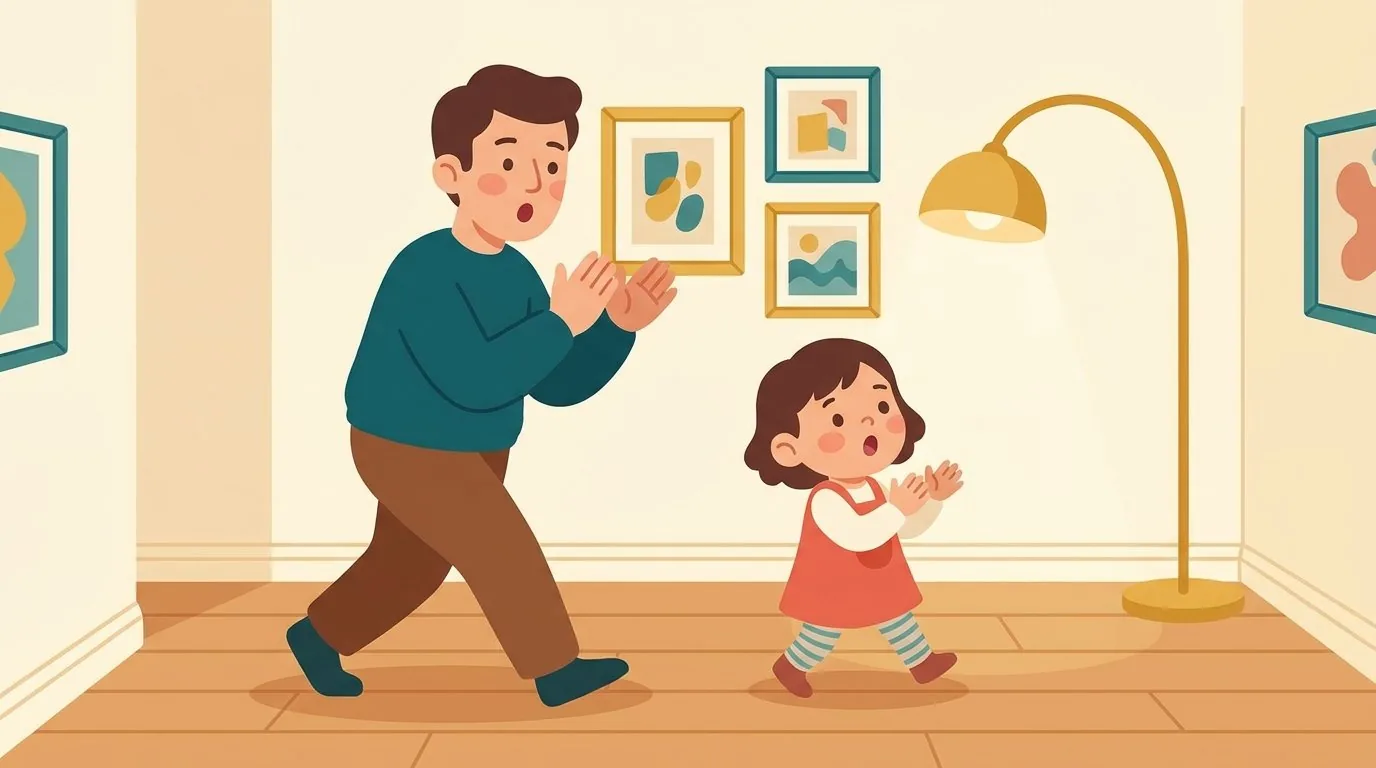
- While walking : one step per line, in the hallway. The body's rhythm carries the text's rhythm, and the child sitting and sighing disappears like magic.
- While singing : to the tune of any known song. What is sung is remembered much better than what is simply said.
- While drawing : a small illustration per stanza, on a strip of paper. The strip becomes a visual memory aid that the child can glance over.
- Changing voice : say the poem like a robot, grandmother, TV presenter. We laugh, repeat six times without realizing it: that's the whole point.
These detours are not gimmicks. They make the child do what they would refuse to do ten times in a row in the form “repeat.” The number of repetitions is the real engine; fun is just the fuel.
And if the text is really long, know that the same memory hooks used for other lessons work here: initials, mental images, key phrases. We have gathered a verified series in our 15 mnemonic aids from CP to Bac.
Learn a poem quickly from CP to CM2: what changes with age
The method remains the same; it is the length of the sessions and the parent's role that evolve.
CP and CE1 (ages 6-8). The child does not yet read fluently enough to learn alone: it is you who say it, he repeats. Two lines per evening are more than enough. Have him follow the lines with his finger while you read: he associates what he hears with what he sees.
CE2 and CM1 (ages 8-10). He can prepare the decoding alone, but the questioning remains a moment for two. This is the age to introduce the fill-in-the-blank text, which he creates himself: preparing his own exercise is already reviewing.
CM2 (age 10-11). Aim for complete autonomy: he announces when he is ready, you only listen and time him. Add an oral requirement—looking at the audience, projecting the voice, marking pauses—because this is what will be required in middle school.
At any age, two instructions are worth gold: recite standing up (posture changes the voice) and never correct in the middle. Note the blockages on a scrap of paper, and come back to them at the end.
Only one evening left: the backup plan
This happens to all families. In this case, forget perfection and keep this pace, in twenty minutes:
- Two minutes : you read the entire poem aloud and slowly, while he listens without doing anything else.
- Five minutes : he learns the first stanza, book closed. This is the most important one: a confident start avoids panic.
- Eight minutes : stack the following stanzas, two lines at a time, starting again from the beginning with each addition.
- Five minutes : a complete recitation standing up, then close the workbook. Do not reread in bed.
- The morning : a single rereading at breakfast, then no more talk about it until school.
And on the big day, if stage fright appears: remind him that even actors get stage fright, that a blank is not a disaster, and that he has the right to start his line over from the beginning. A child who knows he has the right to make mistakes forgets his lines much less than a child who is playing for his reputation.
For all other lessons to learn by heart—tables, dates, conjugations, formulas—the same principles work: this is precisely what Le Grand Livre des Pense-Bêtesgathers, from primary school to high school.
📘 All these tips are also available in book form: Le Grand Livre des Pense-Bêtes — word memory, explained to children.
Want to put these tips into practice?
Every day, a new adventure workbook adapted to your child's school level — to print or do on screen. No commitment.

Your questions
How long does it take to learn a poem?
Count on four sessions of ten minutes spread over four evenings rather than one long evening. For a CP child, two lines per session are enough; in CM2, a whole stanza goes without difficulty. The total time spent is the same, but the result is completely different: it is the spacing of the sessions that fixes the text.
My child always gets stuck at the same place, what to do?
The blockage almost always comes from a sequence, not a line. Have him learn separately the last line of the previous stanza glued to the first lines of the next one, as if they formed a single sentence. Repeat this pair five times: the bridge rebuilds itself and the hole disappears.
Do you need to understand poetry to memorize it?
Yes, and that's the very first step. A text that is understood is memorized much faster than a sequence of sounds. Take five minutes the first evening to explain difficult words and ask the child to retell the poem in their own words: you will save twice that time on the following evenings.
Is it serious if my child recites poorly in front of the class?
No. Recitation assesses both oral skills and memory, and ease comes with repeated practice, year after year. Have them recite standing at home, in front of one or two family members, so that the classroom situation is less intimidating. De-dramatizing is more useful here than reviewing once more.
To read next
 Memory aids & memorization
15 mnemonic techniques every student should know (from CP to Bac)
A good mnemonic technique gets a lesson into the head in a few seconds. Discover 15 proven tips, from …
 Memory aids & memorization
How to learn multiplication tables: the plan that finally works
In what order, with which tips and how much time per day? The concrete plan to learn multiplication tables…
 Memory aids & memorization
Mnemonic for the planets: remember the order of the solar system in one sentence
The mnemonic for the planets: the sentence that puts Mercury to Neptune back in order, the table of the 8 planets and …