2-3 years · My first discoveries
10 pages with 6 animals and 6 foods in pairs, two games "big and small" and a guide for the adult. Name, show, and match identical images. The child does not need to read.
Download the PDF 2-3 yearsFor ages 2-3, a 10-page illustrated booklet: images to name, pairs, and size games. For ages 3-6, animal nomenclature cards. Two free PDFs, no email required, to choose according to your child's skills.
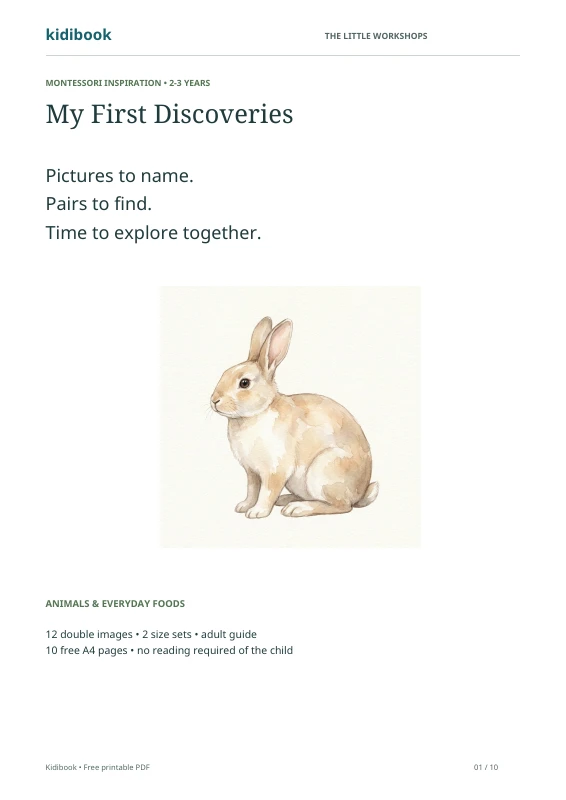
10 pages with 6 animals and 6 foods in pairs, two games "big and small" and a guide for the adult. Name, show, and match identical images. The child does not need to read.
Download the PDF 2-3 yearsThe existing nomenclature pack: 12 animals, cards with names, images alone, and word labels. Start with vocabulary; the separate words are used later, depending on reading skills.
Download the 3-6 years cards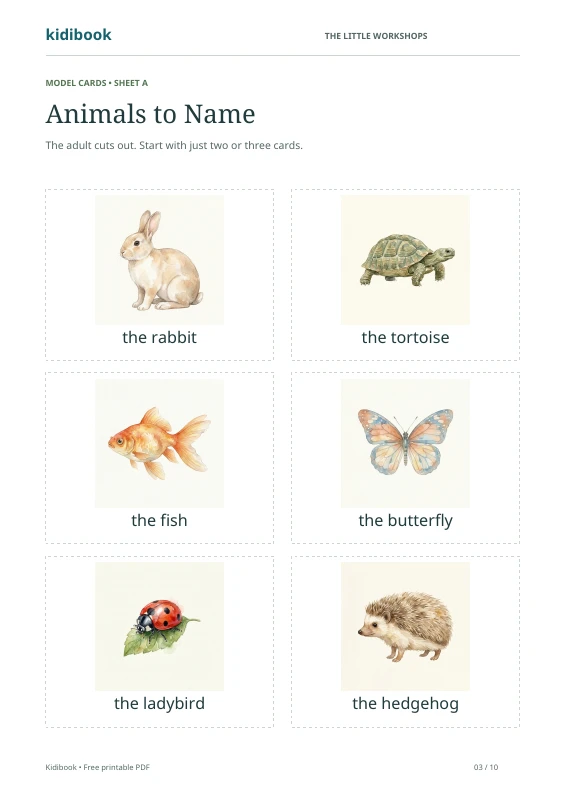
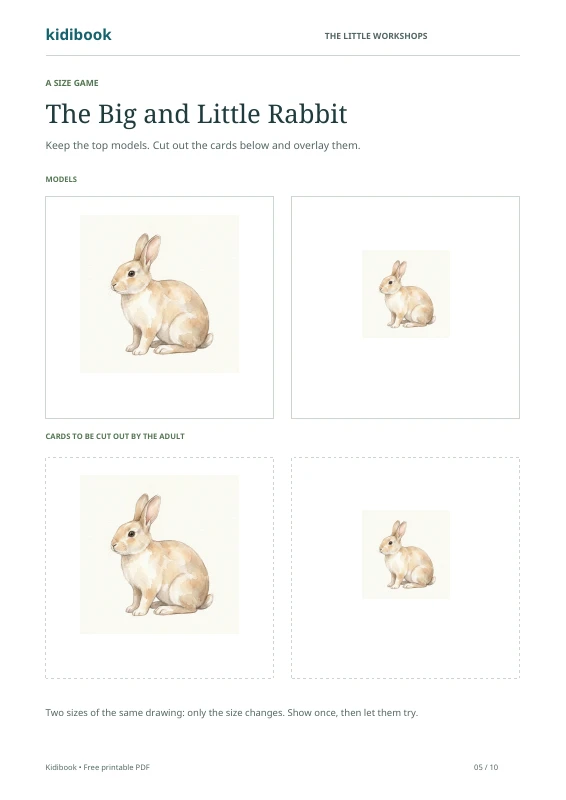
A4 at 100%, single-sided. The adult prepares and cuts the cards. Start with two images and offer a few minutes depending on the child's interest. These activities are inspired by Montessori and continue with everyday objects.

Start by naming the animals and matching two images. The word labels are then used according to the child's interest and skills. An adult prepares the cuts. For the youngest, choose the specific 2-3 years booklet presented above.
Montessori nomenclature cards and printable materials to support children aged 3 to 6 years.
In Montessori pedagogy, the nomenclature cards (or 3-part cards) support children aged 3 to 6 years: first to enrich their vocabulary and refine their observation, then to begin reading by associating words with images — with, at this stage, a key principle: theself-correction, the child checks independently with the answer card. Before reading, you gently guide with the three-step lesson. It's simple, calm, screen-free… and children love it. 🌱
Soft watercolor illustrations, a format designed for small hands, and a 3-step lesson guide for parents.
Image + word: the lion, the giraffe, the hedgehog… to name and enrich vocabulary.
Image only, to associate words with images when the child begins reading.
Word only, with the article in color: blue for masculine, red for feminine.
The 3-step lesson simply explained: name, show, find.
Maria Montessori, Italian doctor and educator, started from a simple idea: the child learns alone, provided they are given the right materials at the right time. No need for a Montessori school to be inspired — a few printed cards and twenty minutes are enough.
Between 3 and 6 years, each child goes through sensitive periods : each sensitive period is a window during which they absorb learning effortlessly — language, order, small objects. Offering an activity during this window makes it easy; offering it too early makes it difficult.
Cutting out the cards, handling them, sorting, tidying up: these actions develop fine motor skills, the ones that prepare the hand to hold a pencil. That is why Montessori workshops always have children handle materials before writing.
The sensory materials and sensory activities engage touch and sight before reasoning. In Montessori schools, the sandpaper letters are traced with the finger: your child feels the shape of the letter before tracing it. A sensory approach that leaves a lasting impression.
Nomenclature cards are a picture dictionary that enriches vocabulary, then a first step towards learning to read : associating the word with the image, recognizing sounds and letters of the alphabet. Enough to learn to read very gently, well before CP (Cours Préparatoire, age 6-7).
Pouring, buttoning, setting the table: practical life activities are at the heart of the method and cost nothing. They serve to awaken autonomy and concentration in all children — the same invisible muscles that academic learning will engage later.
No need to invest in expensive materials: printed cards, everyday objects, and a little time are enough for Montessori games and educational, fun and playful and educational. This is actually what manyeducators andteachers in preschool do with limited resources.
These cards are suitable for toddlers as well as for young children in in preschool, and are still used forvocabulary awakening at the start of CP (age 6) and CE1 (age 7) .Kidibook is neither a Montessori school training organization nor a school: we simply offer materials and activities inspired by this pedagogy, to print at home — a free complement to any Montessori book you may already have at home.
This is the most famous phrase of Maria Montessori, and it sums it all up: the adult prepares, shows once, then steps back. The rest belongs to the child.
Before age 6, the child has what Maria Montessori called an absorbent mind : they record their environment effortlessly, like a sponge. That is why the child's development depends first on what surrounds them, long before what is explained to them.
Rough letters and numbers, puzzle, objects to handle: Montessori educational materials are always concrete and tactile. Our cards follow this logic — without tablets, without screens, just paper and hands.
The materials allow the child to see their own mistake, without an adult pointing it out. This gentle self-discipline gives them self-confidence : they did not succeed "to please others," they succeeded on their own. This is wherefulfillment.
The same activity does not interest two children of the same age at the same time. The adult offers, observes, and tidies up if it doesn’t engage — even if it means bringing out the tray three weeks later. A patient parenting approach, more than a rigid method.
The first children's house opened in Rome in 1907. Today, a Montessori educator or a Montessori educator (Montessori educators trained) follows a Montessori training long and works with specific materials in classroom. At home, we do not replicate a school: we draw inspiration from the spirit, with the means at hand.
No grades, no comparison, no “you should already know this.” A Montessori activity ends when my child wants to stop. This is also what makes these activities relaxing for parents: there is nothing to succeed at.
This is THE Montessori method for learning new words — everything is detailed in the pack guide.
“This is the lion.” Show the card and simply name 2 or 3 cards at a time.
“Show me the lion!” The child points to the correct card. Shuffle, play.
“What is this?” The child names it alone — and is never put on the spot.
12 new watercolor nomenclature cards — apple, strawberry, carrot, leek… Leave your email and receive immediately and for free this pack and the animal one, a total of 24 cards, including silent cards and word labels.
🍓 I receive the Fruits & Vegetables pack → No commitment · unsubscribe with 1 clickThe free 10-page booklet offers images of animals and foods to name, identical pairs, and two size games. It includes an adult guide, no reading required from the child.
A classic Montessori teaching material: cards in 3 parts — image + word, image alone, word alone. The child enriches their vocabulary, then begins reading by associating words with images, with self-correction.
Yes, 100%. The "Animals" pack is a PDF to download and print immediately, no email and no registration required.
The new booklet is suitable for ages 2-3 to name and match images with an adult. The nomenclature pack is intended for ages 3-6 ; the word labels are used only according to reading skills.
It's optional but recommended if you can: the cards last for years. Otherwise, slightly thick paper works very well.
On the word cards, "le" is in blue (masculine) and "la" in red (feminine): a first grammar cue that the child naturally absorbs, without realizing it.
The free printable workbook for 5-6 year olds: graphics, first numbers and games with Bibou.
Free workbooks for each level, from preschool (maternelle) to CM2 (10-11 years old).
From syllables to first sentences: the natural next step after preschool.
Download the "Animals" pack for free — immediate PDF, no email. Ten minutes of printing and cutting, years of use.
📥 I download the free cardsThe animal PDF contains cards with image and name, images alone, and word labels. Prepare the cards before the activity, then offer a few at a time.
Start with two or three familiar animals. Name them together, then invite your child to point to the requested animal. They do not need to know how to read to play with the images.
Offer to match two identical images or sort the animals. Word labels are used later, when the child starts to show interest in writing; they are not a mandatory goal at 3 years.
Follow their interest: a short activity is enough. The printable cards are a language support to share, to be complemented by handling everyday objects.
Download the animal cards in PDF
Also discover: kindergarten activities and printable games.
Our commitments, black on white
No empty promises: only what we deliver.
Printed on demand
Our paper books are made to order, in Europe: expect 2 to 5 working days for printing, then shipping.
Free delivery
Free shipping in mainland France, with no minimum order.
Free reprint
A printing defect on your copy? We will reprint it at our expense.
14 days to change your mind
The legal withdrawal period applies to all paper book orders.
No subscription
The 31-day Adventure is now free, and our books are sold individually: no subscription, no recurring charges.
Trademark registered at INPI
Kidibook is an independent French brand, registered at INPI.
PDF · immediate downloadFree workbook without email or registrationDesigned in France, from Petite Section (3-4 years) to CM2 (10-11 years)