📚 Brevet revision sheets: the method, subject by subject
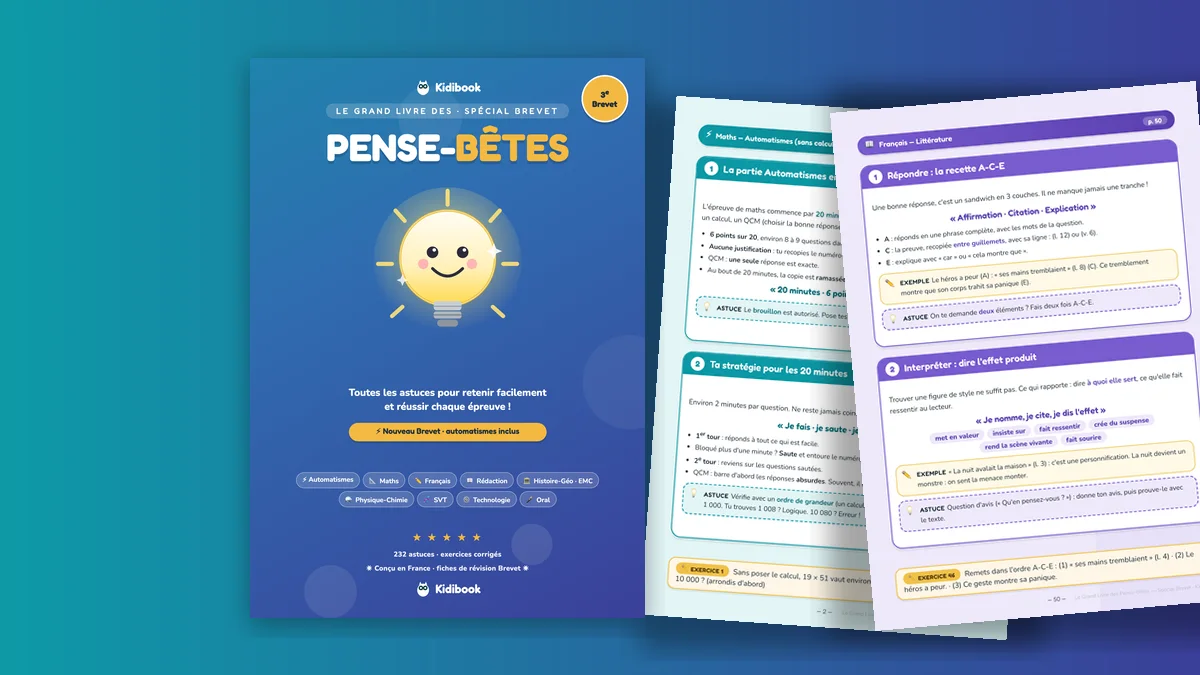
The brevet (Diplôme national du brevet) is the French national exam at the end of collège, the French equivalent of middle school, taken in year 3e (age 14-15). This guide to brevet revision sheets, and the book it mentions, are for students following the French curriculum, whether at a French school abroad (the AEFE network), with the CNED (French distance learning) or in a bilingual family. The book and the free extract are written in French.
Good revision sheets (fiches de révision) are not lessons copied out in smaller writing. They are short pages, one topic per page, that your child can reread in two minutes and, above all, recite with the book closed. Done well, they follow the exams in order: the maths quick-fire questions, the dictation, the writing task, the développement construit (the extended written answer in history-geography), the sciences and the oral.
This page brings together what the best free revision websites offer, sorted by subject, then goes further: what to put on each sheet, a schedule from D-60 (sixty days before the exam) to the night before, and the tricks that keep each sheet in your child's head until the end of June. A free 4-page extract, in French, is ready to print further down.
🎯 In short
- One sheet = one topic: one page, keywords, an example and a trick to remember it.
- The 2027 brevet has 5 exams: French, maths (including 20 minutes without a calculator), history-geography-EMC (civic and moral education), sciences and an oral.
- Rereading is not enough: the sheet is there for self-testing, book closed, a few days apart.
- Start early: 15 minutes a day from D-60 beats a week of cramming.
- A free 4-page extract in French (the brevet on 1 page, the revision schedule, two pages of maths quick-fire skills) is ready to download.
A sheet only works if your child can rewrite it from memory. The test: hide the sheet, write down everything they remember on a blank page, then compare. Whatever is missing is exactly what needs going over again.
📑 Contents
- 📝 What makes a good brevet revision sheet?
- 🗓️ The 2027 brevet at a glance
- 📐 Maths revision sheets: quick-fire skills and problems
- ✏️ French revision sheets: grammar, dictation, writing
- 🏛️ History-geography and EMC revision sheets
- 🔬 Science revision sheets: physics-chemistry, SVT, technology
- 🎤 The oral exam sheet
- 🧠 Why revision sheets aren't always enough
- 📅 The revision schedule, from D-60 to the night before
- ⚠️ The mistakes that make revision sheets useless
- Frequently asked questions
- Verdict
📝 What makes a good brevet revision sheet?
The most popular revision websites offer summarised lessons followed by quizzes. That's the right direction: summarise, then check. For a sheet to really work, though, it needs five ingredients.
1. A single topic
A chapter that's too broad won't stick. “The Second World War” takes three sheets: the main phases, the genocides, occupied France. Each sheet gets a precise title.
2. Keywords, not sentences
The brain holds on to the words that carry the meaning. A one-line definition, the key terms in colour, the dates underlined. If the sheet looks like the exercise book, it's too long.
3. An example
A rule without an example is soon forgotten. For Pythagoras, a 3-4-5 triangle. For past participle agreement, a full sentence. The example is what comes back to mind on exam day.
4. A memory trick
A funny sentence or an image locks in the order and the meaning. SOH-CAH-TOA for trigonometry, « 1 paragraphe = 1 idée + 1 date + 1 exemple » (1 paragraph = 1 idea + 1 date + 1 example) for the développement construit. That's the whole idea behind pense-bêtes, or memory tricks.
5. A check question
The sheet ends with a question. Your child answers it without looking. If they hesitate, the sheet isn't learned yet.
Making the sheet is already half of learning the lesson. Ready-made sheets are useful for self-testing, but nothing replaces the ones your child writes in their own words.
🗓️ The 2027 brevet at a glance
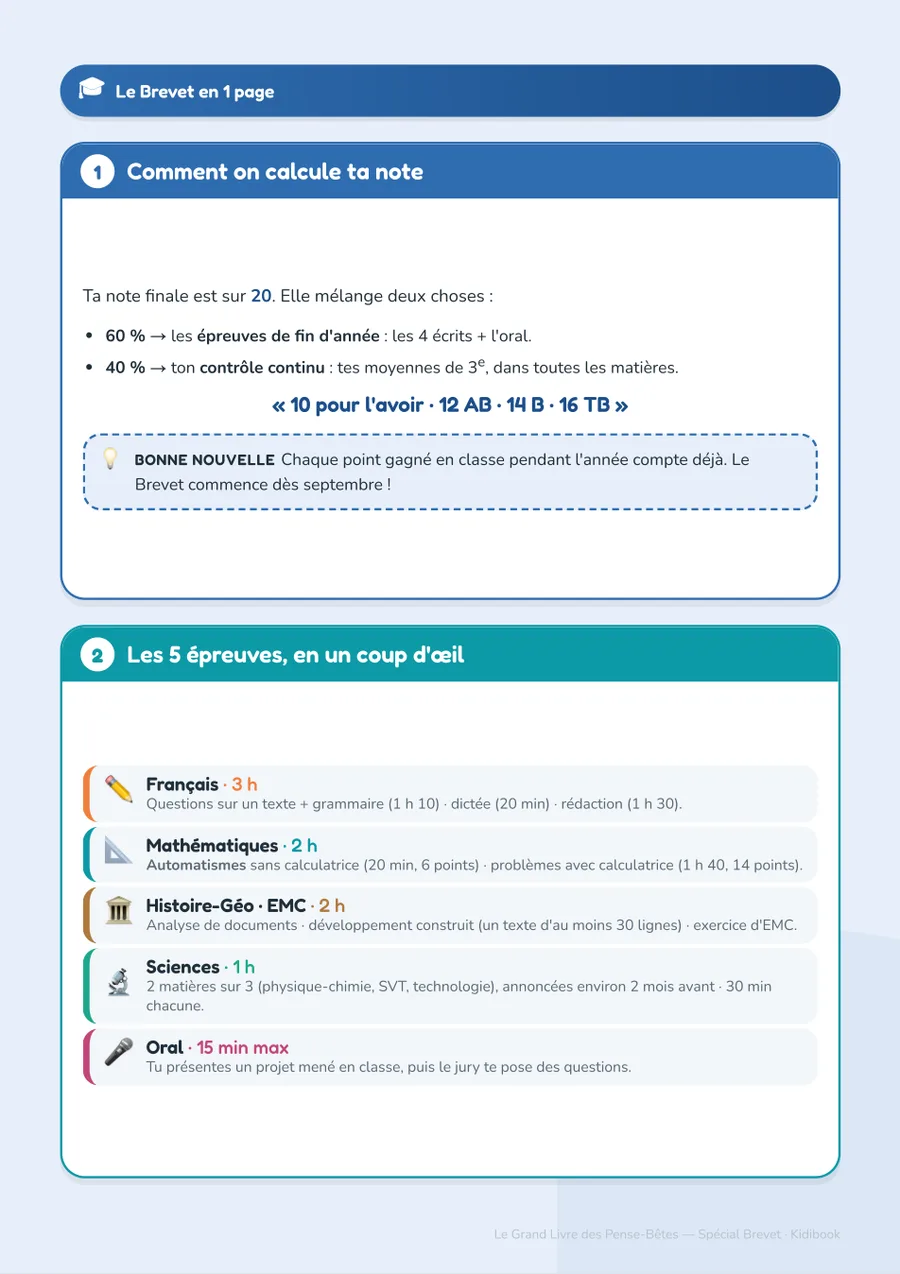
Since the 2026 session, the final mark has been out of 20. The end-of-year exams (the four written papers and the oral) count for 60%, and continuous assessment in 3e (the year's averages in every subject) for 40%. Your child needs 10 out of 20 to get the diploma, 12 for the honours grade assez bien (fairly good), 14 for bien (good) and 16 for très bien (very good). So the sheets follow the exams:
| Exam | Length | What it involves | Sheets to prepare |
|---|---|---|---|
| French | 3 h | Questions on a text and grammar, dictation, writing task | Grammar, dictation traps, rewriting, writing method |
| Maths | 2 h | 20 min of quick-fire skills without a calculator (6 points), then problems (14 points) | Mental arithmetic reflexes, then one sheet per main topic |
| History-geography · EMC | 2 h | Document analysis, développement construit, EMC exercise | 3e chapters, key dates and places, method |
| Sciences | 1 h | Two subjects out of three (physics-chemistry, SVT, technology), 30 min each | Formulas, units, key ideas in all three subjects |
| Oral | 15 min max | Presentation of a project carried out in class, then questions from the panel | Outline of the talk, answers to likely questions |
The two science subjects are only announced about two months before the exam, so it's safer to have sheets for all three.
📐 Maths revision sheets: quick-fire skills and problems
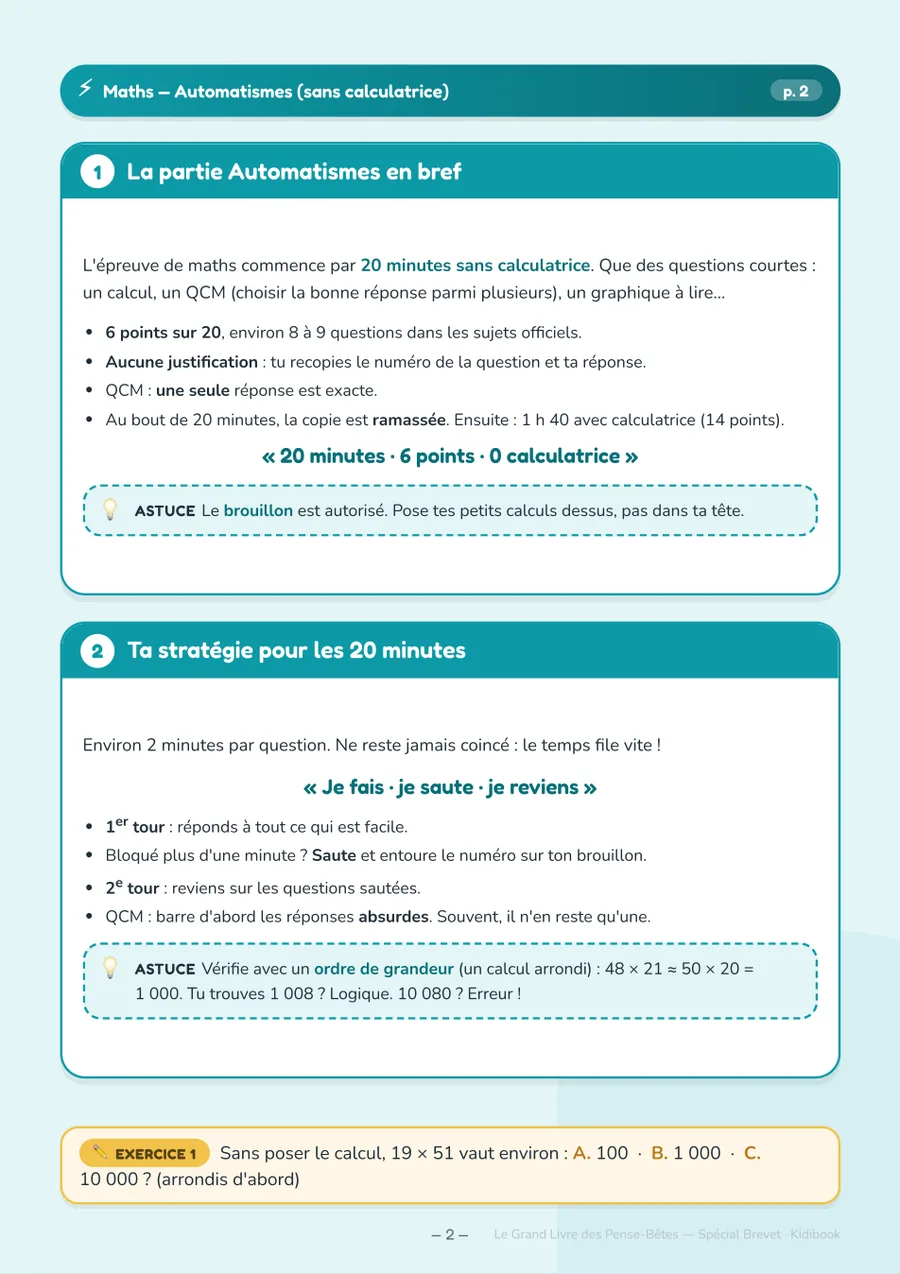
The exam opens with a quick-fire skills section (automatismes): 20 minutes, no calculator, short questions (multiple choice, true or false, quick answers). The papers are collected after 20 minutes. This part calls for reflexes, not proofs: a “mental arithmetic” sheet (× 5, × 25, × 0.5), a fractions and percentages sheet, and a conversions sheet (1.5 h = 1 h 30, not 1 h 50).
For the problems, plan one sheet per main topic in the syllabus:
- numbers and calculations: fractions, powers, square roots, prime numbers;
- algebra: expanding, factorising, solving an equation;
- functions: image and pre-image, linear and affine functions;
- geometry: Pythagoras, Thales, trigonometry, transformations, enlargement and reduction;
- data: mean, median, probability;
- algorithms: reading a Scratch script, writing a spreadsheet formula.
For the angle the Scratch sprite has to turn in a regular polygon, remember « 360° divisé par le nombre de côtés » (360° divided by the number of sides): 120° for an equilateral triangle, not 60°. It's one of the most common traps.
✏️ French revision sheets: grammar, dictation, writing
French carries a lot of weight: three hours and three very different exercises. The sheets fall into three families.
Language
Word classes, functions in the sentence, subordinate clauses, agreement within the noun phrase and of the past participle, the passive voice, reported speech. One sheet per topic, with an example sentence to analyse.
Dictation and rewriting
A “traps” sheet earns points fast: the subject placed far from its verb, the endings -é, -er or -ez (swap in the verb « vendre » and listen), a/à, et/est, ces/ses. For the rewriting exercise (réécriture), note the words that change when you switch from singular to plural or from present to past.
Reading and writing
To answer the questions, a simple recipe: a statement, a quotation in quotation marks with its line number, an explanation. For the writing task, two method sheets, one for the imaginative topic and one for the reflective topic, plus a sheet on the main genres studied in 3e: autobiographical writing, theatre, committed poetry, figures of speech.
🏛️ History-geography and EMC revision sheets
The 3e syllabus splits easily into sheets. In history: the Great War and total war, the totalitarian regimes between the wars, the Second World War and the genocides, Vichy France and the Resistance, the Cold War, independence movements, building Europe, the Fifth Republic and the changing place of women. In geography: the catchment areas of cities, productive spaces, sparsely populated areas, regional planning, the overseas territories, France within the European Union.
In EMC (civic and moral education), the most useful sheets cover the values and symbols of the Republic, laïcité (French secularism), citizens' rights and duties, commitment and defence.
The développement construit calls for a real piece of writing of at least 30 lines in the general track. A method sheet is a must: a rough draft containing only the outline, an introduction that sets the scene (when, where, who), two or three paragraphs, and a conclusion that answers the question.
To go further in this subject, our article history revision sheets for the brevet (in French) walks through the method chapter by chapter.
🔬 Science revision sheets: physics-chemistry, SVT, technology
Thirty minutes per subject is short: science sheets need to go straight to the formulas, the units and the ideas that keep coming up.
- Physics-chemistry: forms and conservation of energy, kinetic energy, Ohm's law, electrical power and energy (P = U × I, E = P × t), sound and light, atoms and ions with their tests, gravitation and weight.
- SVT (life and earth sciences): genes and alleles, meiosis and fertilisation, the body's defences and vaccines, the nervous system and what disrupts it, natural selection, plate tectonics, climate and resources.
- Technology: the information chain and the energy chain, sensors and actuators, programming, networks, specifications and the life cycle of an object.
On every science sheet, write the formula with its units: a correct result with no unit loses points.
🎤 The oral exam sheet
The oral lasts fifteen minutes at most. On their own, your child presents their project for about five minutes, then answers the panel's questions for around ten minutes. One sheet is enough, but it needs preparing early: three parts (why this project, what I did, what I took away from it), a few keywords per part, and the list of questions the panel is likely to ask. The sheet isn't for reading out: your child practises aloud, stopwatch in hand.
🧠 Why revision sheets aren't always enough
Lots of students make beautiful sheets… then reread them ten times. Rereading gives the feeling of knowing without making anything stick. What fixes a topic in memory is the effort of retrieving it unaided, several days apart, plus a memorable hook to find it again: a sentence, an image, a rhythm.
That's what we've gathered in Le Grand Livre des Pense-Bêtes — Spécial Brevet (The Big Book of Memory Tricks, Brevet edition, in French): 232 tricks arranged in exam order, each with an example, and an exercise at the bottom of every page for self-testing. Start with the free extract: « le brevet en 1 page » (the brevet on one page), the revision schedule and two pages of maths quick-fire skills.
📥 Download the free extract (PDF, 4 pages, in French)

Le Grand Livre des Pense-Bêtes — Spécial Brevet
232 tricks to remember the brevet syllabus, arranged in exam order, with 116 exercises and their answers.
- 10 parts: quick-fire skills, problems, dictation, writing, history-geography-EMC, physics-chemistry, SVT, technology, oral, method
- « Le Brevet en 1 page » (the brevet on one page) and a revision schedule from D-60 to the night before
- A4 in colour, printed on demand, free shipping to France, €5 elsewhere
Le Grand Livre des Pense-Bêtes — Spécial Brevet (PDF)
The same book as a file, yours straight after purchase, to print page by page depending on the subject of the moment.
- The same 232 tricks and 116 exercises with answers
- Read it on a computer, tablet or phone
- Print it as many times as you need, for the whole family
📅 The revision schedule, from D-60 to the night before
- Throughout 3e: after each chapter, one sheet and its check question.
- At the mock exam (brevet blanc): spot the three weak points and note the sheets to go back over.
- At D-60: fifteen minutes a day, one quick-fire skills sheet and one sheet from another subject.
- At D-30: one past paper a week, in real exam time, then marking with the sheets.
- At D-7: reread only the tricks and the formulas. Nothing new.
- The night before: bag packed, two or three tricks reread… and a proper night's sleep, which counts for more than the last hour of revision.
The official papers from previous sessions, with their answers, are published every year by the French Ministry of Education and taken up by Lumni, the French public learning platform: they're the best practice for the home stretch.
⚠️ The mistakes that make revision sheets useless
- Copying out the lesson. A two-page sheet in tiny writing will never get reread.
- Making all the sheets in May. There's no time left to learn them.
- Rereading without self-testing. Hiding the sheet and reciting it takes two minutes and changes everything.
- Forgetting the quick-fire skills. Six points are decided in twenty minutes without a calculator: prepare them like a subject in their own right.
- Neglecting the oral. It's prepared out loud, not in your head.
❓ Frequently asked questions
When should my child start making brevet revision sheets?
From the start of 3e, chapter by chapter: that's the lightest way. If that hasn't happened, start after the mock exam at the latest. Fifteen minutes a day from two months before the exam is enough if the sheets already exist.
How many revision sheets are needed for the brevet?
There's no ideal number. Plan one sheet per important chapter, plus a few method sheets (writing task, développement construit, oral, quick-fire skills). What matters is that each sheet stays short and is genuinely learned.
Paper sheets or on-screen sheets?
A screen is handy for looking up a topic. For learning, paper helps more: you write, you underline, you tick off what you know. Many students combine the two.
Where can we find past brevet papers with answers?
The French Ministry of Education publishes the brevet papers every year, and Lumni republishes them with answers and quizzes. It's the free resource to use at the very end, once the sheets have been learned.
Is the brevet required to move up to seconde?
No. Moving up to seconde, the first year of lycée (French high school), is decided by the class council. The plan to make the diploma compulsory for entering lycée, announced in 2024, has been dropped. Even so, the brevet is your child's first exam, and good preparation for lycée.
📚 Useful resources on Kidibook
- The Big Book of Memory Tricks — Our memory-trick books, starting with primary school.
- How to make a revision sheet (in French) — The method step by step, with examples.
- Visual or auditory memory? — What really works when a child learns.
- Learning a lesson by heart — Spaced repetition explained simply.
- The Pomodoro method — Revising in short, timed bursts.
- 30 mnemonic phrases — The phrases worth knowing, from primary school to collège.
- The Diplôme national du brevet — French Ministry of Education (in French) — Organisation, how the mark is calculated, honours grades
- Official memo of 2 September 2025 (Bulletin officiel no. 33, in French) — Brevet exams from the 2026 session onwards
- Lumni — revising for the brevet (in French) — Quizzes, past papers with answers, advice
🏁 Verdict
Good brevet revision sheets fit on one page, follow the exams and end with a question your child answers without looking. Start with the free extract (in French), then, if the method suits them, Le Grand Livre des Pense-Bêtes — Spécial Brevet gathers the 232 tricks of the syllabus, in exam order.
Workbooks, books and free resources to learn while having fun, from preschool to high school. Every page is proofread before it goes live. Learn more